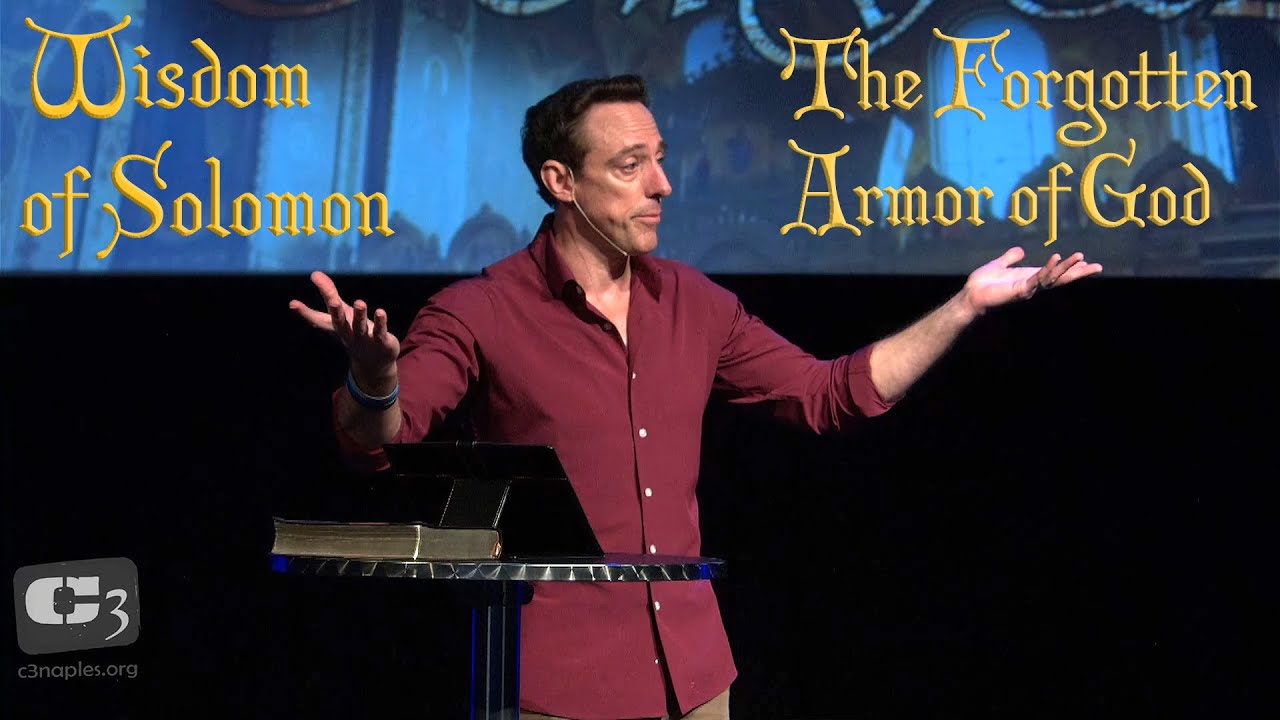
Wisdom of Solomon - The Forgotten Armor of God
The Book of Wisdom teaches us that real treasure isn’t found in gold or fame—it’s found in living wisely for God. True wisdom leads to righteousness, kindness, and faithfulness. Just as Jesus perfectly embodied wisdom, we are called to live with His wisdom in our hearts, making choices that shine His light in a dark world.
Reader's Version
Wisdom of Solomon: The Forgotten Armor of God
Sermon by Gene Simco
Reader’s Version
Last week, we explored the Song of Songs, also known as the Song of Solomon. A beautiful and poetic book about love, desire, and intimacy. Before that, we looked at Ecclesiastes, where Solomon wrestles with the apparent futility of life—vanity, meaninglessness, and the search for purpose "under the sun."
This week, we go deeper.
If you were simply flipping through a modern Bible, you’d likely move on to the book of Isaiah at this point. But that’s only in most modern Bibles. If you were holding a Bible from the first few centuries of Christianity—say, in the hands of an early Church Father or a first-century believer—you’d find two other books right here: Wisdom of Solomon and Sirach, also known as Ben Sira or Ecclesiasticus.
We’ve touched on this before, but it’s worth repeating: the Bible of the early Church was the Greek Septuagint—a translation of the Hebrew Scriptures into Greek that included a number of books that many modern Bibles now omit. Among these books was Wisdom of Solomon, a text read, revered, and considered inspired by much of the early Church. As we’ll see today, its influence reaches into the New Testament itself—quoted or echoed by the apostles, especially Paul.
Let’s be clear: these books were included in every major Christian Bible for the first 1,800 years of Church history. That includes the original King James Version, which contained them in its Old Testament, positioned between the Hebrew Bible and the New Testament. If you’re wondering why some Bibles have more books than others—or how and when these texts were removed—we’ve prepared a helpful beginner’s article that explains the history and process. You can find that resource on our website:
https://c3naples.org/apocrypha-septuagint/
As a non-denominational church, we understand that not everyone views these books as Scripture. Some Christian traditions refer to them as “Apocrypha,” while others—such as the Catholic and Eastern Orthodox churches—consider them canonical. Regardless of your view, it’s important to know that the majority of Christians worldwide today do accept them as part of the Bible. And even if you don’t, there’s still value here. These writings were foundational for early believers, quoted by New Testament writers, and help us better understand the theological background of Jesus and His apostles.
So, while we continue exploring the works of Solomon, we take a detour—not to Isaiah, but to another book in the biblical Wisdom tradition: Sirach.
Sirach is something like Ecclesiastes with street smarts. Also known as Ecclesiasticus, it was written around 200–175 BC by a Jewish teacher named Jesus ben Sirach—no relation to Jesus Christ. Like Wisdom of Solomon, it focuses on the importance of living a life rooted in the fear of the Lord. But while Wisdom of Solomon turns our eyes toward eternity, Sirach brings that wisdom into the grit of daily life.
Sirach is practical. It teaches us about humility, generosity, parenting, marriage, honoring elders, finances, and discipline. It was deeply respected in the early Church—quoted in the Didache and referenced by numerous Church Fathers. If Ecclesiastes wrestles with the question, “What’s the point of all this?” Sirach answers, “Here’s how you walk wisely in it.”
But today, our focus returns to Wisdom of Solomon—a book that opens our eyes to the eternal weight of wisdom, to the immortality of the soul, and most importantly, to the way all true wisdom points us to Christ.
And that’s the point of this entire series: Jesus didn’t just appear in the Gospels. He’s been present in every page, from Genesis to Revelation—even in the books you may not have read yet.
Now we turn to the Wisdom of Solomon. Like Ecclesiastes and Song of Songs (or Song of Solomon), people have long debated who actually wrote it. And that brings us into a fascinating category of ancient literature known as pseudepigraphy.
Now before you flinch at that word, let me explain: “pseudepigraphical” doesn’t mean shady or deceptive. The word pseudepigrapha comes from the Greek: pseudos (false) and epigraphein (to inscribe). It refers to works that were written in the name of a revered figure, not to trick anyone, but to honor and pass on their tradition and teachings. Think of it like writing a tribute album in the voice of your mentor—it’s about preserving a legacy, not forging a signature.
And we have other examples of this in Scripture—books that are accepted by nearly everyone. Ecclesiastes and Song of Songs are traditionally attributed to Solomon, but most scholars agree they were likely compiled or written by others drawing from Solomon’s teachings. Daniel, as another example, was likely finalized centuries later, with Daniel being used as a literary or prophetic figure. Hebrews in the New Testament? It’s anonymous. For centuries, it was attributed to Paul, but modern scholars now suspect someone else—possibly a follower of Paul—compiled or delivered his teachings.
The point is: the early Church didn’t obsess the way we do today over who held the pen. Their question wasn’t “Who wrote it?” It was “Does this align with Christ, and is it filled with the Spirit?”
And so, with that lens, let’s jump into Wisdom of Solomon.
I’m going to walk you through some major movements in this book—starting with a theme that echoes Ecclesiastes, James, and Jesus Himself:
Movement 1: Life Is a Breath… but the Righteous Live Forever
Shape
Wisdom of Solomon 1:1–5 “Love righteousness, you who judge the earth; think of the Lord with uprightness and seek him with sincerity of heart; because he is found by those who do not put him to the test, and manifests himself to those who do not distrust him. For perverse thoughts separate people from God, and when his power is tested, it exposes the foolish. Because wisdom will not enter a deceitful soul, or dwell in a body enslaved by sin. For a holy and disciplined spirit will flee from deceit, and will leave foolish thoughts behind, and will be ashamed at the approach of unrighteousness.”
Shape
Wisdom of Solomon 2:5 “Our life will pass away like the trace of a cloud, and be scattered like mist that is chased by the rays of the sun and overcome by its heat.”
Shape
Wisdom of Solomon 3:1–2 “But the souls of the righteous are in the hand of God, and no torment will ever touch them. In the eyes of the foolish they seemed to have died, and their departure was thought to be a disaster; but they are at peace.”
Shape
Wisdom of Solomon 4:10 “There was one who pleased God and was loved by him, and while living among sinners he was taken up.” (A clear reference to Enoch.)
Shape
Wisdom of Solomon 5:15 “But the righteous live forever, and their reward is with the Lord; the Most High takes care of them.”
Shape
This entire opening movement drives a bold contrast: wisdom leads to life; sin leads to death.
Right from the first chapter, we’re called to love righteousness, to pursue wisdom sincerely, and to avoid putting God to the test. That phrase should sound familiar. Jesus Himself quotes it during His temptation in the wilderness: “You must not test the Lord your God.” (Matthew 4:7) And He’s quoting from Deuteronomy 6:16.
But here’s the thing: many people will point to Malachi 3:10—a passage about tithing under the Law of Moses—and say, “This is the only place in the Bible where God says to test Him.” But that doesn't hold up. In fact, Malachi 3 must be read in context. The passage deals with unfaithful people under the Mosaic covenant, who were cheating God—and testing Him by doing so. It is hyperbolic and ironic, not prescriptive for New Testament giving. Even within Malachi, the wicked are portrayed as “testing God.”
Meanwhile, Wisdom of Solomon 1 affirms what Jesus later taught: testing God is for fools. Wisdom seeks Him sincerely. Foolishness challenges Him arrogantly.
This movement also contains clear echoes of Ecclesiastes. Wisdom 2:5 sounds almost identical to Solomon’s famous lament—life is fleeting, like a vapor, a mist. The Greek word often used in this context is ἀτμίς (atmís)—breath, vapor. We see it again in James 4:14, where life is described as a vapor that appears for a little while and then vanishes.
But that’s not the end of the story. Not for the righteous.
Wisdom 3:1 assures us that the souls of the righteous are in the hand of God. Wisdom 4:10 lifts up Enoch as an example—loved by God, taken early, proving that length of life is not the measure of eternal reward. And Wisdom 5:15 boldly proclaims that the righteous live forever.
It’s a radical contrast: the foolish mock death and perish in dread; the righteous embrace wisdom and inherit life.
Shape
And then—just before transitioning into the next movement—Wisdom of Solomon 5:17–19 gives us something remarkable:
Shape
Wisdom of Solomon 5:17–19 “The Lord will take his zeal as his whole armor, and will arm all creation to repel his enemies. He will put on righteousness as a breastplate, and wear impartial justice as a helmet. He will take holiness as an invincible shield, and will sharpen stern wrath for a sword, and creation will join him to fight against the reckless.”
Shape
Sound familiar? It should. Paul didn’t come up with the imagery of the armor of God from thin air. He’s quoting from here. In Ephesians 6, we’re told to put on the armor of God—but in Wisdom of Solomon, God Himself is wearing it. He is the divine warrior. In Paul’s letters, we—the Church—are being invited to join Him in that armor.
It’s a beautiful fulfillment: Alpha: God wears the armor. Omega: He gives it to us.
In our second movement, we see Solomon’s pursuit wedded to Wisdom—a pursuit not of power, pleasure, or prestige, but of something divine. This is no ordinary quest for knowledge. This is prayerful longing, covenantal devotion, and spiritual union.
Shape
Wisdom of Solomon 7:7 “Therefore I prayed, and understanding was given me; I called on God, and the spirit of wisdom came to me.”
Shape
Wisdom of Solomon 8:2–3 “I loved her and sought her from my youth; I desired to take her for my bride, and I became enamored with her beauty. She glorifies her noble birth by living with God, and the Lord of all loves her.”
Shape
Wisdom of Solomon 9:8 “You have commanded me to build a temple on your holy mountain, an altar in the city where you dwell— a copy of the holy tabernacle that you prepared from the beginning.”
Shape
Wisdom of Solomon 9:17 “Who has learned your counsel, unless you have given wisdom and sent your holy spirit from on high?”
Shape
Solomon’s journey begins where every meaningful pursuit must begin: with prayer. “Therefore I prayed... I called on God.” He doesn’t treat wisdom like a textbook to be mastered but as a gift to be received—a person to be known. And what comes in response? Not just intellectual clarity, but the “spirit of wisdom.”
He goes further: “I desired to take her for my bride.” Here, wisdom is personified as a bride—not in a sensual or romantic sense like we might find in Song of Songs, but in a sacred, exalted way. This is covenantal imagery. Wisdom is beautiful, yes, but she also dwells with God and glorifies Him through her divine origin. Solomon’s devotion to her is spiritual and eternal.
This pursuit of wisdom is not academic—it is relational. It requires prayer, purity, and passion. Wisdom is more than knowledge; she is the indwelling presence of God. And Wisdom 9:17 gives us something extraordinary—an early and powerful formulation of pneumatology, the doctrine of the Holy Spirit:
“Who has learned your counsel, unless you have given wisdom and sent your Holy Spirit from on high?”
Here we see that true wisdom doesn’t come from human effort or scholarly rigor. It comes only by the Holy Spirit. Solomon lays the groundwork for what Paul and the apostles will later make explicit: the Spirit of God reveals the wisdom of God (1 Corinthians 2:10–13). The Holy Spirit isn’t just a New Testament concept—He is present here, active, and essential.
And then Solomon brings it full circle: Wisdom 9:8 ties this pursuit of wisdom to the Temple—“a copy of the holy tabernacle you prepared from the beginning.” This reflects deep theological insight. Solomon knows the earthly Temple is patterned after a heavenly reality. This will be fully developed later in Hebrews 8–9, where we’re told that Jesus entered “the greater, more perfect tabernacle in heaven, not made by human hands.”
So what is Solomon showing us?
That wisdom—the true kind—is not something you figure out. It’s something you pray for. It’s something you pursue like a bride. And it leads not just to knowledge, but to revelation… and ultimately to eternal transformation. These chapters take the passion of Song of Songs and elevate it. This is not sensual love—it is sacred pursuit.
Wisdom is beautiful. Wisdom is relational. Wisdom is eternal.
Our next movement shifts the focus from Solomon’s personal pursuit of wisdom to a panoramic view of how Wisdom guides God’s people through history. In this section of Wisdom of Solomon, we see her not merely as a personal companion to the righteous—but as the unseen hand guiding all of redemptive history.
Shape
Wisdom of Solomon 10:1 “Wisdom protected the first-formed father of the world, when he alone had been created; she delivered him from his transgression.”
Shape
Wisdom of Solomon 11:1 “She prospered the works of the holy prophet, and guided a people through the wilderness.”
Shape
Wisdom of Solomon 12:4–5 “Those former inhabitants of your holy land practiced detestable things—merciless killings of children, sacrificial feasts of human flesh and blood. These initiates from a secret cult... you determined to destroy by the hands of our ancestors.”
Shape
Wisdom of Solomon 13:1 “For all people who were ignorant of God were foolish by nature; and they were unable from the good things that are seen to know the one who exists.”
Shape
Wisdom of Solomon 15:17 “A mortal makes a dead thing with lawless hands—for he himself is better than the objects he worships.”
Shape
Wisdom of Solomon 16:12 “For neither herb nor poultice cured them, but it was your word, O Lord, that heals all people.”
Shape
Chapters 17–19 These chapters continue to recount the Exodus narrative, highlighting the plagues of Egypt, the fiery serpents, and the parting of the Red Sea as acts of judgment and mercy orchestrated through Wisdom.
Shape
From beginning to end, this section reveals a stunning truth: Wisdom was there. She was there in Eden, protecting Adam. She was with Abraham, Isaac, and Jacob. She guided Moses through the wilderness, empowered the prophets, and navigated Israel through the Red Sea.
This isn’t just storytelling—it’s a theology of history. God’s actions were never random. Behind every miracle and judgment, behind every deliverance and conquest, was the Spirit of Wisdom at work.
In Wisdom 12, we’re reminded of God’s judgment on Canaanite cultures that practiced child sacrifice and occult rituals. This is not a moment of ancient tribalism—it’s divine justice against cultic cruelty. God used Israel as an instrument of that judgment, just as He later judged Israel when they fell into the same sins.
Chapters 13 through 15 form a bold critique of idolatry—of worshiping created things instead of the Creator. These chapters lay a direct foundation for Paul’s teaching in Romans 1, where he accuses humanity of “worshiping the creature rather than the Creator.” We’ll explore that connection further in the Alpha & Omega section.
Wisdom 15:17 reminds us how absurd idolatry truly is: a mortal makes something with his own hands and bows down to it—even though he is greater than the object he worships. This echoes the prophetic sarcasm of Isaiah 44 and Jeremiah 10, where idols are mocked for being shaped from the same wood that cooks a meal. It is divine satire against spiritual blindness.
Chapters 16 through 19 return us to Egypt—the plagues, serpents, and the crossing of the Red Sea. But here, the focus is on God’s Word and Wisdom as the source of healing and deliverance. “It was your word, O Lord, that heals all people.” The connection to Christ as the Word made flesh becomes hard to ignore.
The overall theme here is clear: Wisdom is not abstract. She is active. She’s not merely an idea—she is a presence. A Person. She is the invisible force behind God’s visible works, from Genesis to Exodus to the final judgment.
This movement gives us a framework for seeing all of biblical history through a new lens: Wisdom was never absent. She was always working. And her work finds its climax and fulfillment in Christ, the Wisdom of God made manifest (1 Corinthians 1:24).
So while Wisdom of Solomon contains devotion, beauty, and poetry—it is also a book of prophetic theology. It is not a side note. It is the substructure of the story.
Wisdom of Solomon laid the theological groundwork for the New Testament writers. It gave them a language of immortality, the righteous sufferer, divine Wisdom, and Spirit-led understanding. These concepts weren’t innovations—they were the natural outgrowth of truths already present and revered in the Scriptures the early Church read.
This book helped shape how the early Church viewed Jesus: not just as a man, but as the embodiment of Wisdom, the fulfillment of righteousness, and the conqueror of death. The themes of the cross, the resurrection, and even spiritual warfare all echo the voice of Wisdom found here.
So when Paul, James, or the author of Hebrews reached for words to describe Christ and His redemptive work, they weren’t inventing a new framework. They were drawing from a well already dug deep by the Spirit. To truly grasp their theology, we must hear what they were hearing—and they were hearing true Wisdom.
Let’s look at some of those references.
Alpha & Omega: Christ the Fulfillment of Divine Wisdom
Shape
The Righteous One Rejected and Mocked
Ἄλφα (Alpha) – Wisdom of Solomon 2:12–20 "Let us lie in wait for the righteous man, because he is inconvenient to us… He professes to have knowledge of God… If the righteous man is God’s Son, He will help him… Let us test him with insult and torture… Let us condemn him to a shameful death."
Ὦμέγα (Omega) – Matthew 27:41–43 "The leading priests, teachers of religious law, and the elders mocked Jesus. 'He saved others,' they scoffed, 'but he can’t save himself! So he is the King of Israel, is he? Let him come down from the cross right now, and we will believe in him! He trusted God, so let God rescue him now if he wants him! For he said, ‘I am the Son of God.’”
Explanation This is one of the clearest prophetic echoes of the crucifixion outside Isaiah 53. The religious leaders’ taunts on the cross nearly quote Wisdom 2 word for word. Early Christians viewed this passage as a pre-crucifixion prophecy. The righteous man is mocked, tortured, and condemned because he is called the Son of God—a direct fulfillment in Jesus Christ.
Shape
Immortality of the Righteous
Ἄλφα – Wisdom of Solomon 3:1–3 "The souls of the righteous are in the hand of God, and no torment will ever touch them. In the eyes of the foolish they seemed to have died… but they are at peace."
Ὦμέγα – John 11:25–26 “I am the resurrection and the life. Anyone who believes in me will live, even after dying. Everyone who lives in me and believes in me will never ever die.”
Explanation Wisdom speaks of real, bodily resurrection and eternal security in God’s hands. Jesus makes that promise explicit: death isn’t the end for those who belong to Him. The early church saw in this passage the foundation for enduring persecution and martyrdom with hope. Christ becomes the fulfillment of the righteous one who lives eternally.
Shape
The Glorified Righteous at the Final Judgment
Ἄλφα – Wisdom of Solomon 3:7 "The righteous will shine and run like sparks among the stubble."
Ὦμέγα – Matthew 13:43 "Then the righteous will shine like the sun in their Father’s Kingdom."
Explanation This is not from Isaiah—Jesus is echoing Wisdom 3, affirming that those who follow Him will be glorified at the final judgment. The righteous shine not with their own light, but with God’s reflected glory, just as Wisdom envisioned.
Shape
The Spirit of Wisdom Sent from Above
Ἄλφα – Wisdom of Solomon 9:17 "Who has learned your counsel unless you have given wisdom and sent your Holy Spirit from on high?"
Ὦμέγα – 1 Corinthians 2:10–13 "It was to us that God revealed these things by His Spirit… No one can know God’s thoughts except God’s own Spirit… We speak words given to us by the Spirit, using the Spirit’s words to explain spiritual truths."
Explanation The same Spirit that revealed wisdom in the Old Testament is poured out at Pentecost. This isn’t just intellectual insight—it’s spirit-breathed revelation, the foundation of apostolic teaching and Christian living.
Shape
Jesus: The Radiance of God’s Glory
Ἄλφα – Wisdom of Solomon 7:22–30; 8:1 "She is a reflection of eternal light, a spotless mirror of the working of God, and an image of his goodness."
Ὦμέγα – Hebrews 1:3; John 1:1–4 "The Son radiates God’s own glory and expresses the very character of God… In the beginning the Word already existed. The Word was with God, and the Word was God… The Word gave life to everything."
Explanation The wisdom described in this passage is not abstract knowledge—she is radiant, eternal, divine. John and the author of Hebrews both adopt this language to describe Jesus as the embodied Logos, the exact imprint of God. The early church recognized Wisdom’s divine language as Christological.
Shape
Creation Reveals the Creator
Ἄλφα – Wisdom of Solomon 13:1–9 "They failed to recognize the Craftsman through His works… they could not know Him who exists through the good things that are seen."
Ὦμέγα – Romans 1:18–25 "Ever since the world was created, people have seen the earth and sky. Through everything God made, they can clearly see his invisible qualities… So they have no excuse for not knowing God."
Explanation Paul isn’t inventing this idea in Romans 1. He’s drawing directly from Wisdom 13—a stunning parallel that exposes idolatry and affirms natural revelation. God has made Himself known through creation, and those who reject Him are willfully ignorant. The groundwork for Paul’s theology is clearly laid in the wisdom tradition.
Shape
The Heavenly Temple: Earthly Shadows
Ἄλφα – Wisdom of Solomon 9:8 "You have commanded me to build a temple on your holy mountain… a copy of the holy tabernacle that you prepared from the beginning."
Ὦμέγα – Hebrews 8:5; John 2:21; Colossians 2:9 "They serve in a system of worship that is only a copy, a shadow of the real one in heaven… But when Jesus said ‘this temple,’ He meant His own body… For in Christ lives all the fullness of God in a human body."
Explanation Solomon recognized the temple he built was a copy of something eternal. Hebrews teaches the same—earthly worship reflects heavenly reality. The early church saw Jesus as the true Temple, the dwelling place of God in bodily form. Christ is not just the High Priest—He is the fulfillment of the temple, tabernacle, and every sacred space.
Shape
The Armor of God: Divine Holiness Shared
Ἄλφα – Wisdom of Solomon 5:17–20 "The Lord will take his zeal as his whole armor… He will take holiness as a breastplate… true judgment as a helmet… He will sharpen stern wrath for a sword."
Ὦμέγα – Ephesians 6:10–17 "Put on all of God’s armor… the belt of truth… the breastplate of righteousness… the shield of faith… the helmet of salvation… the sword of the Spirit, which is the word of God."
Explanation Isaiah 59 first pictures God wearing armor. Wisdom builds on that, describing divine judgment and holiness as weaponry. But Paul takes this tradition further: you now wear the armor. What was once divine attire becomes believers’ protection. No other Scripture gives such a complete armor list. Paul’s use of the metaphor isn’t poetic—it’s rooted in Wisdom literature, adapted to equip the church in spiritual warfare.
A white sheet with black text
AI-generated content may be incorrect., Picture
What Was God's Armor Becomes Ours
The chart shows a theological progression:
In Isaiah 59, the armor belongs to God Himself—He wears it to execute justice and salvation.
In Wisdom of Solomon, that armor becomes more developed and poetic, still attributed to God but now described with moral and spiritual traits: righteousness, impartial justice, holiness, and wrath.
In Ephesians, Paul takes the divine armor of God and places it on the believer. What was God's armor in the Old Testament is now the believer's defense in spiritual warfare.
In 1 Thessalonians, Paul again references the armor imagery—but in a more focused and pastoral context, emphasizing faith, love, and hope.
Shape
Line-by-Line Explanation
Breastplate
Isaiah & Wisdom of Solomon: God wears “righteousness” as a breastplate.
Ephesians: Believers are commanded to wear the “breastplate of righteousness.”
1 Thessalonians: It evolves further into “faith and love” as a breastplate.
🔍 This is moral and covenantal protection—God's righteousness becomes our defense.
Helmet
Isaiah: “Helmet of salvation” on God.
Wisdom of Solomon: Refined as “impartial justice.”
Ephesians: Same language—“helmet of salvation.”
1 Thessalonians: “Helmet of the hope of salvation.”
🔍 The helmet protects the mind and represents confident trust in God's saving plan.
Shield
Only in Wisdom of Solomon and Ephesians:
Wisdom: “Holiness as an invincible shield.”
Ephesians: “Shield of faith.”
🔍 Faith becomes the impenetrable shield through which we extinguish the enemy’s attacks.
Shape
Belt / Girding
Only listed in Ephesians:
“Belt of truth buckled around your waist.”
🔍 No prior reference in Isaiah or Wisdom, but Paul introduces it as essential to holding everything together—truth as foundational integrity.
Shape
Sword
Wisdom of Solomon: “Sharp wrath for a sword.”
Ephesians: “Sword of the Spirit, which is the Word of God.”
🔍 Wrath is replaced with the Spirit’s Word—this transition marks a shift from divine judgment to gospel proclamation.
Shape
Footwear / Readiness
Only listed in Ephesians: “Feet fitted with the readiness that comes from the gospel of peace.”
🔍 This wasn’t in Isaiah or Wisdom, showing Paul’s inspired creativity in applying OT armor metaphors to the Christian mission.
Prayer
Only in Ephesians: “Pray in the Spirit on all occasions.”
🔍 Not a literal piece of armor, but the power source that activates all the others.
Final Takeaway: A Shared Battle Gear
Isaiah 59: God wears the armor to intervene and save.
Wisdom of Solomon: Deepens the metaphor with moral imagery—righteousness, justice, holiness.
Ephesians 6: The same armor is handed to us in Christ—through the Holy Spirit and Word of God.
1 Thessalonians 5: Emphasizes the triad of faith, love, and hope—the spiritual heartbeat of our defense.
Shape
Theological Implication:
Paul didn’t invent this metaphor. He adapted divine imagery that Jewish readers already knew—especially from Wisdom of Solomon—and reframed it as Christian identity. He tells believers: “You are in Christ—so wear what He wears.” “God fought to save you—now you fight, clothed in Him.”
If wisdom is not just poetic, but powerful—then how do we get it?
Scripture makes it clear that wisdom is a Christian virtue. It's not optional. Jesus told His disciples, “Be as shrewd as snakes and harmless as doves” (Matthew 10:16). That means we need both discernment and gentleness—not one or the other, but both. This balance equips us for the real battle. As Paul said, “We are not fighting against flesh-and-blood enemies but against evil rulers and authorities of the unseen world” (Ephesians 6:12).
2 Corinthians 10:4
We use God’s mighty weapons, not worldly weapons, to knock down the strongholds of human reasoning and to destroy false arguments.
James adds that if we want wisdom, we should ask God for it. But he also tells us there are conditions for receiving it. Wisdom isn’t automatic—it’s spiritual, moral, and relational. It is always a virtue, not just in theory but in practice. From Proverbs to Wisdom of Solomon, the Bible repeatedly shows us that wisdom can save us from a world of unnecessary suffering.
Let’s take a look at what that looks like.
“A fool’s proud talk becomes a rod that beats him, but the words of the wise keep them safe.” (Proverbs 14:3)
“The wise are cautious and avoid danger; fools plunge ahead with reckless confidence.” (Proverbs 14:16)
“Fools vent their anger, but the wise quietly hold it back.” (Proverbs 29:11)
“A wise person chooses the right road; a fool takes the wrong one.” (Ecclesiastes 10:2)
“You can identify fools just by the way they walk down the street!” (Ecclesiastes 10:3)
The Wisdom of Solomon expands on this:
“Perverse thoughts separate people from God, and when His power is tested, it exposes the foolish. Wisdom will not enter a deceitful soul or dwell in a body enslaved to sin.” (Wisdom of Solomon 1:4)
“They reasoned, but they were led astray, for their wickedness blinded them. They did not know the secret purposes of God or hope for the wages of holiness.” (Wisdom of Solomon 2:21–22)
“They will come with dread when their sins are reckoned up, and their lawless deeds will convict them to their face.” (Wisdom of Solomon 4:20)
If you're tired of drama, then it's time to seek wisdom. Foolish decisions always cost more than we expected—guilt, shame, regret, broken relationships, lost time, and sometimes a trail of spiritual wreckage. Some of us spend years cleaning up the damage of our own choices, or worse, those of others we've yoked ourselves to. That’s why Scripture constantly warns us: Don’t play with foolishness.
So, if you want to walk in wisdom, here are some practical steps based on biblical truth:
Surrender Sin and Pride
Wisdom doesn't live in just anyone. Wisdom of Solomon 1:4–5 says it plainly: “Wisdom will not enter a deceitful soul, nor dwell in a body enslaved to sin. For a holy and disciplined spirit will flee from deceit and leave foolish thoughts behind and will be ashamed when unrighteousness approaches.”
James echoes this spiritual principle:
“But when you ask Him, be sure that your faith is in God alone. Do not waver, for a person with divided loyalty is as unsettled as a wave of the sea that is blown and tossed by the wind. Such people should not expect to receive anything from the Lord.” (James 1:6–7)
James 1:5 says to ask for wisdom—but the verses that follow make it clear that pride and double-mindedness block the Spirit. This matches Paul’s teaching in Romans 6–8 and Peter’s in 2 Peter 2:19: “You are a slave to whatever controls you.” If sin is your master, don’t expect wisdom to speak. But if you yield to the Spirit, He leads you into truth.
Do Not Be Unequally Yoked
Paul writes in 2 Corinthians 6:15–16:
“What harmony can there be between Christ and the devil? How can a believer be a partner with an unbeliever? And what union can there be between God’s temple and idols? For we are the temple of the living God. As God said: ‘I will live in them and walk among them. I will be their God, and they will be my people.’”
These verses are a major theological problem for the modern “deliverance ministry” movement—especially those that claim Christians can be demon-possessed. Paul doesn’t allow that idea. James 4:7 says, “Resist the devil, and he will flee from you,” and 1 John 5:18 affirms, “God’s children do not make a practice of sinning, for God’s Son holds them securely, and the evil one cannot touch them.”
You can’t be the temple of the Holy Spirit and the host of a demon at the same time.
So when people in the church blame “a spirit of anger” or “a demon of lust” for their sin, they’re often avoiding the real issue: the flesh. It’s not a demon. It’s disobedience. Deliverance ministry may be appropriate for the unregenerate—but for the baptized believer, what’s needed is repentance and submission to the Spirit, not an exorcism.
Repent and Believe
Jesus Himself gave the formula:
“The time promised by God has come at last!” He announced. “The Kingdom of God is near! Repent of your sins and believe the Good News!” (Mark 1:15)
Repentance isn’t optional. It’s the first step. Jesus also said:
“If any of you wants to be My follower, you must give up your own way, take up your cross daily, and follow Me.” (Luke 9:23)
We’ve all sinned. That’s not in question. But if we want wisdom—if we want to live in the light, guided by God’s Spirit—we must repent. Then and only then does the armor of God make sense. Wisdom begins when the war against God ends—and surrender is the starting point.
Acts 2:38
Each of you must repent of your sins and turn to God, and be baptized in the name of Jesus Christ for the forgiveness of your sins. Then you will receive the gift of the Holy Spirit.
We’ve talked about this before, but it’s worth revisiting.
When it comes to wisdom—and holiness—we need to look at the whole counsel of God, not just cherry-picked verses. One of the most misunderstood books in this conversation is 1 John. And I encourage every believer: read the whole letter. All five chapters. Not piecemeal. Not verse-of-the-day. Sit down and read it in one sitting. It won’t take long—but it will change how you see the Christian life.
Many Christians quote 1 John 1:8 to defend ongoing sin:
“If we claim we have no sin, we are only fooling ourselves and not living in the truth.”
But they stop there. They don’t keep reading. And as a result, they build a theology of defeat that the rest of John’s letter flat-out rejects.
Keep going.
1 John 2:1 says:
“I am writing this to you so that you will not sin. But if anyone does sin, we have an advocate who pleads our case before the Father. He is Jesus Christ, the one who is truly righteous.”
Notice the difference. The goal is not to sin—and Christ is our advocate if we fall. Not when as though it's inevitable, but if. That’s an important distinction. John is calling believers to holiness, not hopelessness.
In fact, he draws a very bold line in chapter 3:
“When people keep on sinning, it shows that they belong to the devil, who has been sinning since the beginning.” (1 John 3:8) “Those who have been born into God’s family do not make a practice of sinning, because God’s life is in them.” (1 John 3:9)
He doesn’t mince words. He distinguishes between children of God and children of the devil—based not just on what they profess, but on how they live.
This idea may be uncomfortable, but it’s biblical. And I’ll offer a real-world example for those who think this kind of holiness is unrealistic: Alcoholics Anonymous. There are people in AA who have been sober 20, 30, even 40 years. They were once completely enslaved to a substance—and now they are free. They simply stopped indulging in their favorite sin.
And yet Christians—who claim to be filled with the Holy Spirit—often say, “It’s impossible not to sin.” Why? If someone can overcome addiction through sheer willpower, why can’t the believer overcome sin by the power of the resurrection living inside of them?
That’s not legalism. That’s faith. That’s what Jesus said would happen.
The requirement is clear: Surrender to God in obedience. Not perfection in our own strength—but the pursuit of holiness in His.
The Wisdom of Solomon affirms this beautifully:
“Keeping your laws is the assurance of immortality.” (Wisdom of Solomon 6:18)
Let’s be clear here: we are saved by grace through faith in Jesus Christ, not by works (Ephesians 2:8–9). But if we keep reading, verse 10 says:
“For we are God’s masterpiece. He has created us anew in Christ Jesus, so we can do the good things He planned for us long ago.”
Good works aren’t the cause of salvation—they’re the evidence of it. Jesus made this crystal clear in John 14:15–16:
“If you love Me, obey My commandments. And I will ask the Father, and He will give you another Advocate, who will never leave you.”
Repentance, obedience, and active pursuit of God—these are the marks of genuine faith. They’re not extra credit. They’re the Christian life.
And when we walk in that obedience, wisdom follows. The Holy Spirit gives insight when we ask in faith, walk in love, and live in obedience. Paul reinforces this in 1 Corinthians 12:8:
“To one person the Spirit gives the ability to give wise advice; to another the same Spirit gives a message of special knowledge.”
Wisdom is not just acquired—it’s distributed by the Spirit. But He doesn’t pour it out on divided hearts.
If you want to be armed with wisdom, the prerequisite is clear: full surrender.
If we truly want wisdom, we have to seek her early.
The Wisdom of Solomon tells us plainly:
“Wisdom is radiant and unfading, and she is easily discerned by those who love her, and is found by those who seek her. She hastens to make herself known to those who desire her. One who rises early to seek her will not grow weary, for she will be found sitting at the gate.” (Wisdom of Solomon 6:12–14)
There’s a principle here: urgency matters. The early seeker—the one who sets aside distraction, sleep, and selfishness to pursue the Lord—is the one who finds her.
The writer of Hebrews makes the same point:
“Remember what it says: ‘Today when you hear His voice, don’t harden your hearts as Israel did when they rebelled.’” (Hebrews 3:15)
Don’t wait until your life falls apart to seek God. Don’t make wisdom the last resort when it was meant to be the first defense. Set your alarm—spiritually and literally. Prioritize time with the Lord.
Jesus’ parables reinforce this theme of urgency. Today is the day. Not tomorrow. Not later. Not when you're done entertaining the flesh. The kingdom of God doesn’t wait for our convenience.
And Jesus illustrates this in one of His most famous teachings—the Parable of the Sower.
“The seed that fell on the footpath represents those who hear the message, only to have Satan come at once and take it away.” “The seed on the rocky soil represents those who hear the message and immediately receive it with joy. But since they don’t have deep roots, they don’t last long. They fall away as soon as they have problems or are persecuted.” “The seed that fell among the thorns represents others who hear God’s word, but all too quickly the message is crowded out by the worries of this life, the lure of wealth, and the desire for other things.” “And the seed that fell on good soil represents those who hear and accept God’s word and produce a harvest of thirty, sixty, or even a hundred times as much as had been planted.” (Mark 4:15–20)
Each one of those soils represents a heart posture.
The hardened heart doesn’t even let the word in.
The shallow heart gets emotional but doesn’t endure.
The distracted heart chokes out the truth with worry, wealth, and worldliness.
But the fertile heart receives the word and multiplies it.
Here’s the point: Wisdom can’t grow in a hardened heart. And delay—spiritual procrastination—is often the enemy of fruitfulness.
There are many who are destroyed, not by rebellion, but by putting it off. They mean well. They nod in agreement. But they don’t respond when they hear the call. They say, “I’ll get serious later.” And they miss their moment.
“Today when you hear His voice…” Not tomorrow. Today.
Let that urgency drive your pursuit of wisdom. Seek her early—and let your heart be soft enough to receive her.
Now that we’ve sought wisdom, it’s time to suit up.
We aren’t just studying the armor—wisdom wears it. And the Apostle Paul makes that connection crystal clear.
“A final word: Be strong in the Lord and in His mighty power. Put on all of God’s armor so that you will be able to stand firm against all strategies of the devil. For we are not fighting against flesh-and-blood enemies, but against evil rulers and authorities of the unseen world, against mighty powers in this dark world, and against evil spirits in the heavenly places.” “Therefore, put on every piece of God’s armor so you will be able to resist the enemy in the time of evil. Then after the battle you will still be standing firm.” “Stand your ground, putting on the belt of truth and the body armor of God’s righteousness. For shoes, put on the peace that comes from the Good News so that you will be fully prepared. In addition to all of these, hold up the shield of faith to stop the fiery arrows of the devil. Put on salvation as your helmet, and take the sword of the Spirit, which is the word of God.” (Ephesians 6:10–17)
Each piece of this armor flows from God’s wisdom through His Spirit:
The belt of truth girds our lives in reality and righteousness.
The breastplate of righteousness is not our own goodness, but Christ’s.
The shoes of peace come from the Gospel itself—wisdom lived out.
The shield of faith is how we extinguish lies, fear, and fiery temptations.
The helmet of salvation protects the mind with eternal perspective.
The sword of the Spirit—the Word of God—is wisdom in action.
This isn’t just about surviving; it’s about standing firm, resisting the devil, and walking boldly in the calling of Christ.
But notice something vital: our strength is rooted in wisdom—the Word of God, the Gospel of peace, the truth that sets free.
So where do we go to stay sharp? Where do we find alignment, encouragement, correction, and collective strength?
The Church.
Wisdom is not merely an individual pursuit. It is found in the assembly of the righteous.
“Without wise leadership, a nation falls; there is safety in having many advisers.” (Proverbs 11:14)
“Stand in the assembly of the elders. Who is wise? Cleave to him.” (Sirach 6:34)
The early Christians knew this too:
“Let us hold tightly without wavering to the hope we affirm, for God can be trusted to keep His promise. Let us think of ways to motivate one another to acts of love and good works. And let us not neglect our meeting together, as some people do, but encourage one another—especially now that the day of His return is drawing near.” (Hebrews 10:23–25)
Once again, the urgency of Jesus' parables echoes through the apostles' voices: The day is coming. We don't know when, so we must be ready.
The church is a training ground for spiritual armor and wisdom. It's where iron sharpens iron, where we learn to fight not with fists but with faith, not with anger but with truth, not alone but together.
It’s like an army—a peaceful one, a united front against the enemy's schemes.
So if you’re reading this from Naples, Florida, and you haven’t yet connected to a local body of believers, I want to personally invite you to join us at C3 Church. I’d love to meet you, help you plug into a loving and faithful community, and walk with you as we grow in wisdom and strength together.
If you’re watching or reading from afar, I urge you to find a Bible-believing, Spirit-led church in your area. And if you need help, reach out—we’ll do our best to help you find a place to grow.
You weren’t made to wander in vanity. You weren’t made to chase the wind like Solomon once did.
You were made for wisdom. You were made to shine like sparks through the stubble. And through Christ—the Wisdom of God made flesh—you don’t just gain knowledge. You gain life.
So:
Ask. Seek. Surrender. Suit up. Walk out armored, awake, and anointed.
In the name of the One who is our Wisdom—Jesus Christ.
© 2025 Gene Simco. All Rights Reserved. This material may not be reproduced, distributed, or transmitted in any form or by any means without the prior written permission of the author, except in the case of brief quotations used for critical reviews or educational purposes.
Scripture Quotations Notice: All Scripture quotations, unless otherwise noted, are taken from the Holy Bible, New Living Translation, copyright ©1996, 2004, 2015 by Tyndale House Foundation. Used by permission of Tyndale House Publishers, Inc., Carol Stream, Illinois 60188. All rights reserved.
Deuterocanonical and Septuagint-based quotations, including passages from Wisdom of Solomon, are adapted from the New Revised Standard Version (NRSV), Lexham English Septuagint (LES), and the New English Translation of the Septuagint (NETS), used with respect to the original Greek text as read by the early Church. ________________________________________ ©️ Copyright 2025 Gene Simco Most Scripture quotations are taken from the Holy Bible, New Living Translation, copyright ©1996, 2004, 2015 by Tyndale House Foundation. Used by permission of Tyndale House Publishers, Carol Stream, Illinois 60188. All rights reserved. Scriptures in brackets reflect the original Biblical languages.
Sermon by Gene Simco
Reader’s Version
Last week, we explored the Song of Songs, also known as the Song of Solomon. A beautiful and poetic book about love, desire, and intimacy. Before that, we looked at Ecclesiastes, where Solomon wrestles with the apparent futility of life—vanity, meaninglessness, and the search for purpose "under the sun."
This week, we go deeper.
If you were simply flipping through a modern Bible, you’d likely move on to the book of Isaiah at this point. But that’s only in most modern Bibles. If you were holding a Bible from the first few centuries of Christianity—say, in the hands of an early Church Father or a first-century believer—you’d find two other books right here: Wisdom of Solomon and Sirach, also known as Ben Sira or Ecclesiasticus.
We’ve touched on this before, but it’s worth repeating: the Bible of the early Church was the Greek Septuagint—a translation of the Hebrew Scriptures into Greek that included a number of books that many modern Bibles now omit. Among these books was Wisdom of Solomon, a text read, revered, and considered inspired by much of the early Church. As we’ll see today, its influence reaches into the New Testament itself—quoted or echoed by the apostles, especially Paul.
Let’s be clear: these books were included in every major Christian Bible for the first 1,800 years of Church history. That includes the original King James Version, which contained them in its Old Testament, positioned between the Hebrew Bible and the New Testament. If you’re wondering why some Bibles have more books than others—or how and when these texts were removed—we’ve prepared a helpful beginner’s article that explains the history and process. You can find that resource on our website:
https://c3naples.org/apocrypha-septuagint/
As a non-denominational church, we understand that not everyone views these books as Scripture. Some Christian traditions refer to them as “Apocrypha,” while others—such as the Catholic and Eastern Orthodox churches—consider them canonical. Regardless of your view, it’s important to know that the majority of Christians worldwide today do accept them as part of the Bible. And even if you don’t, there’s still value here. These writings were foundational for early believers, quoted by New Testament writers, and help us better understand the theological background of Jesus and His apostles.
So, while we continue exploring the works of Solomon, we take a detour—not to Isaiah, but to another book in the biblical Wisdom tradition: Sirach.
Sirach is something like Ecclesiastes with street smarts. Also known as Ecclesiasticus, it was written around 200–175 BC by a Jewish teacher named Jesus ben Sirach—no relation to Jesus Christ. Like Wisdom of Solomon, it focuses on the importance of living a life rooted in the fear of the Lord. But while Wisdom of Solomon turns our eyes toward eternity, Sirach brings that wisdom into the grit of daily life.
Sirach is practical. It teaches us about humility, generosity, parenting, marriage, honoring elders, finances, and discipline. It was deeply respected in the early Church—quoted in the Didache and referenced by numerous Church Fathers. If Ecclesiastes wrestles with the question, “What’s the point of all this?” Sirach answers, “Here’s how you walk wisely in it.”
But today, our focus returns to Wisdom of Solomon—a book that opens our eyes to the eternal weight of wisdom, to the immortality of the soul, and most importantly, to the way all true wisdom points us to Christ.
And that’s the point of this entire series: Jesus didn’t just appear in the Gospels. He’s been present in every page, from Genesis to Revelation—even in the books you may not have read yet.
Now we turn to the Wisdom of Solomon. Like Ecclesiastes and Song of Songs (or Song of Solomon), people have long debated who actually wrote it. And that brings us into a fascinating category of ancient literature known as pseudepigraphy.
Now before you flinch at that word, let me explain: “pseudepigraphical” doesn’t mean shady or deceptive. The word pseudepigrapha comes from the Greek: pseudos (false) and epigraphein (to inscribe). It refers to works that were written in the name of a revered figure, not to trick anyone, but to honor and pass on their tradition and teachings. Think of it like writing a tribute album in the voice of your mentor—it’s about preserving a legacy, not forging a signature.
And we have other examples of this in Scripture—books that are accepted by nearly everyone. Ecclesiastes and Song of Songs are traditionally attributed to Solomon, but most scholars agree they were likely compiled or written by others drawing from Solomon’s teachings. Daniel, as another example, was likely finalized centuries later, with Daniel being used as a literary or prophetic figure. Hebrews in the New Testament? It’s anonymous. For centuries, it was attributed to Paul, but modern scholars now suspect someone else—possibly a follower of Paul—compiled or delivered his teachings.
The point is: the early Church didn’t obsess the way we do today over who held the pen. Their question wasn’t “Who wrote it?” It was “Does this align with Christ, and is it filled with the Spirit?”
And so, with that lens, let’s jump into Wisdom of Solomon.
I’m going to walk you through some major movements in this book—starting with a theme that echoes Ecclesiastes, James, and Jesus Himself:
Movement 1: Life Is a Breath… but the Righteous Live Forever
Shape
Wisdom of Solomon 1:1–5 “Love righteousness, you who judge the earth; think of the Lord with uprightness and seek him with sincerity of heart; because he is found by those who do not put him to the test, and manifests himself to those who do not distrust him. For perverse thoughts separate people from God, and when his power is tested, it exposes the foolish. Because wisdom will not enter a deceitful soul, or dwell in a body enslaved by sin. For a holy and disciplined spirit will flee from deceit, and will leave foolish thoughts behind, and will be ashamed at the approach of unrighteousness.”
Shape
Wisdom of Solomon 2:5 “Our life will pass away like the trace of a cloud, and be scattered like mist that is chased by the rays of the sun and overcome by its heat.”
Shape
Wisdom of Solomon 3:1–2 “But the souls of the righteous are in the hand of God, and no torment will ever touch them. In the eyes of the foolish they seemed to have died, and their departure was thought to be a disaster; but they are at peace.”
Shape
Wisdom of Solomon 4:10 “There was one who pleased God and was loved by him, and while living among sinners he was taken up.” (A clear reference to Enoch.)
Shape
Wisdom of Solomon 5:15 “But the righteous live forever, and their reward is with the Lord; the Most High takes care of them.”
Shape
This entire opening movement drives a bold contrast: wisdom leads to life; sin leads to death.
Right from the first chapter, we’re called to love righteousness, to pursue wisdom sincerely, and to avoid putting God to the test. That phrase should sound familiar. Jesus Himself quotes it during His temptation in the wilderness: “You must not test the Lord your God.” (Matthew 4:7) And He’s quoting from Deuteronomy 6:16.
But here’s the thing: many people will point to Malachi 3:10—a passage about tithing under the Law of Moses—and say, “This is the only place in the Bible where God says to test Him.” But that doesn't hold up. In fact, Malachi 3 must be read in context. The passage deals with unfaithful people under the Mosaic covenant, who were cheating God—and testing Him by doing so. It is hyperbolic and ironic, not prescriptive for New Testament giving. Even within Malachi, the wicked are portrayed as “testing God.”
Meanwhile, Wisdom of Solomon 1 affirms what Jesus later taught: testing God is for fools. Wisdom seeks Him sincerely. Foolishness challenges Him arrogantly.
This movement also contains clear echoes of Ecclesiastes. Wisdom 2:5 sounds almost identical to Solomon’s famous lament—life is fleeting, like a vapor, a mist. The Greek word often used in this context is ἀτμίς (atmís)—breath, vapor. We see it again in James 4:14, where life is described as a vapor that appears for a little while and then vanishes.
But that’s not the end of the story. Not for the righteous.
Wisdom 3:1 assures us that the souls of the righteous are in the hand of God. Wisdom 4:10 lifts up Enoch as an example—loved by God, taken early, proving that length of life is not the measure of eternal reward. And Wisdom 5:15 boldly proclaims that the righteous live forever.
It’s a radical contrast: the foolish mock death and perish in dread; the righteous embrace wisdom and inherit life.
Shape
And then—just before transitioning into the next movement—Wisdom of Solomon 5:17–19 gives us something remarkable:
Shape
Wisdom of Solomon 5:17–19 “The Lord will take his zeal as his whole armor, and will arm all creation to repel his enemies. He will put on righteousness as a breastplate, and wear impartial justice as a helmet. He will take holiness as an invincible shield, and will sharpen stern wrath for a sword, and creation will join him to fight against the reckless.”
Shape
Sound familiar? It should. Paul didn’t come up with the imagery of the armor of God from thin air. He’s quoting from here. In Ephesians 6, we’re told to put on the armor of God—but in Wisdom of Solomon, God Himself is wearing it. He is the divine warrior. In Paul’s letters, we—the Church—are being invited to join Him in that armor.
It’s a beautiful fulfillment: Alpha: God wears the armor. Omega: He gives it to us.
In our second movement, we see Solomon’s pursuit wedded to Wisdom—a pursuit not of power, pleasure, or prestige, but of something divine. This is no ordinary quest for knowledge. This is prayerful longing, covenantal devotion, and spiritual union.
Shape
Wisdom of Solomon 7:7 “Therefore I prayed, and understanding was given me; I called on God, and the spirit of wisdom came to me.”
Shape
Wisdom of Solomon 8:2–3 “I loved her and sought her from my youth; I desired to take her for my bride, and I became enamored with her beauty. She glorifies her noble birth by living with God, and the Lord of all loves her.”
Shape
Wisdom of Solomon 9:8 “You have commanded me to build a temple on your holy mountain, an altar in the city where you dwell— a copy of the holy tabernacle that you prepared from the beginning.”
Shape
Wisdom of Solomon 9:17 “Who has learned your counsel, unless you have given wisdom and sent your holy spirit from on high?”
Shape
Solomon’s journey begins where every meaningful pursuit must begin: with prayer. “Therefore I prayed... I called on God.” He doesn’t treat wisdom like a textbook to be mastered but as a gift to be received—a person to be known. And what comes in response? Not just intellectual clarity, but the “spirit of wisdom.”
He goes further: “I desired to take her for my bride.” Here, wisdom is personified as a bride—not in a sensual or romantic sense like we might find in Song of Songs, but in a sacred, exalted way. This is covenantal imagery. Wisdom is beautiful, yes, but she also dwells with God and glorifies Him through her divine origin. Solomon’s devotion to her is spiritual and eternal.
This pursuit of wisdom is not academic—it is relational. It requires prayer, purity, and passion. Wisdom is more than knowledge; she is the indwelling presence of God. And Wisdom 9:17 gives us something extraordinary—an early and powerful formulation of pneumatology, the doctrine of the Holy Spirit:
“Who has learned your counsel, unless you have given wisdom and sent your Holy Spirit from on high?”
Here we see that true wisdom doesn’t come from human effort or scholarly rigor. It comes only by the Holy Spirit. Solomon lays the groundwork for what Paul and the apostles will later make explicit: the Spirit of God reveals the wisdom of God (1 Corinthians 2:10–13). The Holy Spirit isn’t just a New Testament concept—He is present here, active, and essential.
And then Solomon brings it full circle: Wisdom 9:8 ties this pursuit of wisdom to the Temple—“a copy of the holy tabernacle you prepared from the beginning.” This reflects deep theological insight. Solomon knows the earthly Temple is patterned after a heavenly reality. This will be fully developed later in Hebrews 8–9, where we’re told that Jesus entered “the greater, more perfect tabernacle in heaven, not made by human hands.”
So what is Solomon showing us?
That wisdom—the true kind—is not something you figure out. It’s something you pray for. It’s something you pursue like a bride. And it leads not just to knowledge, but to revelation… and ultimately to eternal transformation. These chapters take the passion of Song of Songs and elevate it. This is not sensual love—it is sacred pursuit.
Wisdom is beautiful. Wisdom is relational. Wisdom is eternal.
Our next movement shifts the focus from Solomon’s personal pursuit of wisdom to a panoramic view of how Wisdom guides God’s people through history. In this section of Wisdom of Solomon, we see her not merely as a personal companion to the righteous—but as the unseen hand guiding all of redemptive history.
Shape
Wisdom of Solomon 10:1 “Wisdom protected the first-formed father of the world, when he alone had been created; she delivered him from his transgression.”
Shape
Wisdom of Solomon 11:1 “She prospered the works of the holy prophet, and guided a people through the wilderness.”
Shape
Wisdom of Solomon 12:4–5 “Those former inhabitants of your holy land practiced detestable things—merciless killings of children, sacrificial feasts of human flesh and blood. These initiates from a secret cult... you determined to destroy by the hands of our ancestors.”
Shape
Wisdom of Solomon 13:1 “For all people who were ignorant of God were foolish by nature; and they were unable from the good things that are seen to know the one who exists.”
Shape
Wisdom of Solomon 15:17 “A mortal makes a dead thing with lawless hands—for he himself is better than the objects he worships.”
Shape
Wisdom of Solomon 16:12 “For neither herb nor poultice cured them, but it was your word, O Lord, that heals all people.”
Shape
Chapters 17–19 These chapters continue to recount the Exodus narrative, highlighting the plagues of Egypt, the fiery serpents, and the parting of the Red Sea as acts of judgment and mercy orchestrated through Wisdom.
Shape
From beginning to end, this section reveals a stunning truth: Wisdom was there. She was there in Eden, protecting Adam. She was with Abraham, Isaac, and Jacob. She guided Moses through the wilderness, empowered the prophets, and navigated Israel through the Red Sea.
This isn’t just storytelling—it’s a theology of history. God’s actions were never random. Behind every miracle and judgment, behind every deliverance and conquest, was the Spirit of Wisdom at work.
In Wisdom 12, we’re reminded of God’s judgment on Canaanite cultures that practiced child sacrifice and occult rituals. This is not a moment of ancient tribalism—it’s divine justice against cultic cruelty. God used Israel as an instrument of that judgment, just as He later judged Israel when they fell into the same sins.
Chapters 13 through 15 form a bold critique of idolatry—of worshiping created things instead of the Creator. These chapters lay a direct foundation for Paul’s teaching in Romans 1, where he accuses humanity of “worshiping the creature rather than the Creator.” We’ll explore that connection further in the Alpha & Omega section.
Wisdom 15:17 reminds us how absurd idolatry truly is: a mortal makes something with his own hands and bows down to it—even though he is greater than the object he worships. This echoes the prophetic sarcasm of Isaiah 44 and Jeremiah 10, where idols are mocked for being shaped from the same wood that cooks a meal. It is divine satire against spiritual blindness.
Chapters 16 through 19 return us to Egypt—the plagues, serpents, and the crossing of the Red Sea. But here, the focus is on God’s Word and Wisdom as the source of healing and deliverance. “It was your word, O Lord, that heals all people.” The connection to Christ as the Word made flesh becomes hard to ignore.
The overall theme here is clear: Wisdom is not abstract. She is active. She’s not merely an idea—she is a presence. A Person. She is the invisible force behind God’s visible works, from Genesis to Exodus to the final judgment.
This movement gives us a framework for seeing all of biblical history through a new lens: Wisdom was never absent. She was always working. And her work finds its climax and fulfillment in Christ, the Wisdom of God made manifest (1 Corinthians 1:24).
So while Wisdom of Solomon contains devotion, beauty, and poetry—it is also a book of prophetic theology. It is not a side note. It is the substructure of the story.
Wisdom of Solomon laid the theological groundwork for the New Testament writers. It gave them a language of immortality, the righteous sufferer, divine Wisdom, and Spirit-led understanding. These concepts weren’t innovations—they were the natural outgrowth of truths already present and revered in the Scriptures the early Church read.
This book helped shape how the early Church viewed Jesus: not just as a man, but as the embodiment of Wisdom, the fulfillment of righteousness, and the conqueror of death. The themes of the cross, the resurrection, and even spiritual warfare all echo the voice of Wisdom found here.
So when Paul, James, or the author of Hebrews reached for words to describe Christ and His redemptive work, they weren’t inventing a new framework. They were drawing from a well already dug deep by the Spirit. To truly grasp their theology, we must hear what they were hearing—and they were hearing true Wisdom.
Let’s look at some of those references.
Alpha & Omega: Christ the Fulfillment of Divine Wisdom
Shape
The Righteous One Rejected and Mocked
Ἄλφα (Alpha) – Wisdom of Solomon 2:12–20 "Let us lie in wait for the righteous man, because he is inconvenient to us… He professes to have knowledge of God… If the righteous man is God’s Son, He will help him… Let us test him with insult and torture… Let us condemn him to a shameful death."
Ὦμέγα (Omega) – Matthew 27:41–43 "The leading priests, teachers of religious law, and the elders mocked Jesus. 'He saved others,' they scoffed, 'but he can’t save himself! So he is the King of Israel, is he? Let him come down from the cross right now, and we will believe in him! He trusted God, so let God rescue him now if he wants him! For he said, ‘I am the Son of God.’”
Explanation This is one of the clearest prophetic echoes of the crucifixion outside Isaiah 53. The religious leaders’ taunts on the cross nearly quote Wisdom 2 word for word. Early Christians viewed this passage as a pre-crucifixion prophecy. The righteous man is mocked, tortured, and condemned because he is called the Son of God—a direct fulfillment in Jesus Christ.
Shape
Immortality of the Righteous
Ἄλφα – Wisdom of Solomon 3:1–3 "The souls of the righteous are in the hand of God, and no torment will ever touch them. In the eyes of the foolish they seemed to have died… but they are at peace."
Ὦμέγα – John 11:25–26 “I am the resurrection and the life. Anyone who believes in me will live, even after dying. Everyone who lives in me and believes in me will never ever die.”
Explanation Wisdom speaks of real, bodily resurrection and eternal security in God’s hands. Jesus makes that promise explicit: death isn’t the end for those who belong to Him. The early church saw in this passage the foundation for enduring persecution and martyrdom with hope. Christ becomes the fulfillment of the righteous one who lives eternally.
Shape
The Glorified Righteous at the Final Judgment
Ἄλφα – Wisdom of Solomon 3:7 "The righteous will shine and run like sparks among the stubble."
Ὦμέγα – Matthew 13:43 "Then the righteous will shine like the sun in their Father’s Kingdom."
Explanation This is not from Isaiah—Jesus is echoing Wisdom 3, affirming that those who follow Him will be glorified at the final judgment. The righteous shine not with their own light, but with God’s reflected glory, just as Wisdom envisioned.
Shape
The Spirit of Wisdom Sent from Above
Ἄλφα – Wisdom of Solomon 9:17 "Who has learned your counsel unless you have given wisdom and sent your Holy Spirit from on high?"
Ὦμέγα – 1 Corinthians 2:10–13 "It was to us that God revealed these things by His Spirit… No one can know God’s thoughts except God’s own Spirit… We speak words given to us by the Spirit, using the Spirit’s words to explain spiritual truths."
Explanation The same Spirit that revealed wisdom in the Old Testament is poured out at Pentecost. This isn’t just intellectual insight—it’s spirit-breathed revelation, the foundation of apostolic teaching and Christian living.
Shape
Jesus: The Radiance of God’s Glory
Ἄλφα – Wisdom of Solomon 7:22–30; 8:1 "She is a reflection of eternal light, a spotless mirror of the working of God, and an image of his goodness."
Ὦμέγα – Hebrews 1:3; John 1:1–4 "The Son radiates God’s own glory and expresses the very character of God… In the beginning the Word already existed. The Word was with God, and the Word was God… The Word gave life to everything."
Explanation The wisdom described in this passage is not abstract knowledge—she is radiant, eternal, divine. John and the author of Hebrews both adopt this language to describe Jesus as the embodied Logos, the exact imprint of God. The early church recognized Wisdom’s divine language as Christological.
Shape
Creation Reveals the Creator
Ἄλφα – Wisdom of Solomon 13:1–9 "They failed to recognize the Craftsman through His works… they could not know Him who exists through the good things that are seen."
Ὦμέγα – Romans 1:18–25 "Ever since the world was created, people have seen the earth and sky. Through everything God made, they can clearly see his invisible qualities… So they have no excuse for not knowing God."
Explanation Paul isn’t inventing this idea in Romans 1. He’s drawing directly from Wisdom 13—a stunning parallel that exposes idolatry and affirms natural revelation. God has made Himself known through creation, and those who reject Him are willfully ignorant. The groundwork for Paul’s theology is clearly laid in the wisdom tradition.
Shape
The Heavenly Temple: Earthly Shadows
Ἄλφα – Wisdom of Solomon 9:8 "You have commanded me to build a temple on your holy mountain… a copy of the holy tabernacle that you prepared from the beginning."
Ὦμέγα – Hebrews 8:5; John 2:21; Colossians 2:9 "They serve in a system of worship that is only a copy, a shadow of the real one in heaven… But when Jesus said ‘this temple,’ He meant His own body… For in Christ lives all the fullness of God in a human body."
Explanation Solomon recognized the temple he built was a copy of something eternal. Hebrews teaches the same—earthly worship reflects heavenly reality. The early church saw Jesus as the true Temple, the dwelling place of God in bodily form. Christ is not just the High Priest—He is the fulfillment of the temple, tabernacle, and every sacred space.
Shape
The Armor of God: Divine Holiness Shared
Ἄλφα – Wisdom of Solomon 5:17–20 "The Lord will take his zeal as his whole armor… He will take holiness as a breastplate… true judgment as a helmet… He will sharpen stern wrath for a sword."
Ὦμέγα – Ephesians 6:10–17 "Put on all of God’s armor… the belt of truth… the breastplate of righteousness… the shield of faith… the helmet of salvation… the sword of the Spirit, which is the word of God."
Explanation Isaiah 59 first pictures God wearing armor. Wisdom builds on that, describing divine judgment and holiness as weaponry. But Paul takes this tradition further: you now wear the armor. What was once divine attire becomes believers’ protection. No other Scripture gives such a complete armor list. Paul’s use of the metaphor isn’t poetic—it’s rooted in Wisdom literature, adapted to equip the church in spiritual warfare.
A white sheet with black text
AI-generated content may be incorrect., Picture
What Was God's Armor Becomes Ours
The chart shows a theological progression:
In Isaiah 59, the armor belongs to God Himself—He wears it to execute justice and salvation.
In Wisdom of Solomon, that armor becomes more developed and poetic, still attributed to God but now described with moral and spiritual traits: righteousness, impartial justice, holiness, and wrath.
In Ephesians, Paul takes the divine armor of God and places it on the believer. What was God's armor in the Old Testament is now the believer's defense in spiritual warfare.
In 1 Thessalonians, Paul again references the armor imagery—but in a more focused and pastoral context, emphasizing faith, love, and hope.
Shape
Line-by-Line Explanation
Breastplate
Isaiah & Wisdom of Solomon: God wears “righteousness” as a breastplate.
Ephesians: Believers are commanded to wear the “breastplate of righteousness.”
1 Thessalonians: It evolves further into “faith and love” as a breastplate.
🔍 This is moral and covenantal protection—God's righteousness becomes our defense.
Helmet
Isaiah: “Helmet of salvation” on God.
Wisdom of Solomon: Refined as “impartial justice.”
Ephesians: Same language—“helmet of salvation.”
1 Thessalonians: “Helmet of the hope of salvation.”
🔍 The helmet protects the mind and represents confident trust in God's saving plan.
Shield
Only in Wisdom of Solomon and Ephesians:
Wisdom: “Holiness as an invincible shield.”
Ephesians: “Shield of faith.”
🔍 Faith becomes the impenetrable shield through which we extinguish the enemy’s attacks.
Shape
Belt / Girding
Only listed in Ephesians:
“Belt of truth buckled around your waist.”
🔍 No prior reference in Isaiah or Wisdom, but Paul introduces it as essential to holding everything together—truth as foundational integrity.
Shape
Sword
Wisdom of Solomon: “Sharp wrath for a sword.”
Ephesians: “Sword of the Spirit, which is the Word of God.”
🔍 Wrath is replaced with the Spirit’s Word—this transition marks a shift from divine judgment to gospel proclamation.
Shape
Footwear / Readiness
Only listed in Ephesians: “Feet fitted with the readiness that comes from the gospel of peace.”
🔍 This wasn’t in Isaiah or Wisdom, showing Paul’s inspired creativity in applying OT armor metaphors to the Christian mission.
Prayer
Only in Ephesians: “Pray in the Spirit on all occasions.”
🔍 Not a literal piece of armor, but the power source that activates all the others.
Final Takeaway: A Shared Battle Gear
Isaiah 59: God wears the armor to intervene and save.
Wisdom of Solomon: Deepens the metaphor with moral imagery—righteousness, justice, holiness.
Ephesians 6: The same armor is handed to us in Christ—through the Holy Spirit and Word of God.
1 Thessalonians 5: Emphasizes the triad of faith, love, and hope—the spiritual heartbeat of our defense.
Shape
Theological Implication:
Paul didn’t invent this metaphor. He adapted divine imagery that Jewish readers already knew—especially from Wisdom of Solomon—and reframed it as Christian identity. He tells believers: “You are in Christ—so wear what He wears.” “God fought to save you—now you fight, clothed in Him.”
If wisdom is not just poetic, but powerful—then how do we get it?
Scripture makes it clear that wisdom is a Christian virtue. It's not optional. Jesus told His disciples, “Be as shrewd as snakes and harmless as doves” (Matthew 10:16). That means we need both discernment and gentleness—not one or the other, but both. This balance equips us for the real battle. As Paul said, “We are not fighting against flesh-and-blood enemies but against evil rulers and authorities of the unseen world” (Ephesians 6:12).
2 Corinthians 10:4
We use God’s mighty weapons, not worldly weapons, to knock down the strongholds of human reasoning and to destroy false arguments.
James adds that if we want wisdom, we should ask God for it. But he also tells us there are conditions for receiving it. Wisdom isn’t automatic—it’s spiritual, moral, and relational. It is always a virtue, not just in theory but in practice. From Proverbs to Wisdom of Solomon, the Bible repeatedly shows us that wisdom can save us from a world of unnecessary suffering.
Let’s take a look at what that looks like.
“A fool’s proud talk becomes a rod that beats him, but the words of the wise keep them safe.” (Proverbs 14:3)
“The wise are cautious and avoid danger; fools plunge ahead with reckless confidence.” (Proverbs 14:16)
“Fools vent their anger, but the wise quietly hold it back.” (Proverbs 29:11)
“A wise person chooses the right road; a fool takes the wrong one.” (Ecclesiastes 10:2)
“You can identify fools just by the way they walk down the street!” (Ecclesiastes 10:3)
The Wisdom of Solomon expands on this:
“Perverse thoughts separate people from God, and when His power is tested, it exposes the foolish. Wisdom will not enter a deceitful soul or dwell in a body enslaved to sin.” (Wisdom of Solomon 1:4)
“They reasoned, but they were led astray, for their wickedness blinded them. They did not know the secret purposes of God or hope for the wages of holiness.” (Wisdom of Solomon 2:21–22)
“They will come with dread when their sins are reckoned up, and their lawless deeds will convict them to their face.” (Wisdom of Solomon 4:20)
If you're tired of drama, then it's time to seek wisdom. Foolish decisions always cost more than we expected—guilt, shame, regret, broken relationships, lost time, and sometimes a trail of spiritual wreckage. Some of us spend years cleaning up the damage of our own choices, or worse, those of others we've yoked ourselves to. That’s why Scripture constantly warns us: Don’t play with foolishness.
So, if you want to walk in wisdom, here are some practical steps based on biblical truth:
Surrender Sin and Pride
Wisdom doesn't live in just anyone. Wisdom of Solomon 1:4–5 says it plainly: “Wisdom will not enter a deceitful soul, nor dwell in a body enslaved to sin. For a holy and disciplined spirit will flee from deceit and leave foolish thoughts behind and will be ashamed when unrighteousness approaches.”
James echoes this spiritual principle:
“But when you ask Him, be sure that your faith is in God alone. Do not waver, for a person with divided loyalty is as unsettled as a wave of the sea that is blown and tossed by the wind. Such people should not expect to receive anything from the Lord.” (James 1:6–7)
James 1:5 says to ask for wisdom—but the verses that follow make it clear that pride and double-mindedness block the Spirit. This matches Paul’s teaching in Romans 6–8 and Peter’s in 2 Peter 2:19: “You are a slave to whatever controls you.” If sin is your master, don’t expect wisdom to speak. But if you yield to the Spirit, He leads you into truth.
Do Not Be Unequally Yoked
Paul writes in 2 Corinthians 6:15–16:
“What harmony can there be between Christ and the devil? How can a believer be a partner with an unbeliever? And what union can there be between God’s temple and idols? For we are the temple of the living God. As God said: ‘I will live in them and walk among them. I will be their God, and they will be my people.’”
These verses are a major theological problem for the modern “deliverance ministry” movement—especially those that claim Christians can be demon-possessed. Paul doesn’t allow that idea. James 4:7 says, “Resist the devil, and he will flee from you,” and 1 John 5:18 affirms, “God’s children do not make a practice of sinning, for God’s Son holds them securely, and the evil one cannot touch them.”
You can’t be the temple of the Holy Spirit and the host of a demon at the same time.
So when people in the church blame “a spirit of anger” or “a demon of lust” for their sin, they’re often avoiding the real issue: the flesh. It’s not a demon. It’s disobedience. Deliverance ministry may be appropriate for the unregenerate—but for the baptized believer, what’s needed is repentance and submission to the Spirit, not an exorcism.
Repent and Believe
Jesus Himself gave the formula:
“The time promised by God has come at last!” He announced. “The Kingdom of God is near! Repent of your sins and believe the Good News!” (Mark 1:15)
Repentance isn’t optional. It’s the first step. Jesus also said:
“If any of you wants to be My follower, you must give up your own way, take up your cross daily, and follow Me.” (Luke 9:23)
We’ve all sinned. That’s not in question. But if we want wisdom—if we want to live in the light, guided by God’s Spirit—we must repent. Then and only then does the armor of God make sense. Wisdom begins when the war against God ends—and surrender is the starting point.
Acts 2:38
Each of you must repent of your sins and turn to God, and be baptized in the name of Jesus Christ for the forgiveness of your sins. Then you will receive the gift of the Holy Spirit.
We’ve talked about this before, but it’s worth revisiting.
When it comes to wisdom—and holiness—we need to look at the whole counsel of God, not just cherry-picked verses. One of the most misunderstood books in this conversation is 1 John. And I encourage every believer: read the whole letter. All five chapters. Not piecemeal. Not verse-of-the-day. Sit down and read it in one sitting. It won’t take long—but it will change how you see the Christian life.
Many Christians quote 1 John 1:8 to defend ongoing sin:
“If we claim we have no sin, we are only fooling ourselves and not living in the truth.”
But they stop there. They don’t keep reading. And as a result, they build a theology of defeat that the rest of John’s letter flat-out rejects.
Keep going.
1 John 2:1 says:
“I am writing this to you so that you will not sin. But if anyone does sin, we have an advocate who pleads our case before the Father. He is Jesus Christ, the one who is truly righteous.”
Notice the difference. The goal is not to sin—and Christ is our advocate if we fall. Not when as though it's inevitable, but if. That’s an important distinction. John is calling believers to holiness, not hopelessness.
In fact, he draws a very bold line in chapter 3:
“When people keep on sinning, it shows that they belong to the devil, who has been sinning since the beginning.” (1 John 3:8) “Those who have been born into God’s family do not make a practice of sinning, because God’s life is in them.” (1 John 3:9)
He doesn’t mince words. He distinguishes between children of God and children of the devil—based not just on what they profess, but on how they live.
This idea may be uncomfortable, but it’s biblical. And I’ll offer a real-world example for those who think this kind of holiness is unrealistic: Alcoholics Anonymous. There are people in AA who have been sober 20, 30, even 40 years. They were once completely enslaved to a substance—and now they are free. They simply stopped indulging in their favorite sin.
And yet Christians—who claim to be filled with the Holy Spirit—often say, “It’s impossible not to sin.” Why? If someone can overcome addiction through sheer willpower, why can’t the believer overcome sin by the power of the resurrection living inside of them?
That’s not legalism. That’s faith. That’s what Jesus said would happen.
The requirement is clear: Surrender to God in obedience. Not perfection in our own strength—but the pursuit of holiness in His.
The Wisdom of Solomon affirms this beautifully:
“Keeping your laws is the assurance of immortality.” (Wisdom of Solomon 6:18)
Let’s be clear here: we are saved by grace through faith in Jesus Christ, not by works (Ephesians 2:8–9). But if we keep reading, verse 10 says:
“For we are God’s masterpiece. He has created us anew in Christ Jesus, so we can do the good things He planned for us long ago.”
Good works aren’t the cause of salvation—they’re the evidence of it. Jesus made this crystal clear in John 14:15–16:
“If you love Me, obey My commandments. And I will ask the Father, and He will give you another Advocate, who will never leave you.”
Repentance, obedience, and active pursuit of God—these are the marks of genuine faith. They’re not extra credit. They’re the Christian life.
And when we walk in that obedience, wisdom follows. The Holy Spirit gives insight when we ask in faith, walk in love, and live in obedience. Paul reinforces this in 1 Corinthians 12:8:
“To one person the Spirit gives the ability to give wise advice; to another the same Spirit gives a message of special knowledge.”
Wisdom is not just acquired—it’s distributed by the Spirit. But He doesn’t pour it out on divided hearts.
If you want to be armed with wisdom, the prerequisite is clear: full surrender.
If we truly want wisdom, we have to seek her early.
The Wisdom of Solomon tells us plainly:
“Wisdom is radiant and unfading, and she is easily discerned by those who love her, and is found by those who seek her. She hastens to make herself known to those who desire her. One who rises early to seek her will not grow weary, for she will be found sitting at the gate.” (Wisdom of Solomon 6:12–14)
There’s a principle here: urgency matters. The early seeker—the one who sets aside distraction, sleep, and selfishness to pursue the Lord—is the one who finds her.
The writer of Hebrews makes the same point:
“Remember what it says: ‘Today when you hear His voice, don’t harden your hearts as Israel did when they rebelled.’” (Hebrews 3:15)
Don’t wait until your life falls apart to seek God. Don’t make wisdom the last resort when it was meant to be the first defense. Set your alarm—spiritually and literally. Prioritize time with the Lord.
Jesus’ parables reinforce this theme of urgency. Today is the day. Not tomorrow. Not later. Not when you're done entertaining the flesh. The kingdom of God doesn’t wait for our convenience.
And Jesus illustrates this in one of His most famous teachings—the Parable of the Sower.
“The seed that fell on the footpath represents those who hear the message, only to have Satan come at once and take it away.” “The seed on the rocky soil represents those who hear the message and immediately receive it with joy. But since they don’t have deep roots, they don’t last long. They fall away as soon as they have problems or are persecuted.” “The seed that fell among the thorns represents others who hear God’s word, but all too quickly the message is crowded out by the worries of this life, the lure of wealth, and the desire for other things.” “And the seed that fell on good soil represents those who hear and accept God’s word and produce a harvest of thirty, sixty, or even a hundred times as much as had been planted.” (Mark 4:15–20)
Each one of those soils represents a heart posture.
The hardened heart doesn’t even let the word in.
The shallow heart gets emotional but doesn’t endure.
The distracted heart chokes out the truth with worry, wealth, and worldliness.
But the fertile heart receives the word and multiplies it.
Here’s the point: Wisdom can’t grow in a hardened heart. And delay—spiritual procrastination—is often the enemy of fruitfulness.
There are many who are destroyed, not by rebellion, but by putting it off. They mean well. They nod in agreement. But they don’t respond when they hear the call. They say, “I’ll get serious later.” And they miss their moment.
“Today when you hear His voice…” Not tomorrow. Today.
Let that urgency drive your pursuit of wisdom. Seek her early—and let your heart be soft enough to receive her.
Now that we’ve sought wisdom, it’s time to suit up.
We aren’t just studying the armor—wisdom wears it. And the Apostle Paul makes that connection crystal clear.
“A final word: Be strong in the Lord and in His mighty power. Put on all of God’s armor so that you will be able to stand firm against all strategies of the devil. For we are not fighting against flesh-and-blood enemies, but against evil rulers and authorities of the unseen world, against mighty powers in this dark world, and against evil spirits in the heavenly places.” “Therefore, put on every piece of God’s armor so you will be able to resist the enemy in the time of evil. Then after the battle you will still be standing firm.” “Stand your ground, putting on the belt of truth and the body armor of God’s righteousness. For shoes, put on the peace that comes from the Good News so that you will be fully prepared. In addition to all of these, hold up the shield of faith to stop the fiery arrows of the devil. Put on salvation as your helmet, and take the sword of the Spirit, which is the word of God.” (Ephesians 6:10–17)
Each piece of this armor flows from God’s wisdom through His Spirit:
The belt of truth girds our lives in reality and righteousness.
The breastplate of righteousness is not our own goodness, but Christ’s.
The shoes of peace come from the Gospel itself—wisdom lived out.
The shield of faith is how we extinguish lies, fear, and fiery temptations.
The helmet of salvation protects the mind with eternal perspective.
The sword of the Spirit—the Word of God—is wisdom in action.
This isn’t just about surviving; it’s about standing firm, resisting the devil, and walking boldly in the calling of Christ.
But notice something vital: our strength is rooted in wisdom—the Word of God, the Gospel of peace, the truth that sets free.
So where do we go to stay sharp? Where do we find alignment, encouragement, correction, and collective strength?
The Church.
Wisdom is not merely an individual pursuit. It is found in the assembly of the righteous.
“Without wise leadership, a nation falls; there is safety in having many advisers.” (Proverbs 11:14)
“Stand in the assembly of the elders. Who is wise? Cleave to him.” (Sirach 6:34)
The early Christians knew this too:
“Let us hold tightly without wavering to the hope we affirm, for God can be trusted to keep His promise. Let us think of ways to motivate one another to acts of love and good works. And let us not neglect our meeting together, as some people do, but encourage one another—especially now that the day of His return is drawing near.” (Hebrews 10:23–25)
Once again, the urgency of Jesus' parables echoes through the apostles' voices: The day is coming. We don't know when, so we must be ready.
The church is a training ground for spiritual armor and wisdom. It's where iron sharpens iron, where we learn to fight not with fists but with faith, not with anger but with truth, not alone but together.
It’s like an army—a peaceful one, a united front against the enemy's schemes.
So if you’re reading this from Naples, Florida, and you haven’t yet connected to a local body of believers, I want to personally invite you to join us at C3 Church. I’d love to meet you, help you plug into a loving and faithful community, and walk with you as we grow in wisdom and strength together.
If you’re watching or reading from afar, I urge you to find a Bible-believing, Spirit-led church in your area. And if you need help, reach out—we’ll do our best to help you find a place to grow.
You weren’t made to wander in vanity. You weren’t made to chase the wind like Solomon once did.
You were made for wisdom. You were made to shine like sparks through the stubble. And through Christ—the Wisdom of God made flesh—you don’t just gain knowledge. You gain life.
So:
Ask. Seek. Surrender. Suit up. Walk out armored, awake, and anointed.
In the name of the One who is our Wisdom—Jesus Christ.
© 2025 Gene Simco. All Rights Reserved. This material may not be reproduced, distributed, or transmitted in any form or by any means without the prior written permission of the author, except in the case of brief quotations used for critical reviews or educational purposes.
Scripture Quotations Notice: All Scripture quotations, unless otherwise noted, are taken from the Holy Bible, New Living Translation, copyright ©1996, 2004, 2015 by Tyndale House Foundation. Used by permission of Tyndale House Publishers, Inc., Carol Stream, Illinois 60188. All rights reserved.
Deuterocanonical and Septuagint-based quotations, including passages from Wisdom of Solomon, are adapted from the New Revised Standard Version (NRSV), Lexham English Septuagint (LES), and the New English Translation of the Septuagint (NETS), used with respect to the original Greek text as read by the early Church. ________________________________________ ©️ Copyright 2025 Gene Simco Most Scripture quotations are taken from the Holy Bible, New Living Translation, copyright ©1996, 2004, 2015 by Tyndale House Foundation. Used by permission of Tyndale House Publishers, Carol Stream, Illinois 60188. All rights reserved. Scriptures in brackets reflect the original Biblical languages.
