Reader's Version
- Scandalous Scripture: The Bible We Don't Read in Church
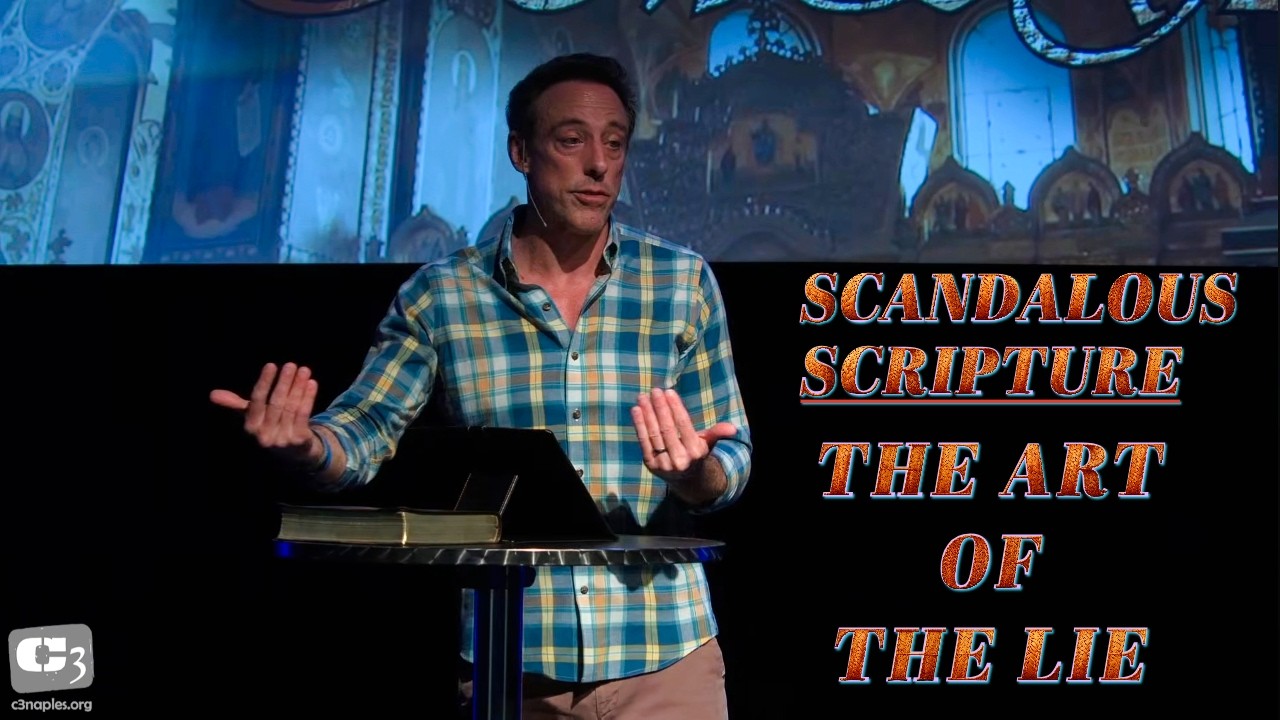
- Part 2: The Art of the Lie
- Sermon by Gene Simco | Reader's Version
- Introduction: A Suggestion of a Stop Sign
- One thing you will notice pretty much immediately when being in the city of Naples is that the driving is absolutely treacherous. To drive in Naples is a very dangerous thing. We have people from all over the country—indeed, the world—here. It is a tourist destination, and everyone has their own idea about how to drive or the rules of the road. Some people don't even know where the turn signal is in their cars. They don't know what side of the street they should be driving on.
- What makes it worse is this is a retirement area, so many people are on medications or day drinking. Naples is a place where stop signs are simply suggestions, especially in parking lots.
- I heard a story about a man who hit someone's car in a parking lot. There were lots of people around who witnessed it, so the man felt obligated to get out of the car and do something. The person whose car he hit wasn't there, so he proceeded to write a note. He took out his wallet, went back to his car, got his insurance card out of the glove box, and he began to write a note. He put it on the windshield underneath the wiper.
- Later on, when the woman whose car was hit returned to it, she noticed this huge dent. She was very upset, but then noticed the note. She pulled it from underneath the wiper, and it read:
- "I have just smashed into your car. The people who saw the accident are watching me right now. They think I'm writing down my name, address, and insurance information. I'm not. Good luck."
- Indeed, today we will talk about deception.
- The Reality of a Scandalous Bible
- If you grew up watching sanitized, G-rated Bible cartoons or those family-friendly Christian movies where everyone is constantly wholesome, I have a harsh reality check for you: the Bible is not wholesome.
- We established this last week, so let's look at the definition of a scandal again. A scandal is a circumstance or action that offends propriety or established moral conceptions, or disgraces those associated with it.
- If you actually read the text carefully, the Bible is deeply, shockingly scandalous. Last week, we looked at the "Blame Game" in the opening chapters of Genesis. We saw how humanity's default setting from Eden to Noah was to point the finger, make excuses, and blame everyone else—even God—for our own sin.
- But where did that sin originate? It originated with a lie. Before Adam and Eve started blaming each other, they were deceived by the serpent. The enemy took the truth of God and twisted it, telling Eve, "You won't die. God knows you'll be just like Him."
- Satan is the father of lies, and today we are going to look at how humanity took that original deception and turned it into an art form. So, let's look at some of the parts of these accounts in the Bible that we don't usually read. Indeed, this is the Bible of the early church—the Bible we don't read in church.
- The Pride of Babel
- After the flood that we discussed last week, humanity gets a fresh start, but they quickly revert to their old ways. We pick up the story in Genesis 11. Instead of spreading out and filling the earth as God commanded, they decide to kind of bunch together.
- Genesis 11:3-4 (NLT)
- They began saying to each other, “Let’s make bricks and harden them with fire.” (In this region bricks were used instead of stone, and tar was used for mortar.) Then they said, “Come, let’s build a great city for ourselves with a tower that reaches into the sky. This will make us famous and keep us from being scattered all over the world.”
- Now, look at the pride there. Just like Adam and Eve trying to grab equality with God, humanity is doing it now collectively. They want to make a name for themselves. So what does God do?
- Genesis 11:7-9 (NLT)
- “Come, let’s go down and confuse the people with different languages. Then they won’t be able to understand each other.” In that way, the Lord scattered them all over the world, and they stopped building the city. That is why the city was called Babel, because that is where the Lord confused the people with different languages.
- A Note on "Confusion" and Translation Now, a quick note before we continue on. It's very interesting. You may have heard the phrase in Christianity: "God is not a God of confusion." Well, here we see that He is, in a way, according to this account in Genesis.
- That reading comes from a bad translation, notably in the ESV version of the Bible, in 1 Corinthians 14:33. When Paul—led by the Holy Spirit—says God is not a God of "confusion," what he is actually talking about is disorder in the worship service. The Greek word Paul uses there is ἀκαταστασία (akatastasia), which in modern pronunciation sounds like ah-kah-tah-stah-SEE-ah. It does not mean mental confusion; it is better translated as instability, disorder, clutter, or even a tumult—meaning there were people speaking in tongues and causing chaos in the service.
- If Paul had meant actual "confusion," he would have used the true biblical Greek word for it: σύγχυσις (synchysis), pronounced SEEN-hee-sees. In fact, if we look back at Genesis 11 in the Septuagint (the ancient Greek translation of the Old Testament), that is the exact root word used! God says, "Let us confuse (syncheō) their language," and the resulting state was synchysis.
- So, God absolutely will use synchysis (confusion) to judge human pride at Babel, but He does not author akatastasia (disorder) in His church.
- Now, continuing with the story, God judges their pride by confusing their languages. This is the ultimate setup for how our mouths constantly get us into trouble. From this point on, language becomes a tool not just for communication, but for division, confusion, and deception.
- Abraham's Cowardly Deception
- If we fast-forward on that theme, God scatters the nations, and out of all of them, He calls one man: Abram. He tells Abram to leave his country, promising to make him a great nation. Now, you would think the father of the faith would trust God implicitly. But almost immediately, a famine hits, and Abram heads to Egypt. Instead of trusting in God, he leans on his own deceptive tongue.
- Genesis 12:11-13 (NLT)
- As he was approaching the border of Egypt, Abram said to his wife, Sarai, “Look, you are a very beautiful woman. When the Egyptians see you, they will say, ‘This is his wife. Let’s kill him; then we can have her!’ So please tell them you are my sister. Then they will spare my life and treat me well because of their interest in you.”
- Abram literally throws his wife under the bus to save his own skin. Now, this is a half-truth that he tells because Sarai is actually his half-sister, which is kind of weird in the Bible and definitely scandalous in our day. Maybe not in theirs, but here we have this "father of the faith" not really being completely faithful. He allows Pharaoh to take Sarai into his harem so that Abram can get rich off sheep, cattle, and servants.
- God has to send plagues on Pharaoh to fix Abram's mess (plagues that actually foreshadow the Exodus plagues). And the crazy part? Abram does the exact same thing years later with King Abimelech in Genesis 20.
- Isaac Repeats the Sins of His Father
- In the timeline of Genesis, a lot happens between Abraham and his son Isaac. But for the purposes of this series, we are going to skip over some of the most famous stories just to catch our theme. Remember, we are not always looking at the most popular stories; we are looking at the scandalous ones.
- We have the destruction of Sodom and Gomorrah, and a deeply scandalous story involving Lot and his daughters. We are going to acknowledge that right now, but breeze right past it, because next week's sermon is entirely about how the patriarchs used sex as a weapon. For today, we are sticking to the family trade of lying.
- Abraham eventually dies, and the promise passes to his son, Isaac. Isaac has a beautiful wife named Rebekah. A famine hits. He moves to Gerar, which is ruled by a king named Abimelech—the exact same title as the guy his dad lied to. And what does Isaac do?
- Genesis 26:6-7 (NLT)
- So Isaac stayed in Gerar. When the men who lived there asked Isaac about his wife, Rebekah, he said, “She is my sister.” He was afraid to say, “She is my wife.” He thought, “They will kill me to get her, because she is so beautiful.”
- You can't make this stuff up. Isaac repeats the exact same lie, committing the exact same sin as his father, in the exact same region. Deception is now generational.
- Now, a lot of people will ask, "Is Abimelech the same guy?" Well, it appears to be a royal title rather than a specific name, so maybe not. But it certainly could be, and if it is, it makes this whole situation even stranger.
- Jacob: The Master Manipulator
- Next, we get to Jacob, the manipulator.
- Isaac and Rebekah have twin boys, Esau and Jacob. Jacob's name literally means "deceiver" or "heel-catcher." He starts by preying on his brother's physical weakness, tricking a starving Esau into trading his birthright for a bowl of red stew (or lentils) in Genesis 25. But the ultimate deception happens when Isaac is old, blind, and ready to pass on the family blessing. Rebekah, proving she fits right into this deceptive family, plots with Jacob to steal it.
- Now, we will talk about this later—Jacob will eventually become Israel, and we'll get to that in a moment. But before Jacob walks into that tent to lie to his father's face and serve him that meal, we have to look at the mastermind behind the operation. The deception in this story didn't actually start with Jacob; it started with his mother, Rebekah.
- The Mastermind: Rebekah's Conspiracy
- Isaac is old, blind, and he thinks he's about to die. He calls for his favorite son, Esau, and tells him to go hunt some wild game and make a delicious meal so he can pass on the family blessing. But Rebekah is eavesdropping. She prefers Jacob, and instead of trusting God—who had already prophesied that the older would serve the younger—she decides to take matters into her own hands and engineer a massive family conspiracy against her own blind husband.
- Genesis 27:5-10 (NLT)
- But Rebekah overheard what Isaac had said to his son Esau. So when Esau left to hunt for the wild game, she said to her son Jacob, “Listen. I overheard your father say to Esau, ‘Bring me some wild game and prepare me a delicious meal. Then I will bless you in the Lord’s presence before I die.’ Now, my son, listen to me. Do exactly as I tell you. Go out to the flocks, and bring me two fine young goats. I will use them to prepare your father’s favorite dish. Then take the food to your father so he can eat it and bless you before he dies.”
- (Skipping ahead...)
- Genesis 27:14-16 (NLT)
- So Jacob went out and got the young goats for his mother. Rebekah took them and prepared a delicious meal, just the way Isaac liked it. Then she took Esau’s best clothes, which were there in the house, and dressed Jacob in them. She made him a pair of gloves from the hairy skin of the young goats, and she fastened a strip of the hide around his neck.
- This isn't just some spur-of-the-moment white lie. This is deep, premeditated deception. Rebekah completely orchestrates the con. She cooks the counterfeit meal, steals her older son's clothes so Jacob will smell right, and she literally pins dead goat skins to her youngest son's arms and neck so he will feel hairy to his blind father.
- Think about how scandalous this is. A wife is actively plotting to deceive her disabled, dying husband to rob her firstborn son of his inheritance. She teaches Jacob exactly how to lie. Jacob is a willing participant, but Rebekah is the architect. It proves that in this family, deception wasn't just a mistake they made when they were scared. It was their standard operating procedure for getting what they wanted.
- Genesis 27:18-19 (NLT)
- So Jacob took the food to his father. “My father?” he said. “Yes, my son,” Isaac answered. “Who are you—Esau or Jacob?” Jacob replied, “It’s Esau, your firstborn son. I’ve done as you told me. Here is the wild game. Now sit up and eat it so you can give me your blessing.”
- He lies straight to his blind, dying father's face. He even wears goat skins on his arms so his dad will think he's hairy like Esau. It is an incredibly elaborate, premeditated con.
- Getting What You Give: Laban and Leah
- This continues. You give what you get. When Esau finds out, he vows to kill Jacob. So Jacob has to run for his life. He goes to his uncle Laban's house to find a wife. Jacob works for seven years for Laban's beautiful daughter, Rachel. But Jacob is about to learn a very hard lesson: you reap what you sow. The deceiver is about to get conned by the master.
- Genesis 29:22-25 (NLT)
- So Laban invited everyone in the neighborhood and prepared a wedding feast. But that night, when it was dark, Laban took Leah to Jacob, and he slept with her. ... But when Jacob woke up in the morning—it was Leah! “What have you done to me?” Jacob raged at Laban. “I worked seven years for Rachel! Why have you tricked me?”
- Jacob, who used the darkness of his father's blindness to steal a blessing, is tricked by the darkness of a tent and a heavy wedding veil. He gets what he gave. Laban literally swaps out the brides on Jacob, and he ends up having to work another seven years just to get his first choice of a bride.
- The Grifter Showdown: Jacob vs. Laban
- Jacob doesn't just learn his lesson after being tricked into marrying Leah. He decides to play the game. After years of hard labor, Jacob finally asks to leave and go back home. Laban doesn't want to lose his best worker, so he tells Jacob to name his wages.
- Jacob says, "I will keep only the speckled, spotted, and black sheep and goats. You keep all the solid-colored ones." Laban quickly agrees, thinking he's getting a massive bargain. But watch what happens next. Laban immediately tries to rig the game, and Jacob responds by out-conning the con man.
- Genesis 30:35-36 (NLT)
- But that very day Laban went out and removed all the male goats that were streaked and spotted, all the female goats that were speckled and spotted or had white patches, and all the black sheep. He placed them in the care of his own sons, who took them a three-days’ journey from where Jacob was.
- What's happening here is Laban makes the deal—saying, "Yes, Jacob, you can have all these different colored sheep"—but then immediately removes them and takes them three days away, thinking he is tricking him.
- Genesis 30:37-39, 41-42 (NLT)
- Then Jacob took some fresh branches from poplar, almond, and plane trees and peeled off strips of bark, making white streaks on them. He placed these peeled branches in the watering troughs where the flocks came to drink, for that was where they mated. And when they mated in front of the white-streaked branches, they gave birth to young that were streaked, speckled, and spotted. ... Whenever the stronger females were ready to mate, Jacob placed the peeled branches in the troughs in front of them... But he didn’t do this with the weaker ones, so the weaker flocks belonged to Laban and the stronger ones were Jacob’s.
- This is a masterclass in double-crossing. Laban, smiling in Jacob's face, sneaks out that very day and steals all the speckled and spotted animals, hiding them a three days' journey away so the flocks have zero chance of breeding those colors. Laban thinks he has totally bankrupted his son-in-law.
- But Jacob doesn't complain. He just gets sneaky. He uses an ancient, superstitious breeding trick—putting peeled, striped branches in the water troughs when the strongest animals were mating so they would somehow produce streaked, speckled, and spotted offspring. Whether or not the sticks actually worked biologically (because God was ultimately the one blessing Jacob's wealth, which Jacob later admits in Chapter 31), Jacob's intent is pure manipulation. He intentionally rigs the breeding cycle so Laban gets all the weak, sickly animals, and Jacob walks away with the strong, healthy ones.
- It's grifter versus grifter. Instead of trusting God to provide the wages, Jacob resorts right back to the family trade: deception.
- Rachel's Deception
- But it doesn't stop there. Years later, when Jacob finally packs up his family to escape Laban, his favorite wife, Rachel, proves she is just as deceptive. She steals her father's household idols. When Laban chases them down and searches the tents for them, she hides them inside her camel saddle.
- Genesis 31:34-35 (NLT)
- Rachel had taken the household idols and hidden them in her camel saddle, and now she was sitting on them. ... “Forgive me, my lord,” Rachel said to her father. “I can’t get up just now, for I am having my monthly period.” So Laban searched the tent but couldn’t find the idols.
- She lies to him, telling him she can't get up because she is on her menstrual cycle, all while the idols are hidden underneath her. Lie after lie, deception after deception. This is the foundation of the nation of Israel.
- Wrestling with the Truth: Jacob Becomes Israel
- Here is how he finally becomes Israel.
- Jacob eventually takes his wives, his children, and all his strategically bred flocks and runs away from Laban. But now he has a massive problem. He is heading right back toward Esau, who wanted to kill him. He is terrified. He sends bribes ahead, separates his family into camps, and spends the night alone on the banks of the Jabbok River.
- It is there that Jacob ends up in a literal, physical wrestling match with God (the Angel of the Lord) until daybreak. God dislocates Jacob's hip, but Jacob refuses to let go until he has a blessing. But notice how he gets the blessing this time. It all hinges on a single question that brings the entire theme of deception full circle.
- Genesis 32:27-28 (NLT)
- The man asked him, “What is your name?” “Jacob,” he answered. “Your name will no longer be Jacob,” the man told him. “From now on you will be called Israel, because you have fought with God and with men and have won.”
- Do not miss the scandalous beauty of what just happened. Decades earlier, Jacob stood before his blind father Isaac, seeking a blessing. Isaac asked him, "Who are you?" And Jacob lied. He said, "I am Esau." He stole the blessing through deception.
- Now, he is wrestling with God, desperately seeking a blessing. God asks him the exact same question: "What is your name?" God already knew his name, but He was forcing Jacob to finally own it.
- This time, Jacob doesn't lie. He doesn't put on goat skins or hide in the dark. He simply says, "Jacob." In Hebrew, that name literally means deceiver, grifter, supplanter. Jacob finally tells the truth. He confesses his true identity: I am the deceiver.
- And the moment he stops lying, the moment he brings the truth into the light, God changes his identity. He says, You are no longer Jacob the deceiver. You are Israel (which means "wrestles with God").
- The cycle of deception in his heart was finally broken by a confession of the truth. He stopped playing the game, and God gave him a new legacy.
- The Deadly Nature of a Lie
- We read these stories and laugh at how crazy they are, but the New Testament takes the truth incredibly seriously. Why? Because the truth is the bedrock of God's character.
- Last week, we looked at James regarding temptation. Listen to what James says about our mouths and the lies we tell.
- James 3:5-6 (NLT)
- In the same way, the tongue is a small thing that makes grand speeches. But a tiny spark can set a great forest on fire. And among all the parts of the body, the tongue is a flame of fire. It is a whole world of wickedness, corrupting your entire body.
- This is very, very serious, right? And if you want to know how seriously God takes lying, jump all the way to the end of the book.
- Revelation 21:8 (NLT)
- “But cowards, unbelievers, the corrupt, murderers, the immoral, those who practice witchcraft, idol worshipers, and all liars—their fate is in the fiery lake of burning sulfur. This is the second death.”
- We see the new heavens and the new earth here. Indeed, this lake of fire is where all the liars go. When we continue on in the new heavens and the new earth, there are no liars allowed there.
- The Reversal: Pentecost
- But we see a massive reversal if we go back into the book of Acts, and that's how we get out of this generational curse of deception. We look to Jesus. Just like Jesus reversed the sin of Adam in the garden by humbling Himself (as we saw last week in Philippians 2), God provides a massive reversal for the sins of the tongue and the confusion of Babel.
- Remember last week when we looked at Galatians 5 and the fruit of the Spirit? If we go back a couple of chapters, we see this:
- Galatians 3:13 (NLT)
- But Christ has rescued us from the curse pronounced by the law. When he was hung on the cross, he took upon himself the curse for our wrongdoing. For it is written in the Scriptures, “Cursed is everyone who is hung on a tree.”
- Just as they passed down the curse of their own sinful habits, Christ hung on the cross to break that cycle and absorb the curse Himself, freeing us to walk in the truth by the Holy Spirit.
- Now, at the Tower of Babel, human pride caused God to confuse their language, scattering humanity into isolated, untrusting, deceptive groups. But look at what happens in Acts 2 on the Day of Pentecost.
- Acts 2:1-13 (NLT)
- On the day of Pentecost all the believers were meeting together in one place. Suddenly, there was a sound from heaven like the roaring of a mighty windstorm, and it filled the house where they were sitting. Then, what looked like flames or tongues of fire appeared and settled on each of them. And everyone present was filled with the Holy Spirit and began speaking in other languages, as the Holy Spirit gave them this ability.
- At that time there were devout Jews from every nation living in Jerusalem. When they heard the loud noise, everyone came running, and they were bewildered to hear their own languages being spoken by the believers.
- They were completely amazed. “How can this be?” they exclaimed. “These people are all from Galilee, and yet we hear them speaking in our own native languages! Here we are—Parthians, Medes, Elamites, people from Mesopotamia, Judea, Cappadocia, Pontus, the province of Asia, Phrygia, Pamphylia, Egypt, and the areas of Libya around Cyrene, visitors from Rome (both Jews and converts to Judaism), Cretans, and Arabs. And we all hear these people speaking in our own languages about the wonderful things God has done!” They stood there amazed and perplexed. “What can this mean?” they asked each other.
- But others in the crowd ridiculed them, saying, “They’re just drunk, that’s all!”
- A Note on the Gift of Tongues
- When we look at this incredible moment in Acts 2, it is important to clarify how the New Testament actually views the gift of tongues. At Pentecost, the miracle was specifically that the believers were speaking in known, understood languages. The diverse crowd wasn't hearing babble; they were hearing the Gospel clearly in their own native dialects.
- The Apostle Paul heavily reinforces this need for understanding in 1 Corinthians 14. He explains that if someone speaks in a tongue in the church, it must be interpreted so that the entire church can be built up.
- 1 Corinthians 14:9 (NLT)
- "It’s the same for you. If you speak to people in words they don’t understand, how will they know what you are saying? You might as well be talking into empty space."
- If language is not understood, it creates the exact same disorder (akatastasia) and division that God used as a judgment at the Tower of Babel. Furthermore, the New Testament is clear that this specific gift is not a requirement or a universal experience for every Christian. In 1 Corinthians 12, Paul explains that the Holy Spirit distributes different gifts to different people to build up the unified body.
- 1 Corinthians 12:29-30 (NLT)
- "Are we all apostles? Are we all prophets? Are we all teachers? Do we all have the power to do miracles? Does everyone have the gift of healing? Of course not. Does God give all of us the ability to speak in unknown languages? Can anyone translate unknown languages? No."
- The Holy Spirit doesn't give everyone the exact same gift, but He gives all of us the power to speak the absolute truth of Jesus Christ.
- When the Holy Spirit falls on the early church, what is the very first miracle? God takes the tongues of the believers—the same tongues that James says are a "flame of fire"—and redeems them. Indeed, they see things like flames of fire, but for an entirely different purpose! People from every nation on earth hear the disciples speaking the truth of God—that is, the Gospel—in their own native languages.
- Babel used language to build a monument to human pride, resulting in confusion. Pentecost used language to build a monument to Jesus, resulting in total unity and absolute truth.
- You see, Jesus said, "I am the way, the truth, and the life" (John 14:6). He didn't have to manipulate, con, or deceive anyone to get His inheritance. And through the power of the Holy Spirit, we don't have to either. We are called to strip off the lies of our old sinful nature and speak the truth in love.
- Walking in the Truth
- As we strip off the goat skins and break this generational cycle of deception, what are we actually called to do? We are called to walk in the truth.
- The Apostle John wrote about this lifestyle with deep, pastoral love. Toward the very end of the New Testament, he writes to the early church to encourage them:
- 2 John 1:4 (NLT)
- "How happy I was to meet some of your children and find them walking in the truth, just as the Father commanded us."
- He echoes this same immense joy in his next letter:
- 3 John 1:4 (NLT)
- "I could have no greater joy than to hear that my children are following the truth."
- Greek Insight: Aletheia
- To understand how profound this is, we have to look at the biblical Greek word John uses for "truth." The word is ἀλήθεια (aletheia), pronounced ah-LAY-thee-ah.
- In ancient Greek, aletheia literally translates to "un-hiddenness," "that which is not concealed," or "the unveiled reality." It is the state of being completely exposed to the light, without any masks or illusions.
- When John talks about "walking in the aletheia," he isn't just saying, "Try not to tell lies today." He is talking about living an entirely un-hidden life. This is the exact opposite of the generational curse of Genesis. It is the opposite of Jacob hiding behind dead goat skins in a dark tent. It is the opposite of Rachel sitting on her saddle to conceal her hidden idols.
- To walk in aletheia means your life, your actions, and your words perfectly align with the unveiled reality of God's character. You no longer have to hide in the shadows of self-preservation or manipulation because the Truth has set you free.
- Remember, we talked about that sin nature last week versus the Holy Spirit. They are always at war with one another. But if we have the Spirit, through sanctification, we can conquer that sin.
- Application: Breaking the Cycle of Deception
- So, how do we apply this? How do we walk out of the scandalous deception of Genesis and into the freedom of the New Testament? Well, we have to stop playing the game. Here is how we do it this week.
- 1. Answer God's Question Honestly
- When the Angel of the Lord asked Jacob, "What is your name?" it was an invitation to confess. God is asking you the exact same thing today. Before you can experience a name change and a new legacy like Israel, you have to admit you are Jacob.
- You have to identify the lies you tell to protect yourself. Remember last week when we talked about James 5? We have to confess our sins. Tell God the brutal, scandalous truth about your own heart. And perhaps, for the sake of accountability, we need to confess it to others.
- 2. Take Off the Goat Skins
- Jacob spent his life wearing a disguise, literally pinning dead goat skins to his arms to pretend to be someone he wasn't, just to get ahead.
- Where are you wearing the goat skins? Where are you faking it, manipulating the narrative, or hiding your true self at work, in your marriage, or even at church? The Holy Spirit cannot bless who you are pretending to be. We need to drop the act and step into the light.
- Exactly which goat skin are you wearing? It's easy to judge the patriarchs for their ancient cons, but the truth is, we wear these same disguises today. We have just modernized the wardrobe. Here is how the deceptions of Abraham, Rebekah, Jacob, Laban, and Rachel show up in our everyday lives:
- Abraham and Isaac: The Lie of Self-Preservation
- The Ancient Lie: "She is my sister." Both men threw their wives under the bus because they were afraid of getting killed by foreign kings. It was a lie born entirely out of fear.
- How We Do It Today (The "Under the Bus" Lie): This happens when we make a mistake at work and subtly shift the blame to a coworker to save our own job. It happens when we avoid a hard conversation by telling a white lie just to protect our own comfort. Whenever we compromise our integrity or sacrifice someone else's reputation to protect our own skin, we are wearing Abraham's disguise.
- Rebekah: The Lie of Control
- The Ancient Lie: "Do exactly as I tell you." Rebekah knew God had chosen Jacob, but she didn't trust God's timing or methods. She orchestrated a massive, premeditated conspiracy to force the outcome she wanted.
- How We Do It Today (The "Means to an End" Lie): This is the disguise of the manipulator. We twist narratives, withhold certain facts, or subtly play family members against each other to ensure a situation goes our way. We justify it by saying, "I'm just doing what's best for my family," or "I had to do it to protect them." It is a lack of trust disguised as helpful management.
- Jacob: The Lie of Identity
- The Ancient Lie: "I am Esau, your firstborn." Jacob wore dead goat skins to fake the smell, feel, and identity of his brother to get his father's blessing and approval.
- How We Do It Today (The "Imposter" Disguise): We pretend to be whoever we think people want us to be so we can get the blessing: the promotion, the relationship, or the social status. We lie on our resumes. We fake our spiritual maturity at church. We curate a completely fake lifestyle on social media. We hustle to project the image of the "Esau" that our boss, spouse, or parents expect, terrified that if they ever saw the real "Jacob," they would reject us.
- Laban: The Lie of the Grifter
- The Ancient Lie: Laban smiled, agreed to Jacob's wages, and then sneaked out that exact same day to hide all the speckled sheep so Jacob would go bankrupt.
- How We Do It Today (The "Fine Print" Lie): This is the deception of the shady businessman or the opportunist. It is shaking someone's hand while knowing you are going to exploit a loophole. It’s withholding crucial information during a sale, padding the expense report, or honoring the exact letter of a promise while completely violating the spirit of it. It’s smiling to someone's face while working against them behind their back.
- Rachel: The Lie of the Cover-Up
- The Ancient Lie: Rachel stole her father's idols, hid them under her saddle, sat on them, and lied to her father's face about her physical condition so he wouldn't search the tent.
- How We Do It Today (The "Hidden Idol" Lie): This is the lie we use to protect our secret sins. It is deleting the browser history, hiding the credit card statements, or lying about where we were on Friday night. It is looking our spouse or our church family dead in the eye and saying "Everything is fine," while we are literally sitting on top of the idols we refuse to give up.
- 3. Stop the Generational Cycle
- Abraham lied. Isaac copied his dad and told the exact same lie. Rebekah taught her son Jacob how to deceive. Deception is a family disease. Look at your own family tree: are you passing down a legacy of manipulation and half-truths to your kids? Do you feel like those habits were passed on to you?
- By the power of Jesus Christ—who broke the curse on the cross—you can choose to be the generation where the lying stops. We need to stop resting on our family history as an excuse. If we claim to be Christians, this curse is broken.
- 4. Let Pentecost Rule Your Tongue
- Remember the reversal. Babel brought confusion through pride; Pentecost brought unity through the Holy Spirit and humility. James warns that the tongue is a flame of fire that can burn down your entire life.
- This week, before you spin a story to save your own skin or manipulate an outcome, pause. Ask the Holy Spirit to give you the courage to speak the absolute truth. You don't have to be a grifter anymore. You belong to the Truth.
- The Blessing of the Truth
- Here is the incredibly good news today: You don't have to hustle, manipulate, or lie to get God's blessing. You don't have to wear the goat skins anymore.
- For generations, humanity thought we needed to trick our way into survival (like Abraham and Isaac) or scheme our way into prosperity (like Jacob and Laban). But Jesus Christ stepped into our messy, scandalous history to put an end to the grift. He hung on the cross and took the curse of deception upon Himself. He reversed the pride and confusion of Babel, and He poured out His Holy Spirit at Pentecost so we could finally be unified and speak the truth in love.
- Invitation to Real Church, Real People
- This is an invitation to be part of who we are at C3 Church: real church for real people.
- When Jacob finally stopped lying and admitted who he really was, God didn't crush him. God renamed him. He gave him a brand-new legacy. God wants to do the exact same thing for you today. You don't have to lie. You don't have to fake it. Step out of the shadows, leave the lies behind, and walk in the absolute freedom of the truth this week. God gives you a new name and a new identity in Jesus Christ!
- ________________________________________
- ©️Copyright 2026 Gene Simco Most Scripture quotations are taken from the Holy Bible, New Living Translation, copyright ©1996, 2004, 2015 by Tyndale House Foundation. Used by permission of Tyndale House Publishers, Carol Stream, Illinois 60188. All rights reserved. Scriptures in brackets reflect the original Biblical languages.