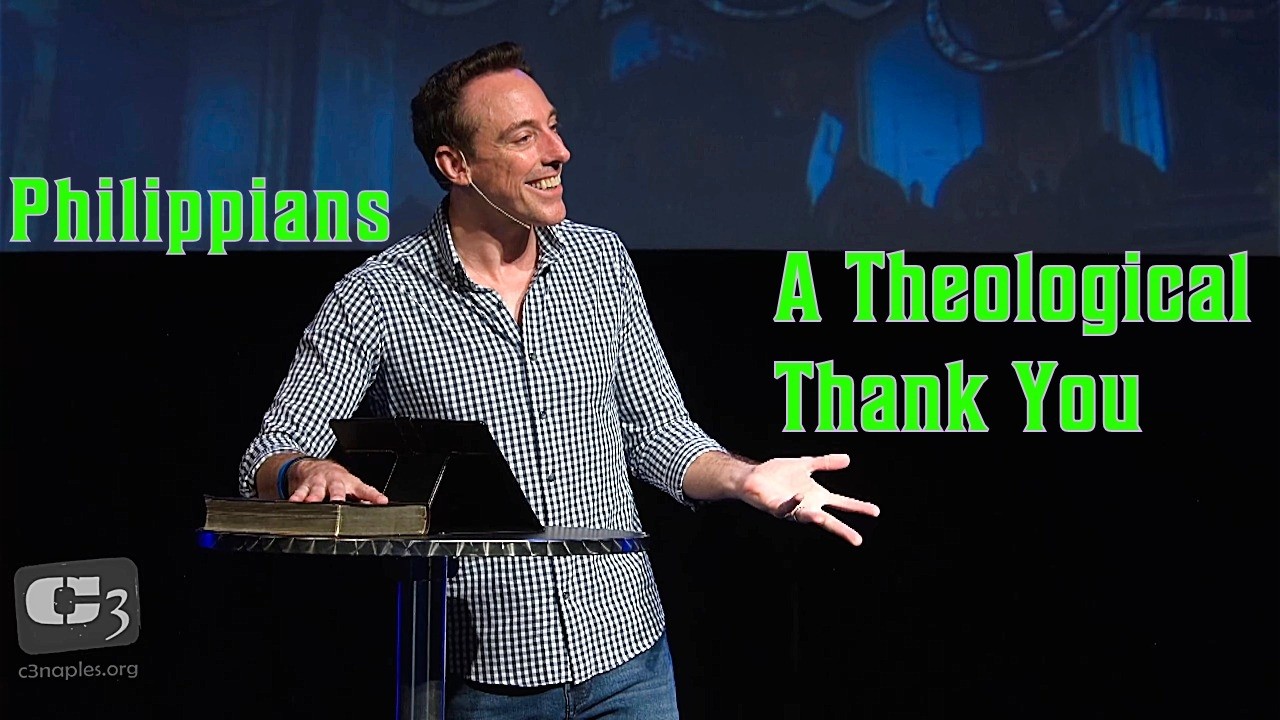
Philippians: A Theological Thank You
Philippians is more than a warm thank-you note — it is one of the most theologically rich letters Paul ever wrote. Composed from prison, this letter redefines joy, strength, and success through the lens of eternity. Paul reminds the church that identity comes before authority, humility comes before exaltation, and resurrection always follows death. He confronts selfish ambition, exposes enemies of the cross, and anchors contentment not in comfort but in Christ. At the center of the letter is the great hymn of Philippians 2 — where Jesus, though fully God, did not grasp but humbled Himself unto death. That pattern becomes the blueprint for Christian living. This message calls us to gratitude over entitlement, endurance over ease, and heavenly citizenship over earthly ambition. Joy is not circumstantial. Strength is not triumph. Contentment is not complacency. This is a theological thank you — written in chains, anchored in Christ, and aimed at eternity.
Video can’t be displayed
Reader's Version
- Philippians: A Theological Thank You
- Sermon by Gene Simco
- Reader’s Version
- We talked about concentric circles last week. This was the pattern that you could look at Ephesians with, or the pattern that Ephesians could be looked at as concentric circles—that is, starting with a really big idea and then having it ripple out, or vice versa. You could look at them as inward-moving concentric circles to a main point.
- Well, this made me think of a story—a story that I heard about a boy with a toy boat. He gets a toy boat for his birthday, and he's really excited to test it out on the water. It's a little bit too big for the bathtub, but he wants to test it out on real water. So finally, one day, his dad takes him to a lake that they usually go fishing at, and the boy doesn't wait. He rushes it out, and before he ties a string onto it, he just puts it on the lake. Well, almost immediately the wind carries it too far away to get.
- So the boy starts panicking. Well, he looks about 50 feet down the lake and sees an old man. They've seen him at the lake before. He just seemed like a grumpy old man who never really talked to them. Well, the man sees what's happening with the boat floating out too far and the boy panicking and yelling. So the old man picks up a rock and he throws it toward the boat!
- He reaches down, picks up a handful of rocks, and begins throwing them toward the boat. Well, the boy started to get very, very upset. But after some time, the boy noticed that the rocks were creating ripples—concentric circles in the water—which were beginning to push the boat back toward the boy.
- Perspective. You see, from the boy's perspective, it looked like the man was trying to sink the boat. But he was doing what he did to help the boy. And this is how it is with God. It is how it is with good parents and a good pastor. We've seen that Paul, in this way, is indeed a good pastor and can seem harsh at times.
- Shape
- Greek Insight & Context: The "ripples" of Paul's pastorship are often felt through his paraklesis (παράκλησις). While we often translate this as "encouragement," it literally means "a calling alongside." Like the old man throwing rocks to save the boat, Paul's "harsh" words are intended to create the necessary ripples to bring the believer back to safety.
- Historical Note: In the ancient world, the concept of paideia (παιδεία) involved the holistic training and correction of a person. Paul isn't just giving "tips"; he is acting as a spiritual father who understands that true growth often requires the "stones" of conviction to move us back toward the shore of Grace.
- We’ve looked at some really tough teachings through Paul’s letters that seem to get increasingly difficult.
- We looked at the book of Romans, where Paul says to the Jews there, "Teach yourself, if you know so much." He talks about judgment in chapters 2 and 14, reminding them that they, too, as Christians, will be judged. In 1 Corinthians, he calls them babies and threatens to come to them with a stick! In 2 Corinthians, we see similar threats that he will examine them, saying, "Test yourself to see if your faith is genuine." Galatians is probably the climax of these very difficult teachings: "You’re cursed fools," and even saying he hopes the false teachers would go the whole way and mutilate themselves. In Ephesians, although it seems to get a little nicer, it’s still tough; he warns that if you engage in these sins that some people excuse, you will not inherit the kingdom of God.
- Well, in Philippians, Paul won’t necessarily pull any punches, but his tone is probably the nicest of all his letters.
- The reason for writing Philippians is that Paul is in prison, and he’s been given a gift. There is an individual from that church named Epaphroditus who is bringing the letter and the gift back and forth in this correspondence. So it is, in essence, a great theological thank you note.
- Historical Context: The Pride of Philippi
- Before we dive into the heart of this letter, we have to understand the ground Paul is writing to. The city of Philippi was not just another stop on the map; it was a city dripping with imperial pride.
- Philippi originally received its name from Philip II of Macedon—the father of Alexander the Great—who conquered and fortified the region in 356 BC to control the nearby gold mines. But its true claim to fame came centuries later. In 42 BC, it was the site of the famous Battle of Philippi, where Mark Antony and Octavian (who would become Caesar Augustus) defeated the assassins of Julius Caesar.
- To reward his victorious veteran soldiers, Augustus turned Philippi into a premier Roman Colony. This was a massive deal. The city was granted the Ius Italicum (the Rights of Italy). This meant that even though Philippi was located in Macedonia (modern-day Greece), it was legally treated as if it were a piece of soil right in the middle of Italy. The citizens spoke Latin, dressed in Roman fashions, lived under Roman law, and—best of all—were completely exempt from paying imperial taxes.
- The people of Philippi were intensely, fiercely proud of their Roman citizenship. To be a citizen of Philippi was to be a citizen of Rome itself. It was their identity, their security, and their ultimate boast.
- Understanding this historical reality is the key that unlocks the entire letter. When Paul writes to them from a Roman prison cell, awaiting trial before the emperor, he deliberately targets their greatest source of pride. He doesn't tell them to be good Roman citizens; he completely subverts their worldview.
- When Paul writes in Philippians 3:20, "But our citizenship is in heaven," he uses the Greek word politeuma (πολίτευμα). He is looking at a congregation of people who hold the most coveted political status in the ancient world, and he is telling them: “Your Roman passport is garbage compared to your heavenly one. You do not belong to the empire of Caesar; you are a colony of Heaven.” Every command Paul gives about humility, contentment, and standing firm is framed by this contrast. He is calling them to abandon the arrogance of their earthly citizenship and to live worthy of a completely different Kingdom.
- Biblical Backstory: The Acts 16 Connection
- We’ve seen Philippi come up in the book of Acts. As I’ve described, these thirteen letters of Paul in the New Testament are written either to places he hasn’t been yet, like Rome, or places he has been, like Philippi.
- When we look at the history, Paul picked up Timothy in Lystra (Acts 16:1-3), and Timothy appears here in Philippians as a co-author. While in Troas, Paul received a vision of a man from Macedonia begging him to "Come over and help us." This is where we see a "we" narrative pick up in the text. Remember that Luke is writing the book of Acts, and it seems as if Luke joins them here, becoming a first-hand witness to the events in Philippi.
- In Philippi, we are introduced to Lydia. She’s a businesswoman selling expensive purple garments. When she takes Paul into her home and is baptized, she represents probably one of the first European converts—a woman of means who supports Paul’s ministry.
- We then run into the slave girl with a "spirit of divination." In the Greek, this is the pneuma pythona (πνεῦμα πύθωνα).
- Nerd Note: The Spirit of Pythona To understand this, you have to understand a bit of mythology. The "Python" was the legendary serpent that guarded the Oracle of Delphi until it was killed by the god Apollo. The "fumes" from the decaying serpent were said to give the Oracle her prophetic powers. By using this term, Luke is identifying the source of the girl’s power as demonic and pagan. Modern translations usually call it a "spirit of divination."
- This girl was actually validating Paul and Silas, shouting that they were servants of the Most High God. But Paul becomes exacerbated—annoyed with her—and casts the demon out. This costs her owners a lot of money because she can no longer prophesy for them. They drag Paul and Silas to jail, and they end up in the inner dungeon.
- Instead of complaining or moaning and wallowing in sorrow, they worship God at midnight and literally bring the house down with an earthquake. This leads to the conversion of the jailer and his entire family.
- Years later, Paul is again in prison—this time in Rome—and this is likely where he writes this letter from. He is writing back to that same group of people in Philippi who saw him in chains the first time.
- As you read Philippians, you have to watch out for two anchors: Joy and Christ’s Return. Paul is not writing random "encouragement quotes." He is writing from a prison cell with eternity in view. This is the context: a thank-you note written from the shadow of execution.
- Greek Insight: The word for "joy" or "rejoice" (chara / χαρά) appears 16 times in these four short chapters. It is important to distinguish this from "happiness." Happiness is based on happenings (circumstances), but chara is a deep-seated confidence in God’s sovereignty regardless of the environment. Paul isn't happy about the chains, but he is joyful because of the Christ who is with him in them.
- Paul opens his letter with humility. He says, "From Paul and Timothy, slaves of Christ Jesus." Paul does not lead with status. He doesn't say "Chief Apostle," "Founder," or "Authority." He says, slaves of Christ Jesus.
- Greek Insight & Context: The word Paul uses is doulos (δοῦλος). While modern ears hear "slavery" through the lens of racial or chattel history, in the first-century Roman world, it carried the idea of total ownership and devotion. A doulos was someone whose will was consumed by the will of their master. It is covenant loyalty. Back then, slaves could sometimes earn money or hold high-level administrative positions, but their identity was entirely bound to whom they belonged. Paul is saying his identity is not rank; it is belonging.
- He writes to the "saints"—the hagios (ἅγιος). This does not mean "stained-glass heroes" or canonized elites. It means "holy ones" or those "set apart." There are no spiritual celebrities here. Notice that leadership is mentioned plainly—overseers and deacons—but there is no celebrity culture and no inflated branding. It is simply structure for service, just as we saw in Ephesians.
- Next, the concept of grace and peace comes up. Paul writes, "May God our Father and the Lord Jesus Christ give you grace and peace." This is not sentimental; it’s theological.
- Paul is intentionally bringing together two worlds. He uses charis (χάρις), a Greek greeting related to "rejoice," and pairs it with the concept of the Jewish shalom, translated in Greek as eirēnē (εἰρήνη). Like we saw in Ephesians—Jew and Gentile, one church, one Lord—this sets the tone. He takes a Gentile greeting and a Jewish greeting and fuses them together.
- Thanksgiving with an Eternal Perspective
- Paul gives thanks with joy, even from prison, because this church partnered in the Gospel from day one. Remember Lydia? Remember the jailer? This was a relationship forged in worship and chains. And here is the key line: "And I am certain that God, who began the good work within you, will continue his work until it is finally finished on the day when Christ Jesus returns." There it is again: Christ’s Return. Joy is tied to future completion.
- Notice that Paul’s prayer is not for comfort.
- Nerd Note: The Definition of Comfort When we think of "comfort," we usually think of "couch comfort"—ease, luxury, and the removal of pain. But the Biblical definition is found in the Greek word paraklesis (παράκλησις). This isn't a pillow; it’s a person. The Holy Spirit is the "Comforter" (Paraclete), which means "one called alongside" to give strength in the midst of a battle. Biblical comfort doesn't necessarily take you out of the suffering; it gives you the "fortitude" (the comfort) to endure and grow through it.
- Paul isn't praying for their circumstances to get easier; he is praying for them to grow in love, knowledge, and discernment. He wants them to be blameless and fruitful, all aimed at one goal: living ready for the Day of Christ’s Return.
- Joy in Chains: The Advance of the Gospel
- Paul then says something shocking. He claims that everything that has happened to him—the beatings, the arrests, the chains—has actually helped to spread the Good News. Even the palace guard knows he is in prison for Christ!
- Everyone in the prison system is hearing about Jesus. This is what "all things" looks like (which we will see later in the letter). It is not personal success, platform expansion, or luxury increase. The Gospel is spreading through confinement. In Paul’s eyes, chains are not obstacles; they are amplifiers. And the believers watching him endure are growing bold instead of fearful.
- Before we can reach the famous "I can do all things through Christ," we have to see this: joy in imprisonment, progress through suffering, and hope anchored in Christ’s Return. Philippians begins by dismantling consumer Christianity before it even addresses contentment.
- Joy is not circumstantial; it is resurrection-focused.
- Next, we see this topic of some false teachers coming in. Paul touches on it very lightly here at first, and unfortunately, this is where a lot of people stop.
- Philippians 1:15–18:
- "It’s true that some are preaching out of jealousy and rivalry, but others preach Christ out of pure motives. They preach because they love me, for they know I have been appointed to defend the Good News. Those others do not have pure motives as they preach about Christ. They preach with selfish ambition, not sincerity, intending to make my chains more painful to me. But that doesn’t matter. Whether their motives are false or genuine, the message about Christ is being preached either way, so I rejoice. And I will continue to rejoice."
- Now, Paul does not endorse these teachers. He does not celebrate their motives. He simply states that Christ is being proclaimed anyway. This is not descriptive of how things should be; it is not approving. Remember in Ephesians 5:6, he said, "Don’t be fooled by those who try to excuse these sins."
- We have to remember that these things—jealousy, rivalry, selfish ambition—these are the sins of the flesh we saw in Galatians 5. God can use crooked tools, but that does not make the crooked tools righteous. This matters because people have used this passage to say false teaching is no big deal—that as long as Jesus’s name is mentioned, we’re good. But if we keep reading the letter, we see Paul’s joy here is not naivete. It is a confidence that God’s purposes cannot be hijacked by ego.
- Christ advances even through flawed messengers, but Paul is not finished addressing the issue. If we jump forward, we see that Paul actually calls them "enemies of the cross of Christ."
- The Escalation: Identifying the Enemies
- By chapter three, he removes all ambiguity. He is no longer speaking gently.
- Philippians 3:2, 18–19:
- "Watch out for those dogs, those people who do evil, those mutilators who say you must be circumcised to be saved... For I have told you often before, and I say it again with tears in my eyes, that there are many whose conduct shows they are really enemies of the cross of Christ. They are headed for destruction. Their god is their appetite, they brag about shameful things, and they think only about this life here on earth."
- He calls them dogs, evildoers, mutilators, and enemies of the cross. That escalated quickly! Why? Because the issue is serious. Their defining mark is that "their god is their belly." It is appetite-driven religion. It is comfort-centered theology and gain-focused spirituality. They are focused on the things of this earth—earthly success baptized in Christian language.
- These teachers avoid suffering, minimize the cross, and reframe obedience as optional. Paul says that this posture is not neutral; it is hostility toward the cross. Why? Because the Cross says: You must die before you arise. You must lose before you gain. You must surrender before exaltation. Any gospel that promises resurrection without death is not a "softer" version of Christianity; it is a different one entirely. And we already heard in Galatians what happens to those who preach a different gospel: they are cursed.
- So when Paul says in chapter one that some preach Christ from selfish ambition, he isn’t shrugging at error. He is confident that Christ advances, but by chapter three he makes it plain: motives matter, doctrine matters, and the cross cannot be edited. This prepares us for the very center of the letter: the pattern of Christ Himself.
- Greek Insight: In Philippians 3:2, the word for "mutilators" is katatomē (κατατομή). This is a biting play on words. The word for circumcision is peritomē (cutting around), but Paul calls these legalists katatomē (cutting up/mutilation). He is saying that by adding human works to the finished work of Christ, they aren't practicing a holy rite; they are just damaging the body.
- Next, he makes the point that to live is Christ and to die is gain. Before we deal with false motives and enemies of the cross, Paul fixes our perspective, and it is radical.
- Philippians 1:20–24:
- "For I fully expect and hope that I will never be ashamed, but that I will continue to be bold for Christ, as I have been in the past. And I trust that my life will bring honor to Christ, whether I live or die. For to me, living means living for Christ, and dying is even better. But if I live, I can do more fruitful work for Christ. So I really don’t know which is better. I’m torn between two desires: I long to go and be with Christ, which would be far better for me. But for your sakes, it is better that I continue to live."
- Now, that does not sound like a mega-church pastor. Paul says, "If I live, it’s for Christ. If I die, that’s gain." He openly admits he would rather depart and be with Christ. He’s not clinging to this world; he’s not terrified of death; he’s not building a "comfort plan." He believes Heaven is better. But—and this is crucial—preference does not determine obedience. Paul remains because the church needs him. This shatters consumer Christianity.
- Then he brings his example to theirs. Paul now turns it on the reader, and he says something that collides with modern theology.
- Philippians 1:27–30:
- "Above all, you must live as citizens of heaven, conducting yourselves in a manner worthy of the Good News about Christ. Then, whether I come and see you again or only hear about you, I will know that you are standing together with one spirit and one purpose, fighting together for the faith, which is the Good News. Don’t be intimidated in any way by your enemies. This will be a sign to them that they are going to be destroyed, but that you are going to be saved, even by God himself. For you have been given not only the privilege of trusting in Christ, but also the privilege of suffering for him. We are in this struggle together. You have seen my struggle in the past, and you know that I am still in the midst of it."
- Again, this is not modern preaching. He reminds them that they are citizens of heaven. They are standing together with that armor of God, and he says you must conduct yourselves in a manner worthy of the Gospel.
- So here we see that conduct matters. Remember Ephesians 2:10—we are created anew in Christ Jesus for good works. Works are how we witness. But that "privilege of suffering" is huge. He tells them, "For you have been given not only the privilege of trusting in Christ, but also the privilege of suffering for him."
- Greek Insight & Context: The word Paul uses for "privilege" or "granted" is echaristhe (ἐχαρίσθη), which comes from the root charis (grace). He is literally saying that suffering has been "graced" to you. In Paul’s vocabulary, faith is a gift, and suffering is also presented as a gift. This destroys the idea that suffering means failure or that you have been abandoned by God. Instead, it is a sign of your shared life with Christ.
- So now we have the framework: Living is Christ, dying is gain, suffering is a privilege, and faithfulness matters more than comfort. And only after establishing that foundation does Paul address selfish ambition and false teachers. Because if you misunderstand suffering, you will misunderstand everything else in Philippians.
- Nerd Note: Citizenship in the Roman World When Paul tells the Philippians to live as "citizens," he uses the verb politeuesthe (πολιτεύεσθε). Philippi was a Roman colony, and its residents were intensely proud of their Roman citizenship, which granted them special rights and exemptions. Paul is using a political term they understood well, but he is reorienting their primary loyalty. He is telling them: "Your conduct isn't governed by the laws of Rome, but by the 'politics' of Heaven."
- So now this brings us to some of the most theologically rich verses of the New Testament. But first, the stage is set: the attitude that makes joy possible. Before Paul gives us the theological center, he gives us a practical command: be united, be humble. Don't be selfish. Don't try to impress. Think of others as better than yourselves. Look out for their interests.
- This is not personality advice; it’s a call to crucify ego. Selfish ambition destroys joy. Comparison kills contentment. Competition corrupts community. And Paul says the remedy is humility. But he does not leave humility abstract. He grounds it in Christ. And this brings us to the very heart of Philippians: an early Christian hymn.
- The Carmen Christi: The Song of Christ
- If you ask me what my favorite verse is, I'll probably scold you on the "verse of the day" theology. But I do have a set of favorite verses. This early Christian hymn, often called the Carmen Christi, is my favorite set of verses. If I could only take one page of the Bible with me on a desert island, this would probably be it. But I don't need to; this is something I've studied in many different versions and in the ancient Greek itself.
- So when I put them all together, and have this hymn committed to memory, it goes something like this:
- "Make your own attitude that of Christ Jesus, who, existing in the form of God, did not regard equality with God as something to be grasped, snatched, or robbed. Instead, he emptied himself and took on the form of a slave. Then, when he came as a man in his human form, he humbled himself in obedience to the point of death—death on a cross. For this reason, God highly exalted him and gave him the name that is above every name, so that at the name of Jesus every knee should bow, in heaven and on earth and under the earth, and every tongue should confess that Jesus Christ is Lord, to the glory of God the Father."
- Now, if we break that down in the NLT version, I'll give you just a few snapshots here of some of the theologically rich elements, and we'll return to it a little bit later. But an easy-to-read version will say something like this, starting at verse 5: "You must have the same attitude that Christ Jesus had." We move to verse 6: "Though he was God..." and this is very, very important. This is a clear statement that Jesus is God. "...he did not think of equality with God as something to be robbed." Some versions will say "robbed." The NLT will say "cling to." It's a complicated word, unless you know what Paul is pointing at.
- Greek Insight & Context: The Reversal of Eden The word in Greek is harpagmos (ἁρπαγμός). If you ask a Greek-speaking person—as my Greek tutor told me—it means to "snatch" something, kind of like stealing something in a store. Well, immediately my mind went to a market, somebody stealing a piece of fruit.
- And indeed, this is exactly what Paul is pointing at! It’s a reversal of the sin in the Garden. What did they want in the Garden? They wanted to be like God. That’s what the serpent told Eve. They were trying to rob or snatch equality with God. Jesus reverses that. He didn't snatch at it; He gave up His divine privileges. (This is not a claim that He gave up His divinity, just some of His privileges).
- He took the humble position of a slave. You see that word there again, just like at the beginning of the letter. And He was born as a human being. When He had come in a human form, He humbled Himself in obedience to God and died a criminal's death on the cross.
- Now, some of those extra explanatory words from the NLT are not actually there in the original version. The Greek actually reads very poetically: "even to death, death on a cross." It's very simple and has a cascading effect—stepping down, down, down into the grave.
- Therefore, God highly exalted Him, or elevated Him to the place of highest honor, and gave Him the name above all names, so that at the name of Jesus every knee should bow in heaven and on earth and under the earth, and every tongue declare that Jesus Christ is Lord, to the glory of God the Father. Absolutely beautiful.
- The Way Up is Down
- This is high Christology. Jesus is truly God. He willingly empties Himself. He takes on the form of not just a servant, but a slave. The One who had every right to demand glory chose to surrender instead.
- But this is not just about who Christ is. It's about how Christians live. Paul begins with: "You must have this attitude." The hymn is not merely to admire; it's to imitate.
- The pattern is clear:
- Humility before exaltation.
- Obedience before glory.
- Death before resurrection.
- And that is exactly what consumer Christianity refuses to accept. We want elevation without surrender, victory without suffering, and resurrection without dying. But the center of Philippians says otherwise: The way up is down.
- Now Paul describes how this pattern is lived out.
- Philippians 2:12–13:
- "Dear friends, you always followed my instructions when I was with you. And now that I am away, it is even more important. Work hard to show the results of your salvation, obeying God with deep reverence and fear. For God is working in you, giving you the desire and the power to do what pleases him."
- Here we find an interesting phrase: "show the results of your salvation." Remember Ephesians 2:8–10? We are saved by grace, but created for good works. We need to see evidence of that salvation, because saved trees produce good fruit!
- Another thing you don't hear a lot in modern Christianity—and the NLT here softens it up a little too much—is the reality of this reverence. "Deep reverence" is not actually in the text. It literally says "fear and terror" in the Greek.
- Greek Insight & Context: The phrase Paul uses is phobos kai tromos (φόβος καὶ τρόμος), which translates directly to "fear and trembling." This isn't just a polite respect; it is a profound, awe-struck realization of God's holiness. It’s the kind of holy terror that keeps you absolutely dependent on His grace.
- Furthermore, Paul immediately grounds the Carmen Christi hymn in real people. While waiting for Jesus' return, Paul is being poured out like a drink offering. Timothy seeks the interests of Christ, not his own. Epaphroditus nearly dies in faithful service.
- There is a quick note here on the anxiety that goes along with that fear. Paul says that he is "anxious" over Epaphroditus. The Greek word is merimna (μέριμνα). We saw that Paul was anxious over the churches in 2 Corinthians 11:28 using the exact same word, merimna. It is a heavy, consuming burden of care for the body of Christ.
- Chapter 3: The Worthless Resume
- Now we get to chapter three, and we see a quick reminder about the false teachers. We already covered this, so we'll just move forward here, but notice how Paul circles back and makes it unmistakable. The false teaching is not a minor issue; it's a safeguard issue. He talks about rejoicing in the Lord and the fact that he writes this to protect their faith. Then he warns again: "Watch out for the dogs, those people who do evil, those mutilators."
- Paul makes it simple. Remember, the issue of the Law was settled in Acts 15. So here, he is talking about obedience to the Mosaic Law and destroying that concept as a means of salvation. We worship by the Spirit. We rely on Christ. We put no confidence in human effort.
- Chapter three clarifies that doctrine absolutely matters. Paul's hyperbole earlier does not mean approval; false teaching is a very big deal. The issue here is reliance on Christ alone. The issue is confidence. People have confidence in the Law, in heritage, in ritual, or in credentials—or they have confidence in Christ alone. Circumcision here represents religious identity, human effort, and superiority. Paul says that system cannot save you. Salvation is not achieved; it’s received.
- Now, Paul does something strategic. He says, if anyone could have confidence in human effort, it's me!
- Circumcised on the eighth day.
- From the tribe of Benjamin.
- A Hebrew of Hebrews.
- A Pharisee.
- A zealous persecutor of the church.
- Blameless under the Law.
- There’s that word again: blameless. By external religious standards, Paul had arrived. If salvation was earned, he would totally qualify! But here is the turn. All those credentials, all that religious capital, all that resume... Paul is about to say it is worthless.
- Philippians 3:7–11:
- "I once thought these things were valuable, but now I consider them worthless because of what Christ has done. Yes, everything else is worthless when compared with the infinite value of knowing Christ Jesus my Lord. For his sake I have discarded everything else, counting it all as garbage, so that I could gain Christ and become one with him. I no longer count on my own righteousness through obeying the law; rather, I become righteous through faith in Christ. For God’s way of making us right with himself depends on faith. I want to know Christ and experience the mighty power that raised him from the dead. I want to suffer with him, sharing in his death, so that one way or another I will experience the resurrection from the dead!"
- Greek Insight: That word Paul uses when he says "counting it all as garbage" is skubalon (σκύβαλον). He describes his impressive credentials as dung. That's exactly what it is. To say it in the nicest way in modern terms, it’s kind of like saying "poop." It is a very harsh, vulgar word in the Greek. Paul isn't competing for credentials anymore; Paul is content with Christ.
- And again, we see his perspective on death. He has to die to achieve the resurrection. He wants to suffer like Jesus: "one way or another, I want to suffer with him." You have to die to be resurrected. That's the only way to experience real paradise.
- Discarding Our Earthly Titles
- There is a vital note to make here about identifying in titles, culture, or race. Paul discards all of that. And this is not a one-off teaching! If we hop back to Galatians for a moment, Galatians 3:26–28 says this:
- "For you are all children of God through faith in Christ Jesus. And all who have been united with Christ in baptism have put on Christ, like putting on new clothes. There is no longer Jew or Gentile, slave or free, male and female. For you are all one in Christ Jesus."
- Remember that "putting on" and "putting off" in Ephesians? Remember that unity of being one body? We do not identify in titles, race, culture, or status. Our identity as true Christians is in Christ and Christ alone.
- We should have no pride in any of these earthly things—not our race, not our titles, not our backgrounds, not our education. It is certainly a sin when we personally do that. And it is even worse when you have things like "ethnic churches" out there; it's disgraceful.
- Now, Paul talks about pressing towards heaven, the real goal.
- Philippians 3:12–14:
- "I don’t mean to say that I have already achieved these things or that I have already reached perfection. But I press on to possess that perfection for which Christ Jesus first possessed me. No, dear brothers and sisters, I have not achieved it, but I focus on this one thing: Forgetting the past and looking forward to what lies ahead, I press on to reach the end of the race and receive the heavenly prize for which God, through Christ Jesus, is calling us."
- These verses serve as a healthy mind reminder about living in the past. We have to remember that we are born again. We are made new in Christ. We have a new life in Christ, and that’s another key to the joy. And note again the heavenly prize, right? This is what Paul can "do all things" for—not the earthly prize. Remember, the earthly prizes are garbage.
- So now let's read on.
- Philippians 3:17–21:
- "Dear brothers and sisters, pattern your lives after mine, and learn from those who follow our example. For I have told you often before, and I say it again with tears in my eyes, that there are many whose conduct shows they are really enemies of the cross of Christ. They are headed for destruction. Their god is their appetite, they brag about shameful things, and they think only about this life here on earth. But we are citizens of heaven, where the Lord Jesus Christ lives. And we are eagerly waiting for him to return as our Savior. He will take our weak mortal bodies and change them into glorious bodies like his own, using the same power with which he will bring everything under his control."
- Note that contrast between the earthly things and the heavenly things: "But we are citizens of heaven." It is a big contrast, and we see the theme of Christ's return again and that hope for new resurrection bodies that we’ve seen also throughout this series.
- Chapter 4: Standing Firm and Rejoicing
- As we move on through chapter four, and Paul begins to conclude the letter, the theme of standing firm and rejoicing is paramount. Paul says, "stand firm in the Lord." Just like in the Armor of God, the point is to stand firm, not claim victory for ourselves.
- He says there is joy as a crown, not money, not status. But even in a healthy church, conflict exists among the people. So he talks about Euodia and Syntyche—faithful women and gospel workers who still disagree. Good churches still need reconciliation! Their names, along with Clement (the author of 1st Clement and 2nd Clement) and others, are written in the Book of Life. It is that eternal perspective again.
- And then comes the refrain: Rejoice in the Lord. Rejoice! Joy is not optional. Unity matters. The Lord is coming soon.
- That is the whole tone as we move into verse six: "Don't be anxious." Philippians 4:6 describes an aim, not a denial of human experience. Paul himself admits anxiety here in this letter and in 2 Corinthians! Even Jesus experiences anguish in Gethsemane; He sweats blood.
- Greek & Medical Insight: The condition of sweating blood is known as hematidrosis. It is a rare physiological condition where, under extreme mental or emotional anguish, the capillaries that feed the sweat glands rupture, causing blood to exude with sweat. The command "don't be anxious" is not a command to pretend that human anxiety or deep biological stress doesn't exist, but a command to refuse to let it rule your ultimate perspective.
- Paul then talks about his example again.
- Philippians 4:8–9:
- "And now, dear brothers and sisters, one final thing. Fix your thoughts on what is true, and honorable, and right, and pure, and lovely, and admirable. Think about things that are excellent and worthy of praise. Keep putting into practice all you learned and received from me—everything you heard from me and saw me doing. Then the God of peace will be with you."
- Imitating the Apostle: A Pulpit Command
- As a side note, there are many who will criticize teachers for preaching like Paul, saying things like, "Well, you're not Paul," or "You're not Jesus." There are other verses like this in the New Testament, but this stands as a very strong one that says we must put into practice what we learned and received from Paul—everything we heard from him and saw him doing.
- We should imitate Paul, indeed. And in preaching, this is a very serious command that is in the New Testament. When we water down the preaching and we don't preach like Paul, we're doing it wrong. When people criticize us—like the false teachers do—for preaching like Paul, saying "we're not Paul," they clearly don't know their Scriptures.
- Imitating Paul and Jesus from the pulpit is not a suggestion; it is a command.
- Now let's look at some famously misquoted verses. Now that you understand the context of Philippians, we will get a running start. Paul thanks them for their gifts, and now we will look at the lead-in to the famous Philippians 4:13.
- Philippians 4:10–14:
- "How I praise the Lord that you are concerned about me again. I know you have always been concerned for me, but you didn’t have the chance to help me. Not that I was ever in need, for I have learned how to be content with whatever I have. I know how to live on almost nothing or with everything. I have learned the secret of living in every situation, whether it is with a full stomach or empty, with plenty or little. For I can do everything through Christ, who gives me strength. Even so, you have done well to share with me in my present difficulty."
- So you can see clearly here that these verses are not about competition. These verses are about contentment, even in tribulation.
- And that is exactly what the Greek word says there at the end—tribulation. "You have done well to share with me in my present difficulty" or tribulation. You have shared with me in that suffering that we talked about earlier.
- So this famous verse is not about achievement or victory. It is about endurance in hunger, poverty, loss, and imprisonment. "I can do all things" means I can endure lack. I can remain faithful. I can suffer without abandoning Christ, as Paul talked about earlier in the letter. Strength here is not triumph; it is steadfastness.
- Greek Insight & Context: The word Paul uses for "difficulty" or "trouble" in verse 14 is thlipsis (θλῖψις). It literally means "pressure" or "crushing," like grapes being crushed in a winepress. Furthermore, when Paul says he is "content" in verse 11, he uses the word autarkēs (αὐτάρκης). In Greek philosophy, this meant being completely self-sufficient and detached from the world. But Paul redefines it: he is not self-sufficient; he is Christ-sufficient. His contentment does not come from inner stoicism, but from the Christ who gives him strength (endynamoō / ἐνδυναμόω—literally "infuses with power").
- Wrapping Up: The Secret of Contentment
- Paul will now wrap up the letter with contentment and thankfulness. He closes right where he had been heading all along: contentment.
- The Bible speaks clearly about this. First Timothy 6:6-8 says, "Godliness with contentment is great wealth. After all, we brought nothing with us when we came into the world, and we can’t take anything with us when we leave it. So if we have enough food and clothing, let us be content." That cuts directly against competition. Competition robs joy. Chasing breeds more restlessness. But contentment itself is gain because it produces joy.
- Paul reminds them: "You are the only church that supported me early on. You gave more than once. You patterned your life in the Gospel." He clarifies, "I'm not asking for more. I'm not fundraising. I want fruit credited to your account." Their generosity is a sacrifice pleasing to God. And the same God who sustained Paul in prison will supply all their needs.
- Full Circle: Grace in Chains
- Then comes the doxology: "All glory to God."
- He gives his final greetings, adding: "And all the rest of God’s people send you greetings, too, especially those in Caesar’s household." Meaning what? Even those guards that we talked about earlier will hear the Gospel! The message has penetrated the highest, most fortified places of the Roman Empire.
- Paul was content. He was content to run his ministry from a prison cell. There was no bitterness, no platform envy, no resentment. Chains did not shrink his mission. He ends exactly where he began:
- Grace... and chains.
- Peace... and confinement.
- Joy... and contentment.
- It comes full circle. And that is what Philippians is all about.
- Philippians is not about achievement. It's about posture: thankfulness instead of entitlement, humility instead of grasping, contentment instead of competition. And all of it flows from the center, like those concentric circles. Christ did not grasp. Christ humbled Himself. Christ obeyed unto death. Then God exalted Him. That is the Alpha and Omega rhythm of Philippians, and that is the path to real joy.
- So let's look at some of those Alpha and Omega fulfillments straight from the Carmen Christi.
- Adam Grasped vs. Christ Emptied
- Genesis 3:5–6: > "God knows that your eyes will be opened as soon as you eat it, and you will be like God, knowing both good and evil. The woman was convinced. She saw that the tree was beautiful and its fruit looked delicious, and she wanted the wisdom it would give her. So she took some of the fruit and ate it. Then she gave some to her husband, who was with her, and he ate it, too."
- Greek Insight & Context: In the Greek Septuagint (the translation of the Old Testament the early church used), the word for "she took" is elaben (ἔλαβεν). It means to actively lay hold of, to take, or to seize for oneself.
- Well, we see the reversal in the Carmen Christi. Philippians 2:6: > "Though he was God, he did not think of equality with God as something to cling to."
- Here, the Greek is harpagmos (ἁρπαγμός)—meaning something to seize, grasp, or exploit. Humanity took what was not given, reaching upward to seize what belonged to God in an effort to become like God. The Fall begins with grasping.
- Paul deliberately contrasts this with Christ, who, though existing in the form of God, did not regard equality with God as something to seize. Where Adam reached upward and fell, Christ refused to grasp and humbled Himself. The Gospel reverses the first sin by undoing the first grasp.
- The Suffering Servant
- Next, we see it in the Suffering Servant.
- Isaiah 53:7: > "He was oppressed and treated harshly, yet he never said a word. He was led like a lamb to the slaughter. And as a sheep is silent before the shearers, he did not open his mouth."
- Greek Insight & Context: In the Septuagint, the phrase "as a sheep led to slaughter" is translated as hōs probaton epi sphagēn ēchthē (ὡς πρόβατον ἐπὶ σφαγὴν ἤχθη). It implies a willing submission to being led to the ultimate sacrifice.
- Then we look at Philippians 2:8: > "He humbled himself in obedience to God and died a criminal’s death on a cross."
- The Greek text for "humbled Himself in obedience to death" is etapeinōsen heauton genomenos hypēkoos mechri thanatou (ἐταπείνωσεν ἑαυτὸν γενόμενος ὑπήκοος μέχρι θανάτου). Literally: "He brought Himself low, having become obedient right up to the point of death."
- Isaiah portrays the servant as silent, submissive, and willingly led to slaughter and suffering. There is no resistance, no self-exaltation, only trust in God's vindication. Paul declares that Jesus fulfills that exact pattern by humbling Himself in obedience all the way to the cross. The servant of Isaiah becomes the obedient Christ of Philippians. Glory follows chosen humility.
- Dominion Given
- We also see it in Dominion Given, as we continue along with the Carmen Christi.
- Daniel 7:14: > "He was given authority, honor, and sovereignty over all the nations of the world, so that people of every race and nation and language would obey him. His rule is eternal—it will never end. His kingdom will never be destroyed."
- Greek Insight & Context: In the Septuagint of Daniel, the phrase "He was given authority" is kai edothē autō exousia (καὶ ἐδόθη αὐτῷ ἐξουσία). Notice the passive verb: edothē (it was given).
- Well, in Philippians, we see the fulfillment of it. Philippians 2:9–10: > "Therefore, God elevated him to the place of highest honor and gave him the name above all names, that at the name of Jesus every knee should bow, in heaven and on earth and under the earth, and every tongue declare that Jesus Christ is Lord, to the glory of God the Father."
- Let's look at the Greek insights here. First, "God highly exalted Him" is the word hyperypsōsen (ὑπερύψωσεν). This is a compound word that means to "super-exalt" or elevate to the highest conceivable majesty. Second, God "gave" Him the name uses the word echarisato (ἐχαρίσατο). This comes from the root word for grace; it means dominion was bestowed freely as a divine gift, not seized by force. Finally, the phrase "every knee should bow" (pan gony kampsē) is a direct quote from the Greek of Isaiah 45:23—a verse strictly reserved for Yahweh alone, which Paul now applies directly to Jesus.
- In Daniel's vision, the Son of Man does not seize dominion; it is given to Him by the Ancient of Days. Paul mirrors this structure perfectly in Philippians. Because Christ humbled Himself, God exalted Him and gave Him the name above every name. Exaltation is received after obedience, never seized before it.
- A Theological Thank You: The Church Built on Faithfulness
- Philippians is a theological "thank you" letter. Paul is not flattering the church; he is recognizing their partnership in the Gospel. They gave when others did not. They stood firm in hardship. They pressed on.
- And as Paul thanked the Philippians, I want to thank you—not simply for supporting me, but for building the church. Last week, we talked about becoming the body of Christ. There is not a theory here: you serve, you give, you disciple. You reconcile, you pray, you show up, you build, you carry weight, and you endure. That is partnership in the Gospel!
- Like Philippi, this church is not defined by perfection, performance, or religious show, but by faithfulness. And faithfulness over time is what produces joy. So I thank you, not for making ministry easy, but for making it meaningful. Your growth brings me great joy.
- You have built the biblical model of a real church built on a family model. It's organic, just like the Bible describes. It's not a program, but one people looking out for others' interests, regardless of socioeconomic status or race.
- I see this happening every Sunday morning when I come into the cafe. It’s just like being at a family dinner; there are people stirring around, just helping out, wanting to serve, wanting to make new friends, and seeing people fed.
- I see this through the worship ministry. It's completely organic, where people will fill in, step in, hop in, jump in at any time, and sing readily. They also know when not to sing, letting the congregation just take over, putting aside entertainment for true worship.
- For everyone who serves in the media, it has become true, economical missions. Where other churches throw tons of money—like Paul was against in Romans 15—going to places they visited over and over again, you guys are a part of spreading the Gospel to thousands of people economically online. What you do should never be overlooked.
- The body is a hospitality. We don't need lanyards, name tags, or programs. Here, everybody is welcoming and readily introduces themselves to people.
- Furthermore, we're seeing restored relationships. We're seeing marriages working to be restored. We see people here being restored to the church. People who said they'd never set foot in a church are coming here regularly.
- And because you're generous enough to use the church as a place where the community can hold recovery meetings, we are seeing people not just come into sobriety, but come to Jesus. It is a true bridge.
- Resurrection Order: Reclaiming the Cross
- Philippians confronts a version of Christianity that wants resurrection without death, joy without obedience, and glory without the cross. Paul dismantles that illusion by showing us the true pattern of Christ and calling us to walk in it.
- If Jesus did not grasp, we must stop grasping. If Jesus embraced obedience unto death, we must stop treating suffering as spiritual failure. The Christian life is not about escaping hardship but remaining faithful inside it. Resurrection power is real, but it's never detached from resurrection order.
- This means we stop interpreting difficulty as abandonment. We stop blaming the suffering believer for "lacking faith." And we stop using verses like Philippians 4:13 as slogans for success rather than promises of endurance. Faithfulness is not measured by comfort; it’s measured by obedience.
- So what does this look like outside the church?
- Reframe Suffering: Immediately when hardship comes, resist the instinct to say, "What did I do wrong?" Ask instead, "How can I remain faithful here?" Suffering is not proof of failure; it’s evidence of participation in Christ. Think "no pain, no gain" in this process.
- Reject Appetite-Driven Faith: Examine what drives your spiritual decisions. If comfort, ease, recognition, or security shape your theology more than obedience, Paul would call that belly-centered faith. Choose faithfulness over preference.
- Stop Grasping for Control: Adam grasped; Jesus released. Let go of the outcomes you can't control and submit into the obedience you can. Exaltation belongs to God, not self-promotion.
- Practice Endurance, Not Performance: Christian strength is not about winning, achieving, or impressing. It is about remaining steady when circumstances do not change. Faithfulness over time glorifies Christ.
- Greek Insight & Context: When Paul says he "presses on" toward the prize in Philippians 3:14, he uses the word diōkō (διώκω). This is a fierce, aggressive word meaning "to hunt" or "to chase down." Ironically, it is the exact same Greek word Paul used in Philippians 3:6 to describe how he used to persecute the church! He took the same zealous, aggressive energy he once used to destroy Christians and redirected it entirely toward pursuing Christ.
- Press On: Leaving the Past Behind
- Paul presses toward the upward call. If your vision board is earthly, you will never have peace. If your mind is fixed on Christ and His return, endurance becomes possible. Pressing on means remembering that citizenship is in heaven, not here. It also means that—as Philippians tells us—we need to forget what lies behind and press forward toward our goals in Christ while we're here, and the heavenly prize that awaits us.
- So here is some encouragement for those living in the past. This is something even I can struggle with from time to time. We must remember when the enemy reminds us of our past failures that we are born again. We are made new in Christ. We are dying to our old self. We are literally a new person in baptism—that's what it symbolizes.
- So just a reminder for those of you, like me, who've been a Christian for a while: tell Satan to get behind you and focus on the heavenly prize in Jesus. You can't live in the rearview mirror.
- And for those who are not Christians, I want to invite you into that baptism. You can connect with us right here on the website if that's something you'd like to be involved in.
- https://c3naples.org/baptism/
- The Ripple You Don’t See
- Remember the boy in the boat from the beginning of our study? From his perspective, the rocks looked destructive, but they were creating ripples that brought the boat back.
- Sometimes obedience feels like loss.
- Sometimes humility feels like shrinking.
- Sometimes pressing on feels unnoticed.
- But the Carmen Christi reminds us that downward is not defeat. Christ humbled Himself, and God exalted Him. Paul endured prison, and the Gospel advanced. What feels like pressure may actually be positioning.
- So don't grasp. Don't drift. Don't let comfort steal your calling. Stay thankful, stay humble, stay confident, and keep pressing on—not toward the earthly reward, not toward comfort or applause, but toward the heavenly prize for which God, through Christ Jesus, is calling you.
- ________________________________________
- ©️ Copyright 2026 Gene Simco Most Scripture quotations are taken from the Holy Bible, New Living Translation, copyright ©1996, 2004, 2015 by Tyndale House Foundation. Used by permission of Tyndale House Publishers, Carol Stream, Illinois 60188. All rights reserved. Scriptures in brackets reflect the original Biblical languages.