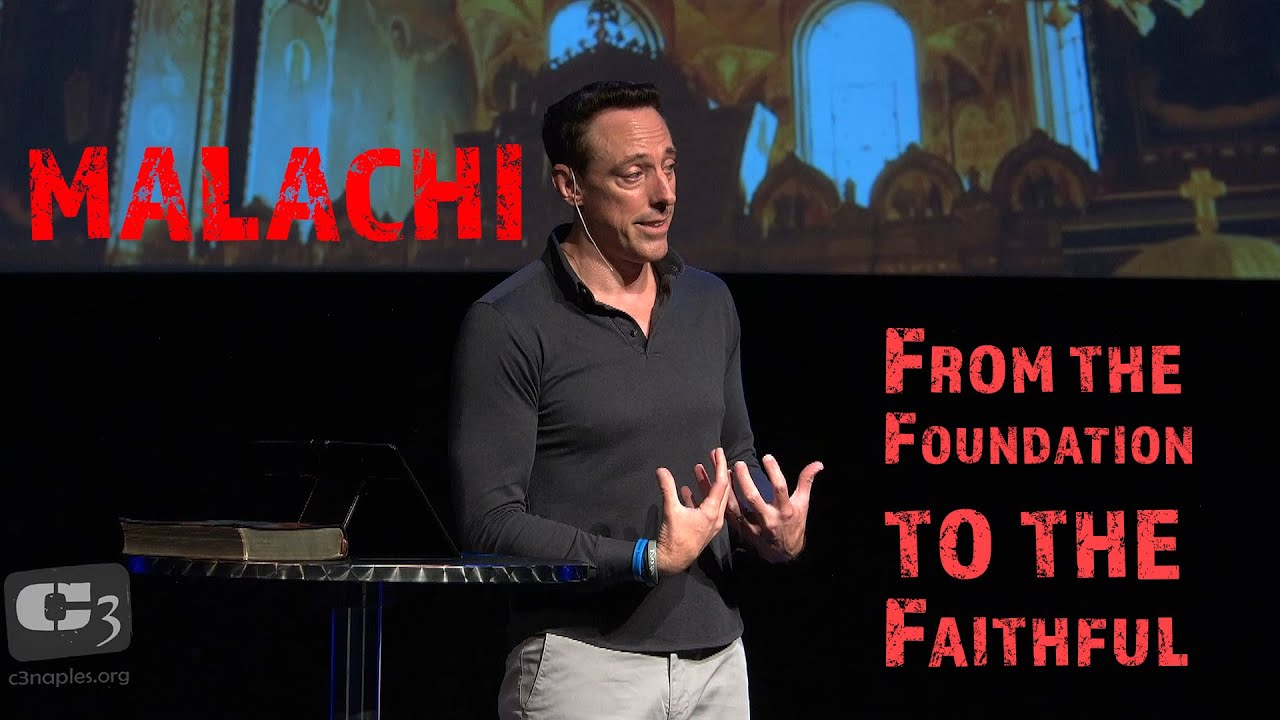
Malachi: From Foundation To Faith
This week we continue our Alpha & Omega series by moving from Haggai to Malachi—two prophets separated by a century, but united in one message: the Lord’s house must be more than built… it must be sustained.
In Haggai, God tells His people to build the temple. In Malachi, He tells them to return to Him and honor Him with their whole hearts—including their worship, their relationships, and yes, their resources.
Pastor Gene walks us through Malachi’s challenge to cold-hearted worship and shows how Jesus fulfills it in the New Testament. We see why generosity isn’t a fundraising tactic; it’s a sign of faith, a work of the Spirit, and part of returning to God with our whole lives.
If you’ve ever struggled with giving, misunderstood Malachi 3, or wondered what true biblical generosity looks like, this message will help you see God’s heart—not His demands.
Join us as we move from the foundation God built… to the faithful people He’s calling us to be.
In Haggai, God tells His people to build the temple. In Malachi, He tells them to return to Him and honor Him with their whole hearts—including their worship, their relationships, and yes, their resources.
Pastor Gene walks us through Malachi’s challenge to cold-hearted worship and shows how Jesus fulfills it in the New Testament. We see why generosity isn’t a fundraising tactic; it’s a sign of faith, a work of the Spirit, and part of returning to God with our whole lives.
If you’ve ever struggled with giving, misunderstood Malachi 3, or wondered what true biblical generosity looks like, this message will help you see God’s heart—not His demands.
Join us as we move from the foundation God built… to the faithful people He’s calling us to be.
Video can’t be displayed
Reader's Version
- Malachi: From Foundation to Faith
- Sermon by Gene Simco
- Reader’s Version
- I heard a story about a little boy attending church for the very first time. It was a traditional church, the kind with polished wooden pews instead of the comfortable chairs we enjoy at C3. They also passed around an offering basket—something we don’t typically do here, though as a pastor I’ll admit there are moments when I wonder whether we should. When the basket came to the boy, his father placed some money inside. The boy immediately protested, loudly enough for the entire row to hear …
- “Don’t pay for me, Daddy—I’m under five!”
- That little moment of innocence captures something deeper about the human heart. We resist cost. We assume someone else will cover it for us. And yet here we are, continuing through the books of the prophets, approaching a text that forces us to examine that very instinct. We have reached the final prophetic book in the Old Testament—the book of Malachi.
- To understand how we arrived here, it helps to know how the Old Testament is arranged. The Bible isn’t ordered like a modern biography. The first section, the Torah—Genesis through Deuteronomy—runs mostly in chronological order. Then come the historical books from Joshua through Esther. After that are the books of poetry and wisdom, stretching from Job through the Song of Songs. Finally, we reach the prophets, Isaiah through Malachi, and these books are not arranged chronologically at all. Jeremiah in particular jumps around in time, and many of the prophetic messages can be placed back into the historical period as events unfold.
- Malachi is traditionally positioned shortly after Ezra and Nehemiah, the same time period where we placed Haggai and Zechariah—after the seventy-year exile when a remnant of God’s people returned to rebuild the temple. We skipped over Zechariah earlier because Haggai fit thematically with where we were going. Chronologically, Malachi closes the Old Testament. But when we look at the traditional Christian canon—the Bible used by the early Church until the 1800s—there is really no such thing as an “intertestamental period.” Books like First and Second Maccabees cover that time and point directly toward Jesus, highlighting events like the Hanukkah festival that He Himself celebrated.
- Malachi is likely written about a century after Haggai and Zechariah. By this time, the temple had long been rebuilt. The work was done; the structure stood. But the people’s hearts were cooling. The priests had grown careless. The people had become complacent. Worship had devolved into habit instead of holiness. Under Haggai the call had been, “Serve the Lord’s house.” Under Malachi it becomes, “Sustain the Lord’s house.” One prophet addressed their labor; the other addresses their loyalty.
- Haggai called God’s people to build the Lord’s house. Malachi calls them to sustain it. A century after the temple rose, the foundation remained solid, but the faith of the people did not. Worship had drifted into routine, and devotion had thinned into leftovers. Malachi enters this moment as a loving but firm father, calling God’s children not merely back to a building, but back to the God who had restored them. From the foundation He laid, Malachi calls them to become the faithful people God desires.
- In modern terms, the people had learned how to work for God, but not how to worship Him with their resources. They served faithfully, but they gave sparingly—if they gave at all. This same tension runs straight through the Church today. Some serve with their time but never tithe. Others give financially but never serve. Only a few do both, and it is through that faithful remnant that the Kingdom advances. Malachi’s message is not condemnation but correction. A loving Father is calling His children to wholehearted devotion.
- So before we talk about money, we must remember this is about relationship. God does not say, “You’re stealing from the temple.” He says, “You’re robbing Me.” The issue is not economy—it is intimacy.
- When we step into Malachi 1:2–6, we hear the opening line that sets the emotional and theological tone for the entire book: “I have always loved you,” says the Lord. But you retort, “Really? How have you loved us?” And the Lord replies, “I have shown my love for you by loving your ancestor Jacob and rejecting his brother Esau. … The Lord says: The sons honor their father, and servants honor their master. If I am your Father and Master, where are the honor and respect I deserve?”
- God begins not with accusation but affection. “I have always loved you.” Yet the people answer with sarcasm: “How have You loved us?” Their spiritual blindness reveals that the problem isn’t doctrine—it’s gratitude. They cannot see God’s faithfulness because they are consumed with their own indifference.
- Malachi 1:7–8 continues the indictment: “You have shown contempt by offering defiled sacrifices on my altar. Then you ask, ‘How have we defiled the sacrifices?’ You defile them by saying the altar of the Lord deserves no respect. When you give blind animals as sacrifices, isn’t that wrong? And isn’t it wrong to offer animals that are crippled and diseased? Try giving gifts like that to your governor, and see how pleased he is!”
- The priests brought the leftovers, not the best. Worship had become convenience. Malachi reminds us that God rejects half-hearted sacrifice—not because He needs perfection, but because He deserves sincerity.
- The next movement addresses the priests directly. Malachi 2:1–4 declares: “Listen, you priests—this command is for you! Listen to me and make up your minds to honor my name,” says the Lord of Heaven’s Armies, “or I will bring a terrible curse against you. I will curse even the blessings you receive. Indeed, I have already cursed them, because you have not taken my warning to heart. I will punish your descendants and splatter your faces with the manure from your festival sacrifices, and I will throw you on the manure pile. Then at last you will know it was I who sent you this warning so that my covenant with the Levites can continue.”
- These are, admittedly, some of my favorite verses in the entire Bible. People often don’t realize that the Scriptures include God threatening to splatter manure in the faces of corrupt priests, yet there it is. It is jarring, graphic, and intentionally so. God is exposing the rot in leadership using imagery that matches the decay of their ministry.
- And that curse He mentions—remember it. It will matter later.
- In Malachi 2:7–9, the Lord continues: “The words of a priest’s lips should preserve knowledge of God, and people should go to him for instruction, for the priest is the messenger of the Lord of Heaven’s Armies. But you priests have left God’s path. Your instructions have caused many to stumble into sin. You have corrupted the covenant I made with the Levites, says the Lord of Heaven’s Armies. So I have made you despised and humbled in the eyes of all the people, for you have not obeyed me but have shown favoritism in the way you carry out my instructions.”
- The priests were supposed to be teachers, but they became performers—guardians of ceremony instead of shepherds of hearts. When spiritual leadership fails, generosity fails with it. A polluted pulpit always produces an anemic altar.
- Then comes Malachi 2:13–16: “Here is another thing you do. You cover the Lord’s altar with tears, weeping and groaning because He pays no attention to your offerings and doesn’t accept them with pleasure. You cry out, ‘Why doesn’t the Lord accept my worship?’ I’ll tell you why! Because the Lord witnessed the vows you and your wife made when you were young. But you have been unfaithful to her, though she remained your faithful partner, the wife of your marriage vows. Didn’t the Lord make you one with your wife? In body and spirit you are His. And what does He want? Godly children from your union. So guard your heart; remain loyal to the wife of your youth. For I hate divorce, says the Lord, the God of Israel. To divorce your wife is to overwhelm her with cruelty, says the Lord of Heaven’s Armies. So guard your heart; do not be unfaithful to your wife.”
- Malachi draws a direct parallel between marital unfaithfulness and spiritual unfaithfulness. When the covenant of love breaks down at home, it eventually breaks down at the altar—or vice versa. Their offerings were rejected because their hearts were divided.
- And the statement “I hate divorce” requires context if we’re going to handle it faithfully. When we go back to Ezra and Nehemiah, we discover that the same generation faced a crisis of intermarriage with foreign wives who were leading the people into idolatry. In those cases, God commanded separation. So Malachi’s words must be read within that framework. God hates the treachery, cruelty, and covenant-breaking at the root of divorce—but in other moments He commanded it to protect the covenant community from idolatry. Both sides of the coin must be seen together. Malachi is condemning a faithless people divorcing their Israelite wives while simultaneously pretending to worship sincerely.
- When we move into the next movement of Malachi’s message, we see the accusation that the people are robbing God. Chapter three opens with the announcement that God will send His messenger, though we will save that portion for the next section when we reach chapter four. For now, we look at the issue of “robbing God.”
- Malachi 3:6–7 declares:
- “I am the Lord, and I do not change. That is why you descendants of Jacob are not already destroyed. Ever since the days of your ancestors, you have scorned my decrees and failed to obey them. Now return to Me, and I will return to you,” says the Lord of Heaven’s Armies. “But you ask, ‘How can we return when we have never gone away?’”
- Malachi begins this section not with accusation but with grace. God’s immutability—His unchanging nature—is the only reason His people have not already been consumed by His justice. His invitation is not to pay, but to return.
- Now, you may have heard the more famous verses that follow. Malachi 3:10 reads:
- “Bring all the tithes into the storehouse so there will be enough food in My Temple. If you do,” says the Lord of Heaven’s Armies, “I will open the windows of heaven for you. I will pour out a blessing so great you won’t have enough room to take it in! Try it! Put Me to the test!”
- But in the spirit of “keep reading,” we must look at the surrounding context. So we back up to verse eight and read the fuller passage.
- Malachi 3:8–10 says:
- “Should people cheat God? Yet you have cheated Me! But you ask, ‘What do you mean? When did we ever cheat You?’ You have cheated Me of the tithes and offerings due to Me. You are under a curse, for your whole nation has been cheating Me. Bring all the tithes into the storehouse so there will be enough food in My Temple. If you do,” says the Lord of Heaven’s Armies, “I will open the windows of heaven for you. I will pour out a blessing so great you won’t have enough room to take it in! Try it! Put Me to the test!”
- A few things should be immediately noticed:
- These are a people who are cheating God, and they are under a curse. Remember—this same curse language was used toward the priests earlier. And this passage is one of the most misused texts in Scripture, often wielded as if God is offering a transactional deal: you give, God gives more. But Malachi is not addressing faithful believers hoping to honor God. He is rebuking corrupt priests and a greedy nation. Their curse was agricultural drought, not spiritual condemnation. And the so-called “test” is not an invitation to manipulate God; it is irony—God exposing their faithlessness.
- If we keep reading, the point becomes unavoidable. Malachi 3:13–15 reads:
- “You have said terrible things about Me,” says the Lord. But you say, “What do you mean? What have we said against You?” “You have said, ‘What’s the use of serving God? What have we gained by obeying His commands or by trying to show the Lord of Heaven’s Armies that we are sorry for our sins? From now on we will call the arrogant blessed. For those who do evil get rich, and those who dare God to punish them suffer no harm.’”
- Here God reveals the heart of the problem: spiritual cynicism. They were giving—but expecting profit. They treated generosity as an investment, not worship. This is the root of prosperity theology even today: a transactional faith that measures blessing by bank account.
- We’ll return to this later, but note this: the “test” is not a command but a challenge thrown at a rebellious people. Later, testing God is explicitly called wicked. Jesus rejects this idea outright. Matthew 4:7 says: “You must not test the Lord your God.” To preach “test God by giving” is to repeat the very sin Malachi condemned.
- By the time we reach chapter four, the remnant appears. But before we go there, we must remember what God actually said in Malachi 3:7: “Return to Me.” He is not asking them to fund a program. He is calling their hearts home.
- Jesus picks this up perfectly: “Where your treasure is, there your heart will also be” (Matthew 6:21).
- Malachi calls them to return. Jesus tells us how the heart returns—by leading with our treasure.
- This means giving is not God raising money; it is God raising children. Where your treasure goes, your heart goes. Returning to God begins with returning your treasure to God.
- Malachi 3:16–18 closes this section:
- “Then those who feared the Lord spoke with each other, and the Lord listened to what they said. In His presence, a scroll of remembrance was written to record the names of those who feared Him and always thought about the honor of His name. ‘They will be My people,’ says the Lord of Heaven’s Armies. ‘On the day when I act in judgment, they will be My own special treasure. I will spare them as a father spares an obedient child. Then you will again see the difference between the righteous and the wicked, between those who serve God and those who do not.’”
- Here a faithful remnant emerges—a people who honor God without expecting return. Their names are written in a scroll of remembrance, a precursor to the Book of Life. These are not the ones who test God but the ones who trust Him.
- The distinction becomes clear:
- The wicked test God through greed.
- The righteous trust God through gratitude.
- In chapter four, we finally see revealed what was introduced briefly at the beginning of chapter three. This becomes the bridge into the New Testament, where the promised “Elijah figure” is fulfilled in John the Baptist, who prepares the way for Jesus. True repentance always shows up in relationships. It produces restored hearts, not just repaired budgets. And for the purpose of this transcript, this section functions as an Alpha and Omega connection.
- Malachi 4:5–6 says, “Look, I am sending you the prophet Elijah before the great and dreadful day of the Lord arrives. His preaching will turn the hearts of fathers to their children, and the hearts of children to their fathers.”
- When we move into the New Testament, the fulfillment becomes unmistakable. Luke 1:16–17 tells us, “And he will turn many Israelites to the Lord their God. He will be a man with the spirit and power of Elijah. He will prepare the people for the coming of the Lord.”
- Jesus confirms this identification Himself. Matthew 11:10, 14 says, “John is the man to whom the Scriptures refer when they say, ‘Look, I am sending my messenger ahead of you, and He will prepare your way before you.’ … And if you are willing to accept what I say, he is Elijah, the one the prophets said would come.”
- Malachi closes the Old Testament with God’s final prophetic word: a messenger is coming. The Gospels open by telling us that the messenger has arrived. John the Baptist steps onto the stage as the forerunner, sent to prepare Israel for her King. Malachi’s call to “return to Me” in Malachi 3:7 becomes John’s cry in the wilderness: “Repent, for the Kingdom of Heaven is near.” Their messages form one continuous call.
- And here the connection to Haggai shines through with surprising clarity. In the days of Haggai, God commanded His people to rebuild the Lord’s house. In the days of John the Baptist, God commanded His prophet to prepare a people for the Lord’s arrival. John fulfills that same supportive role—making the path straight, preparing hearts, and calling God’s people to turn back to Him. John proclaimed the first coming of Jesus. The Church now proclaims His return. We continue the forerunner mission.
- In every age, God calls His people to prepare the way—hearts first, then hands, then resources. Supporting the Lord’s house, whether temple, tabernacle, or Church, has always been the work of those who expect a King.
- We focused last week on what the house of the Lord does. This week we are talking about why it needs to be supported and what that means for us. Under Haggai, the call was serve the Lord’s house—build it. Under Malachi, the call becomes sustain the Lord’s house. Anyone who has ever owned a home understands the shift. Once you build it, you must support it. Once the walls rise, the bills arrive. Everything requires ongoing care.
- We have answered the call. We are in position. But these things—simply put—require monetary support. Every ministry here depends on some kind of financial investment. This is not about excess, and it is not about anyone getting rich. We are very frugal in how we operate at C3 Church, but ministry still costs money. This is not about wealth for individuals. It is about the love of this family and the nurturing of Christ’s body so that the vital work of spreading the Gospel and changing lives—just as it changed mine—can continue unbroken.
- Before going any further, I want to begin with a word of gratitude. I want to acknowledge our Philemons and our Phoebes, our Lydias—those who support faithfully and sacrificially. Many benefactors in this church are doing the quiet, steady work of sustaining ministry. To those who give faithfully here, simply put, thank you. Your generosity keeps the Lord’s house active: a café that fosters fellowship every Sunday; a building open for AA groups that often become bridges to Christ; a media ministry that sends the Gospel far beyond Naples. You are fueling worship, community, and mission.
- Recently, I talked about preaching like Jesus. We are commanded to preach as He did, and we see that command woven throughout Scripture. We’ve looked at that in the past. But I also pointed out what inevitably happens when you do so. I’ve used hyperbole before—saying “no one liked Jesus”—but the point holds. Jesus ends up with twelve apostles who stay close, but in John 6, when He challenges the crowds to eat His flesh and drink His blood, nearly everyone except the disciples walks away. At the end of His ministry, He is left at the cross with maybe John, and of course the faithful women. The crowds that loved His miracles did not love His message.
- And yes, the early church in Acts grew quickly and with great power, but they also experienced persecution that scattered them. That scattering wasn’t random—it happened because they were not fulfilling Jesus’ command to go out. They had become comfortable staying in one place. So the same dynamic appears today. When you live under truth, when you teach truth, the crowd almost always gets smaller. People scatter. So, like the early church, we are a tight-knit family—and everyone’s support is necessary.
- And this is part of why we’re a tight-knit small church. It isn’t because something is wrong—it’s because we preach the gospel the way Jesus commanded us to preach it. When you preach like Jesus, your crowd shrinks before it grows. That’s exactly what happened in His ministry. In Luke 9, when Jesus sends out the Twelve, He sends them out to preach the exact same message He preached: repent, believe, obey. Not an easier version. Not a softer version. And when they obeyed, they met the same resistance He met.
- By the time we reach John 6, Jesus preaches a message so hard that almost everyone leaves. He feeds five thousand people, draws a massive crowd, and then He tells them the truth about discipleship—that they must eat His flesh and drink His blood. And the text says that from that moment, many of His disciples turned back and no longer followed Him. The following of Jesus gets smaller, not bigger, when He tells them the cost of obedience.
- Paul shows the same pattern. In Acts, the church explodes, but as soon as they get comfortable, persecution scatters them. God does it to push them back into mission. And Paul warns Timothy in 2 Timothy 4 that a time will come when people will not tolerate sound teaching. Instead, they will gather teachers who tell them what their itching ears want to hear. In 1 Timothy 4 and Titus 1, he says the same thing—real gospel preaching will always offend the world, and the church will always be tempted to soften the truth to win the crowd.
- But Jesus never softened the truth, and neither did Paul. Jesus ends His ministry at the cross with only a handful of faithful followers—John, His mother, and a few women. That’s it. The crowds who celebrated Him on Sunday abandoned Him by Friday. That’s what preaching the truth produces.
- So when people wonder why we’re small, the answer is simple: because we’re not trying to be a crowd—we’re trying to be a church. When you preach the gospel as Jesus commanded in Matthew 28, when you teach everything He taught instead of just the comfortable parts, when you follow Paul as he follows Christ in 1 Corinthians 11 and Philippians 3, the result is always the same. You get a faithful remnant, not a fan club. You get disciples, not spectators. You get a family, not an audience.
- And that’s why generosity matters. A faithful church—a church that preaches truth, not ear-tickling—depends on faithful people. It was true for Jesus’ ministry. It was true for the church in Acts. It was true for Paul’s churches. And it’s true for us. When you preach the real gospel, you may not build a crowd, but you will build a family. And that’s exactly the kind of church Jesus told us to be.
- So we return to the early church to see what their lives looked like. Acts 2:42–45 says, “All the believers devoted themselves to the apostles’ teaching, and to fellowship, and to sharing in meals, and to prayer. A deep sense of awe came over them all, and the apostles performed many miraculous signs and wonders. And all the believers met together in one place and shared everything they had. They sold their property and possessions and shared their money with those in need.”
- People often focus on the miraculous signs, but Scripture highlights something equally miraculous—their generosity. Generosity is a sign of the Holy Spirit. In the book of Acts, it is presented as one of the first evidences of the Spirit’s work. It appears again in Acts 4:32–35: “All the believers were united in heart and mind. And they felt that what they owned was not their own, so they shared everything they had. The apostles testified powerfully to the resurrection of the Lord Jesus, and God’s great blessing was upon them all. There were no needy people among them, because those who owned land or houses would sell them and bring the money to the apostles to give to those in need.”
- Notice the language: there were no needy people among them. This wasn’t casual generosity. It was extreme. And notice something else—they laid their gifts at the apostles’ feet. The point wasn’t control; it was faith. They trusted their spiritual leadership to distribute as God directed.
- On the other side of that trust stands a sobering warning. When we continue into Acts 5, we see Ananias and Sapphira attempting to deceive the apostles. They sold a piece of property and kept back part of the money while pretending to give the full amount. In their confrontation with Peter, he tells them they have not lied to men but to the Holy Spirit. Both are struck dead—one after the other. It is one of the starkest moments in the New Testament, revealing just how seriously God treats generosity and integrity.
- And I will say this gently but honestly: for pastors who misuse Malachi 3:10 to pressure people into giving, if they were going to pull something out of context, they would be better off using Acts 5. If you wanted an example of punishment for not giving properly, Ananias and Sapphira would fit the bill—death for deceit. But of course, we do not apply that universally to all believers, nor should we. The point is that Scripture handles generosity with depth, weight, and seriousness—not manipulation.
- Now, along those same lines, we’ve been talking about the many mainstream church problems. One of the biggest issues is that churches either misuse Malachi 3:10 the way we’ve been discussing, or people swing in the opposite direction and assume that giving to the church is optional—as if the New Testament never commands generosity. But the truth is that generosity is a New Testament command, not an option.
- Last week we looked at the temple and how, under the new covenant, we are the temple of the Holy Spirit. God’s presence is not housed in a building anymore, but the work of the Gospel still requires the same thing it always has: the support of the people who worship the Lord. Paul makes this connection explicitly in 1 Corinthians 9:13–14, reaching back to Old Testament temple practices and pulling them forward into the life of the church: “Don’t you realize that those who work in the Temple get their meals from the Temple? And those who serve at the altar get a share of the sacrificial offerings. In the same way, the Lord ordered that those who preach the Good News should be supported by those who benefit from it.”
- This isn’t Paul asking for money. In the surrounding verses, he makes it clear he personally refused support so no one could accuse him of seeking gain. And this certainly isn’t a pastor saying, “Pay me.” This is Paul showing continuity between temple worship in the Old Testament and Gospel ministry in the New. The principle didn’t change; the purpose did. In the Old Testament, the priests served the temple. In the New Testament, ministers serve the Gospel. And Jesus Himself is the One who ordered that those who preach should be supported—not for themselves but for the work of the Good News.
- This protects the mission, not the minister. Paul isn’t arguing for personal comfort; he is arguing for continuity. Just as the temple was sustained by the faithful, the Gospel is sustained in exactly the same way by those who believe in it. This isn’t about personalities; it’s about participating in the work of God, just like the people did in Haggai, and just like the early church did in Acts 2, Acts 4, and beyond. The beauty of Paul’s teaching is found here: it is not about paying a person. It is about fueling the mission of the Spirit through the temple that God is building in us and through us. This is why the Lord ordered that the church support the work of the Gospel.
- Paul reinforces this again in Galatians 6:6: “Those who are taught the word of God should provide for their teachers, sharing all good things with them.” Paul doesn’t frame generosity as a suggestion or as a charitable idea. He presents it as a command woven into discipleship. Those who receive spiritual nourishment are called to respond with practical support—not because pastors need something, but because the Gospel demands participation, not spectatorship. Giving is not God raising money; it is God raising disciples. Supporting the church is not “helping the church out.” It is obeying the teaching of Christ and His apostles with open hands and a willing heart. This is how the New Testament Church lived. This is how the Gospel moves forward. And this is how we honor the Lord who gave everything for us.
- Last week we also looked at 1 Timothy, and how pastors equip the church for the mission. Paul gives another command in 1 Timothy 6:17–18: “Teach those who are rich in this world not to be proud and not to trust in their money, which is so unreliable. Their trust should be in God, who richly gives us all we need for our enjoyment. Tell them to use their money to do good. They should be rich in good works and generous to those in need, always being ready to share with others.” Here we see another explicit command about giving.
- But here’s the temptation: as soon as passages like this are read, people assume only the rich need to give—as if the wealthy will cover everything. “Someone else has it” seems spiritual on the surface, but it does not work practically or spiritually. Returning to the practical realities of our own community, we are a tight-knit, small church. Everyone’s participation is needed. Spiritually, the same truth holds: the woman with the two coins did not get a pass.
- If you read the Scriptures carefully, Jesus applauds the poor who give. He never says, “Leave it to the wealthy.” When we come to Mark 12, we see a series of conversations—the parable of the vineyard workers, the exchange over paying taxes to Caesar, Jesus’ rebuke of their greed, and then the questions from the Sadducees. We move through the most important commandment and then arrive at the moment with the widow.
- Mark 12:41–44 tells us: “Jesus sat down near the collection box in the Temple and watched as the crowds dropped in their money. Many rich people put in large amounts. Then a poor widow came and dropped in two small coins. Jesus called His disciples to Him and said, ‘I tell you the truth, this poor widow has given more than all the others who are making contributions. For they gave a tiny part of their surplus, but she, poor as she is, has given everything she had to live on.’”
- Jesus does not praise her because she was poor. He praises her because she refused to excuse herself from obedience. Everyone else gave out of comfort; she gave out of faith. Jesus never said, “Leave giving to the wealthy.” He said that the smallest act of faith outweighs the largest act of convenience. In Malachi, God rebuked people for giving leftovers. In Mark 12, Jesus honors a woman who gives Him her life.
- This is the heart of New Testament generosity—not equal amounts, but equal sacrifice. Not what you give, but how you trust.
- So the Scriptural problems with the idea that “the rich have got it covered” are obvious. But now we need to look at the personal problems with that mindset.
- Shape
- Giving is an exercise of faith. When we look at the book of Second Corinthians, we see that Paul is dealing with two major issues. The first is that the Corinthians are dragging their feet on a collection they already promised to complete. The second is the presence of false teachers—something we see all over the New Testament. Paul even mocks these opponents by calling them “super-apostles,” highlighting the absurdity of their self-promotion. Into this situation he writes about the churches in Macedonia.
- 2 Corinthians 8:1–5 says: “Now I want you to know, dear brothers and sisters, what God in His kindness has done through the churches in Macedonia. They are being tested by many troubles, and they are very poor. But they are also filled with abundant joy, which has overflowed in rich generosity. For I can testify that they gave not only what they could afford, but far more. And they did it of their own free will. They begged us again and again for the privilege of sharing in the gift for the believers in Jerusalem. They even did more than we had hoped, for their first action was to give themselves to the Lord and to us, just as God wanted them to do.”
- So again, the command stands for both the rich and the poor. But here we see why giving is described as a grace—it is an act of faith. It requires letting go of what normally has a hold on us. We already saw this when Paul instructed Timothy in First Timothy 6: don’t put your trust in your money.
- If we back up a bit, Paul’s warning becomes even sharper. Before instructing the wealthy, he warns Timothy about false teachers—just like he does in Second Corinthians. Some people were teaching for profit, using religion as a means to get wealthy. Into that context Paul writes:
- 1 Timothy 6:6–11: “Yet true godliness with contentment is itself great wealth. After all, we brought nothing with us when we came into the world, and we can’t take anything with us when we leave it. So if we have enough food and clothing, let us be content. But people who long to be rich fall into temptation and are trapped by many foolish and harmful desires that plunge them into ruin and destruction. For the love of money is the root of all evil. And some people, craving money, have wandered from the true faith and pierced themselves with many sorrows. But you, Timothy, are a man of God; so run from all these evil things. Pursue righteousness and a godly life, along with faith, love, perseverance, and gentleness.”
- Notice something important: Paul calls Timothy a man of God. Timothy is the only person in the entire New Testament who receives that title. And it is crucial because some prosperity-theology circles claim that “a man of God should be rich.” Yet the New Testament says the exact opposite. Paul says to flee from the love of money. Literally run from it.
- And when Paul writes “the love of money is the root of all evil,” the Greek text does not say “all kinds of evil.” It says all evil (παντων των κακων, pantōn tōn kakōn). It likely functions as hyperbole, but the hyperbole has a point. Paul is showing how powerful the desire for wealth can be in destroying faith, compromising character, and drawing a person away from Christ. The contrast is intentional: run from greed, pursue faith.
- That is the point here. Giving is an exercise of faith because it loosens the grip of what normally holds us. It declares that our security is in God, not in our bank accounts. It reforms our desires. It trains our hearts to trust.
- Paul ties this directly to spiritual self-examination. In 2 Corinthians 13:5 he writes: “Examine yourselves to see if your faith is genuine. Test yourselves. Surely you know that Jesus Christ is among you; if not, you have failed the test of genuine faith.”
- Giving becomes one of the ways we examine, exercise, and test our faith. It is not about the size of the gift but the posture of the heart. When we give, we are testing whether our faith is real, living, and active—or merely theoretical.
- So the question becomes: what should we give?
- To answer that, we revisit Malachi 3—not to guilt anyone, but to correct the misuse of this text and anchor ourselves in New Testament generosity. When we look again at Malachi 3:8–10, the text says, “But you ask, ‘What do you mean? When did we ever cheat you?’ You have cheated Me of the tithes and offerings due to Me. You are under a curse, for your whole nation has been cheating Me. Bring all the tithes into the storehouse so there will be enough food in My Temple. If you do,” says the Lord of Heaven’s Armies, “I will open the windows of heaven for you. I will pour out a blessing so great you won’t have enough room to take it in! Try it! Put Me to the test!”
- Now let’s look carefully at the problems behind the misuse of these verses. First, the context. God is rebuking greedy, corrupt worshipers and corrupt priests—not rewarding faithful believers with a vending-machine promise. Second, the “test” Malachi mentions is something he soon calls wicked (3:15), and Jesus explicitly condemns the practice: “You must not test the Lord your God” (Matthew 4:7). So whatever is happening in Malachi 3, it is not permission for believers to test God with their money.
- If we keep reading, the clarification becomes obvious. There is also the issue of the Law versus the Gospel. Using Malachi 3 as a law to extract money from God’s people misapplies the text entirely. The New Testament is clear that we are not under the Law of Moses. When a pastor does this, they unintentionally repeat the very error Peter confronts in Acts 15—it was a yoke “neither we nor our ancestors could bear.” Putting God’s people back under that yoke is exactly what the apostles condemned.
- There is also the matter of what this misuse encourages: greed. “Give to get” preaching fuels covetousness, which the New Testament calls idolatry. Colossians 3:5 makes that abundantly clear. 1 Timothy 6:9–10 does the same. So besides being bad exegesis, it’s spiritually dangerous.
- Then we consider the genre of Malachi. The language about barns, droughts, and floodgates is prophetic hyperbole designed to confront a hardened people. There is no Christian investment formula buried in this text. From any angle—historical, literary, covenantal—it simply does not support the modern misuse.
- So if that is what Malachi is addressing, what does the New Testament teach?
- Jesus commends the widow who gave everything she had. Acts shows believers giving in such a way that “there were no needy people among them.” Both go far beyond a simple ten-percent box to check. When pastors misuse Malachi 3, I honestly think they are shortchanging themselves. Paul says each must decide in his own heart, and that God loves a cheerful giver. There is a “reap what you sow” argument, and Paul uses it—but like Malachi, he is addressing a group struggling with generosity. Used wrongly, this argument encourages greed instead of faith.
- Again, Colossians 3 tells us a greedy person is an idolater. So we look again at Paul’s teaching in Second Corinthians:
- 2 Corinthians 9:6–11: “Remember this—a farmer who plants only a few seeds will get a small crop. But the one who plants generously will get a generous crop. You must each decide in your own heart how much to give. And don’t give reluctantly or in response to pressure. For God loves a person who gives cheerfully. And God will generously provide all you need. Then you will always have everything you need and plenty left over to share with others. As the Scriptures say, ‘They share freely and give generously to the poor; their good deeds will be remembered forever.’ For God is the one who provides seed for the farmer and then bread to eat. In the same way, He will provide and increase your resources and then produce a great harvest of generosity in you. Yes, you will be enriched in every way so that you can always be generous. And when we take your gifts to those who need them, they will thank God.”
- Notice what Paul does here. He uses a similar argument to Malachi, but again, he is speaking to a people struggling to give. And notice how he turns the whole conversation around. The repetition of that word “generous” is intentional. Paul states the true purpose plainly: you will be enriched so that you can always be generous. The harvest he promises is a harvest of generosity—not a guarantee that God will give you whatever you want.
- And yet, the principle of sowing and reaping still stands. If you are not seeing fruit, it may be because you have not planted any seeds. Practically speaking, the same people who refuse to give are often the ones praying for financial blessing, new jobs, or relief. But if we are not willing to support the Lord’s house, why would God entrust us with more?
- So what should we give? In light of everything we have seen, ten percent is a good place to start. For the church, it is a floor, not a ceiling. The New Covenant pattern is sacrificial generosity—free of manipulation and full of joy. That is why I set my personal tithing as a floor for my own giving. Not so one hand knows what the other is doing, or to boast, but to lead by example. I have it taken out every week by direct deposit. Before I even see that money, it’s an act of faith that says, “Lord, I trust You first.” No matter what happens in my finances, I want to be faithful with my finances. My whole family practices this. The moment my daughter began earning money, she immediately began tithing. It was a command in our home, not a suggestion.
- So to the faithful givers, thank you. Keep excelling in this grace. Your giving is worship. It bears global fruit—our café hospitality, a building that hosts AA groups and invites people to Christ, and the media ministry that sends the Word online. To those who give but don’t serve, remember what we talked about last week: your generosity is fueling the mission. But I want to invite you to step into that mission so you can see the impact God is making through your gift and disciple those who walk alongside you.
- To those who serve but don’t give, your service is precious, but ministry also requires resources. Completing your worship with generosity doesn’t diminish your serving—it multiplies your impact, and it fulfills something Jesus actually commanded. He said, “If you love Me, obey My commands.” And this is one of them. If you love His body, you will nourish it. If you love what the Lord’s house does, you will help sustain it. If everyone took ownership like that, we would be flourishing even more than we already are.
- As a practical matter, it is said that a thousand churches this year will close. Many Christians grieve it, but I wonder how many of those same Christians gave to their churches. You could think of it like a restaurant. Imagine going to your favorite restaurant—the meal is great—but you decide to slip out the back door without paying. Then you go back again, and this time you get caught and are told to wash dishes. Eventually you start thinking, “Well, I’ll just wash the dishes every week instead of paying.” But that doesn’t work, because washing dishes doesn’t pay the bills. If you love something, you support it. If it nourishes you, you contribute to it.
- You wouldn’t dine every week at one of your favorite restaurants and never help keep the lights on. So if the Lord’s house feeds your soul and serves your city, you should support it. People spend money on what matters to them. If you have a favorite restaurant, you pay for the meal. People pay for video games. People pay for Netflix. People pay for alcohol—all things we don’t need. So the question becomes: is the Lord’s house more important to you than those things? Or, if we’re being honest, less important?
- And here’s something worth thinking about. There will always be an excuse not to give. That’s the bad fear. The good fear—the fear Scripture commends—is the fear of the Lord, which is the beginning of wisdom. It’s all over the Bible. But the bad fear is the fear that stops faith from acting.
- We have to exercise our faith. So let me offer some practical steps: pray, prioritize, and plan. Try giving that ten percent. Make room in your budget. Remove things that are probably not godly at all. Ask yourself honestly what is distracting you from the Lord. Remove the fears that stop obedience. Take a real look at your budget and see what you might be prioritizing over Him.
- And automate your integrity. Set up recurring giving so generosity leads your month, not your leftovers. It is a powerful way to exercise your faith—to declare before God that no matter what happens in your finances, you’re putting Him first.
- Pair giving with serving. Choose one ministry lane—café, greeting, media, prayer—and one giving commitment. Put your hands and your heart together. Learn the mission. Spend some time in service and really learn what we do here at C3 Church.
- The foundation is here, but God is not looking for walls. He’s looking for faithful hearts. Malachi does not end with shame. It ends with a Father saying, “Return to Me”—not to a system, not to a building, but to Him. That is the call today. Not, “Give more money.” Not, “Work harder.” But step out of leftovers and into faithfulness. Because generosity is not a bill to pay—it is a pathway back. It is a sign that our hearts are moving toward the God who gave everything for us.
- When we give, when we serve, when we sustain the Lord’s house, we are saying, “God, You have all of me—my heart, my hands, my life.” And the good news is this: God takes ordinary, imperfect people and makes them into a faithful family. A family that prays together. A family that serves together. A family that gives together. A family that supports the work of the gospel so more people can hear the name of Jesus and come to Him.
- This is how we move from the foundation He laid to the faithful people He is calling us to be. So let’s return to Him with joy. Let’s trust Him with our treasure. Let’s step into a faith that fuels the house of the Lord and watch what God builds next.
- ________________________________________
- ©️ Copyright 2025 Gene Simco Most Scripture quotations are taken from the Holy Bible, New Living Translation, copyright ©1996, 2004, 2015 by Tyndale House Foundation. Used by permission of Tyndale House Publishers, Carol Stream, Illinois 60188. All rights reserved. Scriptures in brackets reflect the original Biblical languages.