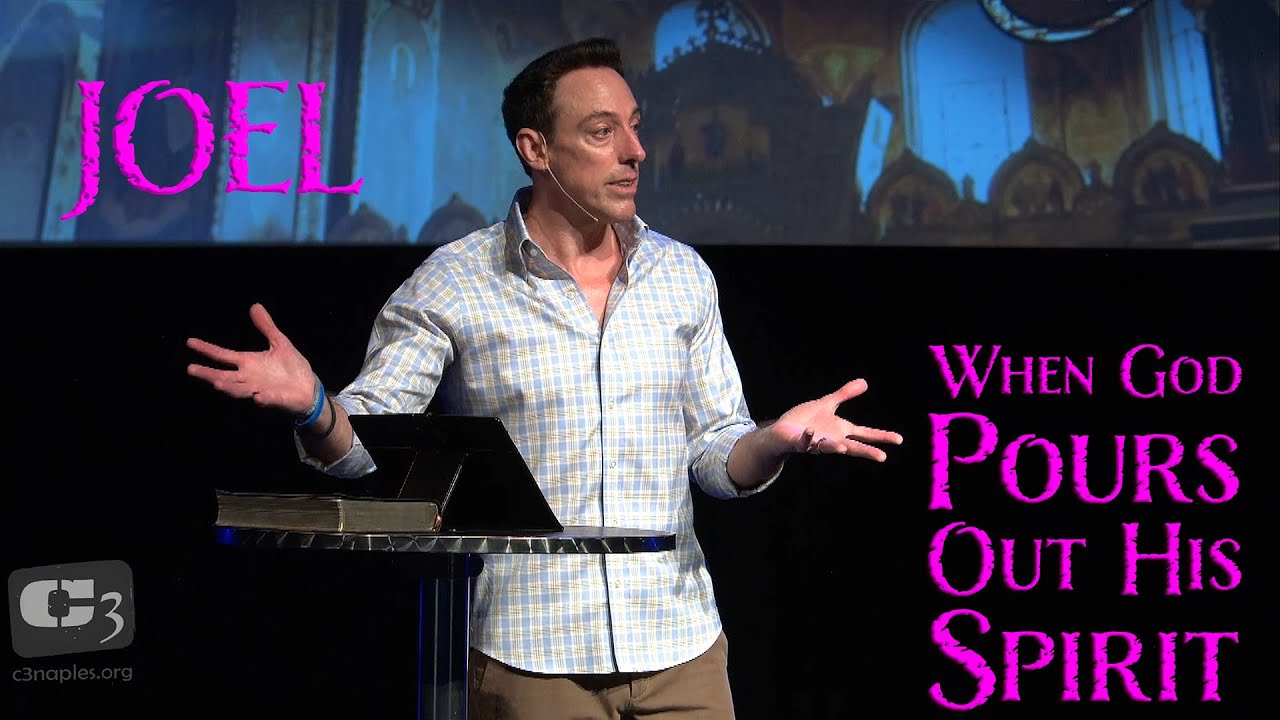
Joel - When God Pours Out His Spirit
In Joel, a plague of locusts warns of God’s judgment, but the prophet also promises restoration and the outpouring of God’s Spirit. At Pentecost, that promise was fulfilled as the Spirit came with power, reversing Babel and uniting the nations. Today, Pastor Gene Simco reminds us that the Spirit is not about hype or confusion but about sealing us as God’s children, giving us gifts to serve, and producing fruit as evidence of His work. The fire that fell at Pentecost still burns in God’s people—you are sealed, gifted, and empowered to walk in His Spirit.
Video can’t be displayed
Reader's Version
- Joel: When God Pours Out His Spirit
- Sermon by Gene Simco
- Reader’s Version
- It has been said that some Christians are like wheelbarrows—they must be pushed. Others are like trailers—they must be pulled. Some are like canoes, always in need of paddling. Still others are like footballs—you never know where they’re going to bounce next. And some are like balloons, filled with hot air and ready to blow up.
- But today, we’re going to look at what Christians should be filled with.
- We’ve just come through the prophet Hosea, and now we continue in the prophetic books of the Bible. Most of these prophets fit within the timeline of 2 Kings and 2 Chronicles. Today, we turn to the book of Joel. This book is not easy to pin down in history—some place it in the days of Elijah, others after the exile—but what is clear is that Joel is speaking to the southern kingdom, to Judah.
- Have you ever noticed how something small can cause massive disruption? A few ants can ruin a picnic. A few termites can bring down a house. Joel opens with just such a picture—a swarm of locusts, tiny creatures capable of wiping out an entire nation’s economy. But Joel’s prophecy isn’t ultimately about insects. It’s about how God uses crisis to wake us up to eternal realities. The locust plague was only a preview of the real crisis: the coming Day of the Lord. Yet Joel does not leave us in despair. His prophecy points to hope—restoration, the outpouring of the Holy Spirit, and God’s eternal dwelling with His people.
- As the book opens, the first chapter gives us this devastating image: a swarm of locusts stripping the land bare. This was more than an agricultural crisis—it was a sign of God’s judgment. Joel calls priests, farmers, and all the people to lament and fast because sin has led to devastation. The locust plague is a vivid picture of what happens when God’s people drift into complacency and rebellion. Destruction comes swiftly and leaves nothing behind. The lesson is simple but urgent: wake up, cry out to God, and take seriously the consequences of sin.
- Joel 1:4
- After the cutting locusts finished eating the crops, the swarming locusts took what was left! After them came the hopping locusts, and then the stripping locusts, too!
- Joel 1:14
- Announce a time of fasting; call the people together for a solemn meeting. Bring the leaders and all the people of the land into the Temple of the Lord your God, and cry out to Him there.
- In our second movement, Joel shifts from the devastation of the locust plague to something far greater: the Day of the Lord. The plague was only a preview of what is to come. This day will be marked by God’s power, by cosmic signs, and by the terror of His judgment.
- Yet in the middle of this frightening vision, there is hope. God pleads with His people not just to tear their garments in ritual mourning, but to tear their hearts in genuine repentance. The Day of the Lord reveals both God’s justice against sin and His eagerness to show mercy when His people return to Him.
- Joel 2:1
- Sound the alarm in Jerusalem! Raise the signal on my holy mountain! Let everyone tremble in fear because the day of the Lord is upon us.
- Joel 2:13
- Don’t tear your clothing in your grief, but tear your hearts instead. Return to the Lord your God, for he is merciful and compassionate, slow to get angry and filled with unfailing love. He is eager to relent and not punish.
- The locust plague was only a foreshadowing—the real Day of the Lord is coming. God is merciful, but He desires genuine heart repentance, not empty rituals.
- Shape
- In our third movement, we see God’s response: restoration and the Spirit’s outpouring. After the call to repentance, God promises restoration. The same God who allowed the locusts to strip the land will restore the harvest, heal the land, and bless His people. But His promise goes far beyond material restoration. He declares that He will pour out His Spirit on all flesh. Sons and daughters will prophesy, old men will dream dreams, and young men will see visions. The Spirit will not be limited by gender or social status.
- This prophecy looks forward to Pentecost, when God’s Spirit would empower His people for mission and ministry.
- Joel 2:25
- The Lord says, “I will give you back what you lost to the swarming locusts, the hopping locusts, the stripping locusts, and the cutting locusts. It was I who sent this great destroying army against you.”
- Joel 2:28–29
- “Then, after doing all those things, I will pour out my Spirit upon all people. Your sons and daughters will prophesy. Your old men will dream dreams, and your young men will see visions. In those days I will pour out my Spirit even on servants—men and women alike.”
- Shape
- Finally, in our fourth movement, Joel gives a vision of final judgment and God dwelling with His people. He closes with the nations gathered for judgment in the Valley of Decision. God will execute justice on those who have oppressed His people. Yet while the nations face judgment, God’s people are promised security, blessing, and His abiding presence in Zion.
- The final word is not destruction, but hope—God Himself will dwell with His people, and Jerusalem will be made holy forever. The prophecy looks forward to both God’s decisive judgment and His eternal kingdom, fulfilled in the reign of Christ.
- Joel 3:14
- Thousands upon thousands are waiting in the valley of decision. There the day of the Lord will soon arrive.
- Joel 3:17
- “Then you will know that I, the Lord your God, live in Zion, my holy mountain. Jerusalem will be holy forever, and foreign armies will never conquer her again.”
- The nations face judgment, but God’s people are promised eternal security. The final vision is this: God Himself dwelling with His people forever.
- Joel shows us the seriousness of sin, the urgency of repentance, and the hope of God’s Spirit and final restoration. But his prophecy does not stop in the Old Testament. It stretches forward into the New Testament and finds its ultimate fulfillment in Christ and Pentecost.
- This brings us to our Christophanies and Fulfillments.
- Shape
- Locust Plague as Judgment
- Joel 1:4
- After the cutting locusts finished eating the crops, the swarming locusts took what was left! After them came the hopping locusts, and then the stripping locusts, too!
- Revelation 9:3
- Then locusts came from the smoke and descended upon the earth, and they were given power to sting like scorpions.
- Joel’s locust plague foreshadows God’s future judgment, echoed in Revelation’s imagery. Both show that when humanity rebels, God allows creation itself to become an instrument of His judgment. The locusts represent devastation and chaos unleashed by sin, reminding us that judgment is both present in history and yet still to come.
- Shape
- The Day of the Lord
- Joel 2:1
- Sound the alarm in Jerusalem! Raise the signal on my holy mountain! Let everyone tremble in fear because the day of the Lord is upon us.
- 1 Thessalonians 5:2–3
- For you know quite well that the day of the Lord’s return will come unexpectedly, like a thief in the night. When people are saying, “Everything is peaceful and secure,” then disaster will fall on them as suddenly as a pregnant woman’s labor pains begin. And there will be no escape.
- Joel’s “Day of the Lord” is not confined to his own time. Paul carries the theme forward, warning that this day will come suddenly, catching many off guard. Both Joel and Paul insist that only those who repent and belong to the Lord will be spared.
- Shape
- Final Judgment and God Dwelling with His People
- Joel 3:14, 17
- Thousands upon thousands are waiting in the valley of decision. There the day of the Lord will soon arrive… “Then you will know that I, the Lord your God, live in Zion, my holy mountain. Jerusalem will be holy forever, and foreign armies will never conquer her again.”
- Revelation 21:3–4
- I heard a loud shout from the throne, saying, “Look, God’s home is now among his people! He will live with them, and they will be his people. God himself will be with them. He will wipe every tear from their eyes, and there will be no more death or sorrow or crying or pain. All these things are gone forever.”
- Joel’s closing vision anticipates the ultimate hope—the day when God Himself will dwell with His people forever. Revelation completes this picture: no more tears, no more death, no more judgment. The temporary restoration Joel describes finds its eternal fulfillment in Christ’s kingdom.
- Shape
- The Spirit’s Outpouring
- Joel 2:28–29
- “Then, after doing all those things, I will pour out my Spirit upon all people. Your sons and daughters will prophesy. Your old men will dream dreams, and your young men will see visions. In those days I will pour out my Spirit even on servants—men and women alike.”
- Acts 2:16–18
- No, what you see was predicted long ago by the prophet Joel: ‘In the last days,’ God says, ‘I will pour out my Spirit upon all people. Your sons and daughters will prophesy. Your young men will see visions, and your old men will dream dreams. In those days I will pour out my Spirit even on my servants—men and women alike—and they will prophesy.’
- Pentecost is Joel’s prophecy fulfilled. What was once reserved for prophets, priests, and kings now belongs to all of God’s people. The Spirit comes upon men and women, young and old, across every status and background. Joel pointed forward; Peter declared that it had come to pass.
- What we see at Pentecost is the full outpouring of the Holy Spirit that Jesus had promised in the Gospels, such as in John 16. After Jesus rose from the dead, He appeared to His disciples for forty days, teaching them and preparing them. Then He ascended to heaven, and His followers were left waiting for the promise He had given them.
- Acts 2:1–4
- On the day of Pentecost all the believers were meeting together in one place. Suddenly, there was a sound from heaven like the roaring of a mighty windstorm, and it filled the house where they were sitting. Then, what looked like flames or tongues of fire appeared and settled on each of them. And everyone present was filled with the Holy Spirit and began speaking in other languages, as the Holy Spirit gave them this ability.
- It is important to understand the setting. Pentecost was one of the three major pilgrimage festivals in Judaism—along with Passover and the Feast of Booths (Tabernacles). It took place fifty days after Passover—“penta” meaning fifty—and was a celebration of the giving of the Law at Mount Sinai (Exodus 19–20). That’s why so many Jews from every nation were gathered in Jerusalem when this outpouring happened.
- And here is the beauty: at Sinai, God’s Law was given on tablets of stone. But now, at Pentecost, God’s Spirit is written on human hearts. What was external has become internal. Paul explains this in 2 Corinthians 3—the new covenant is not of the letter that kills but of the Spirit who gives life.
- This event wasn’t about emotional chaos. It was about clarity, power, and mission. The Spirit was poured out to empower the church to proclaim Christ in every tongue, to be guided by the Spirit rather than by the Law. Pentecost marks the undoing of Babel’s curse—the scattering of languages in Genesis 11 is reversed, as people from every nation heard the good news in their own tongue.
- And don’t miss this: many of the features of Exodus 19 at Sinai are mirrored at Pentecost—fire, sound, the presence of God, and a covenant being established. What was once a nation gathered around a mountain is now the nations gathered in Jerusalem, filled with the Spirit of God.
- When we look to the account of Babel, we see the people trying to build a great tower in order to make a name for themselves. But God intervened.
- Genesis 11:7–9
- “Come, let’s go down and confuse the people with different languages. Then they won’t be able to understand each other.” In that way, the Lord scattered them all over the world, and they stopped building the city. That is why the city was called Babel, because that is where the Lord confused the people with different languages. In this way, he scattered them all over the world.
- Now compare that with Pentecost:
- Acts 2:6–8
- When they heard the loud noise, everyone came running, and they were bewildered to hear their own languages being spoken by the believers. They were completely amazed. “How can this be?” they exclaimed. “These people are all from Galilee, and yet we hear them speaking in our own native languages!”
- At Babel, God divided humanity in judgment. At Pentecost, He united them in grace. The Spirit is not about confusion—it is about clarity and reconciliation.
- Now, there are a lot of myths surrounding the gift of tongues that need to be clarified.
- Myth #1 – Everyone must speak in tongues to prove they have the Spirit.
- Scripture says otherwise. The Spirit gives the gifts as He decides—tongues are just one among many.
- A common teaching in some charismatic circles is that tongues always happen at baptism. But when we look at Scripture, that is simply not true. Consider these examples:
- Acts 2:41 – Those who believed what Peter said were baptized and added to the church that day—about 3,000 in all. (No record of tongues.)
- Acts 8:12 – But now the people believed Philip’s message of Good News… As a result, many men and women were baptized. (No record of tongues.)
- Acts 8:13 – Then Simon himself believed and was baptized… (No record of tongues.)
- Acts 8:38 – He ordered the carriage to stop, and they went down into the water, and Philip baptized him. (The Ethiopian eunuch—no record of tongues.)
- Acts 9:18 – Instantly something like scales fell from Saul’s eyes… Then he got up and was baptized. (Paul—no record of tongues at baptism.)
- Acts 16:15 – She and her household were baptized… (Lydia—no record of tongues.)
- Acts 16:33 – He and everyone in his household were immediately baptized. (The Philippian jailer—no record of tongues.)
- Acts 18:8 – Many others in Corinth… became believers and were baptized. (No record of tongues.)
- Clearly, Scripture never says that baptism always results in tongues. The Spirit gives the gifts as He decides.
- 1 Corinthians 12:7–11
- A spiritual gift is given to each of us so we can help each other… Still another person is given the ability to speak in unknown languages, while another is given the ability to interpret what is being said. It is the one and only Spirit who distributes all these gifts. He alone decides which gift each person should have.
- 1 Corinthians 12:29–30
- Are we all apostles? Are we all prophets? Are we all teachers? Do we all have the power to do miracles? Do we all have the gift of healing? Do we all have the ability to speak in unknown languages? Do we all have the ability to interpret unknown languages? Of course not!
- Paul’s rhetorical list makes it undeniable—not everyone speaks in tongues, not everyone heals, not everyone prophesies. The Spirit distributes gifts according to His will, not ours.
- Shape
- Myth #2 – Tongues are the greatest gift.
- Paul puts gifts in their place by saying they mean nothing without love.
- 1 Corinthians 13:1–2
- If I could speak all the languages of earth and of angels, but didn’t love others, I would only be a noisy gong or a clanging cymbal. If I had the gift of prophecy… but didn’t love others, I would be nothing.
- Love is supreme. Gifts are secondary.
- 1 Corinthians 14:5
- I wish you could all speak in tongues, but even more I wish you could all prophesy. For prophecy is greater than speaking in tongues, unless someone interprets what you are saying so that the whole church will be strengthened.
- 1 Corinthians 14:18–19
- I thank God that I speak in tongues more than any of you. But in a church meeting I would rather speak five understandable words to help others than ten thousand words in an unknown language.
- Even Paul, who had the gift, downplays tongues compared to clear, understandable teaching. The gift is real, but it is never the main thing.
- Shape
- Myth #3 – Tongues are a mark of spiritual superiority.
- Paul is clear: tongues must be exercised with order and restraint, never as a display of chaos.
- 1 Corinthians 14:23
- Even so, if unbelievers or people who don’t understand these things come into your church meeting and hear everyone speaking in an unknown language, they will think you are crazy.
- 1 Corinthians 14:27–28
- No more than two or three should speak in tongues. They must speak one at a time, and someone must interpret what they say. But if no one is present who can interpret, they must be silent in your church meeting and speak in tongues to God privately.
- Clearly, many Christians today have not taken these passages seriously. We sometimes enter meetings where people are shouting wildly in unknown languages, without interpretation, and it only breeds confusion.
- But remember—in Acts 2, the languages were clear and understood. The Spirit brought order and clarity, not chaos. Paul insists: tongues are not a sign of superiority. Misused, they become a sign of confusion and even insanity.
- Myth #4 – The Spirit is only for ecstatic experiences.
- Some believe the Spirit is just about emotional highs, but Scripture is clear: the Spirit is for sealing, gifting, and sanctifying all believers.
- Ephesians 1:13–14
- And now you Gentiles have also heard the truth, the Good News that God saves you. And when you believed in Christ, he identified you as his own by giving you the Holy Spirit, whom he promised long ago. The Spirit is God’s guarantee that he will give us the inheritance he promised and that he has purchased us to be his own people. He did this so we would praise and glorify him.
- The Spirit is God’s guarantee of salvation—not just a source of emotional highs.
- Shape
- Myth #5 – The gifts have ceased.
- Some teach that the gifts of the Spirit ended with the apostles. But Scripture never says that.
- 1 Corinthians 13:9–10
- Now our knowledge is partial and incomplete, and even the gift of prophecy reveals only part of the whole picture! But when the perfect comes, these partial things will be set aside.
- Paul ties the end of the gifts not to the closing of the biblical canon but to the return of Christ. To twist this into meaning “when the Bible was completed” is to take the focus away from Christ and place it on a human-made timeline.
- The Greek word here is τέλειον (teleion)—TEL-ee-on—which means “perfect, complete, mature.” It does not mean “Scripture.” Paul is saying that when Christ comes and the perfect is revealed, then the gifts will no longer be necessary. Until then, the Spirit continues to equip His church.
- Hebrews 13:8
- Jesus Christ is the same yesterday, today, and forever.
- If Christ is the same, His Spirit is the same. The same Spirit poured out at Pentecost still empowers the church today. The fruit and the gifts are alive until Christ returns.
- Shape
- Myth #6 – The Spirit was born at Pentecost.
- The Spirit did not begin at Pentecost—He has been present from the beginning.
- Genesis 1:2
- The earth was formless and empty, and darkness covered the deep waters. And the Spirit of God was hovering over the surface of the waters.
- The Spirit gave life, spoke through the prophets, and empowered leaders. In the Old Testament His presence was often selective and temporary:
- Bezalel was filled with the Spirit to build the Tabernacle (Exodus 31:3).
- Judges like Gideon and Samson were empowered for deliverance (Judges 6:34; 14:6).
- Kings like Saul and David were anointed by the Spirit (1 Samuel 16:13–14).
- Even in the New Testament before Pentecost, the Spirit was active:
- John the Baptist was filled from the womb (Luke 1:15).
- Mary conceived by the Spirit (Luke 1:35).
- Elizabeth, Zechariah, and Simeon were filled with the Spirit (Luke 1:41, 67; 2:25–27).
- But all of these were selective fillings for specific moments.
- At Pentecost, Joel’s prophecy was fulfilled—the Spirit was poured out universally. From that point on, the Spirit dwells permanently in every believer.
- The Spirit has always been God, eternal and active. But now, if you are in Christ, you don’t just see the Spirit at work around you—you have the Spirit living in you. This is the new reality of the church age: sealed, indwelt, and empowered to live Spirit-filled lives.
- Shape
- It’s important to understand that the Holy Spirit is God. Christians believe in the Trinity: three distinct persons in one essence—Father, Son, and Spirit. Not three different modes (which would be the heresy of Modalism), but three distinct persons who cannot be separated, united in one inseparable divine essence.
- We see a picture of this clearly at the very beginning of the New Testament.
- Mark 1:10–11
- As Jesus came up out of the water, he saw the heavens splitting apart and the Holy Spirit descending on him like a dove. And a voice from heaven said, “You are my dearly loved Son, and you bring me great joy.”
- At Jesus’ baptism, the Trinity is revealed. The Father speaks from heaven, the Son obeys, and the Spirit descends. The same Spirit who empowered Jesus now dwells in us. Pentecost was not the Spirit’s beginning—it was His outpouring on all flesh. The Spirit has always been God, present and active. But at Pentecost He came in fullness to live permanently in every believer.
- The Trinity works together for our salvation: the Father sends, the Son redeems, and the Spirit seals and empowers. That means we are not waiting for God’s presence to “show up.” If you are in Christ, the Spirit already dwells in you. The real question is not, “Do I have the Spirit?” but “Does the Spirit have me?”
- And indeed, we are baptized in the Spirit.
- Matthew 28:18–20
- Jesus came and told his disciples, “I have been given all authority in heaven and on earth. Therefore, go and make disciples of all the nations, baptizing them in the name of the Father and the Son and the Holy Spirit. Teach these new disciples to obey all the commands I have given you. And be sure of this: I am with you always, even to the end of the age.”
- Mark 16:17–18
- “These miraculous signs will accompany those who believe: They will cast out demons in my name, and they will speak in new languages. They will be able to handle snakes with safety, and if they drink anything poisonous, it won’t hurt them. They will be able to place their hands on the sick, and they will be healed.”
- Now, note this—we are not going to handle snakes in church, nor will we drink poison on purpose. Jesus Himself said, “Do not put the Lord your God to the test.” These signs were given as real confirmations that followed the apostles and early believers, demonstrating that the Spirit had come in power.
- But did you notice in the Great Commission how Jesus instructs His disciples to baptize in the name of the Father, and the Son, and the Holy Spirit? The Greek repeats the word “and” between each person. They are not all one name. They are three distinct persons, united as one God.
- Before Pentecost, Jesus gave the Great Commission—but He did not expect His disciples to carry it out in their own strength. He promised the power of the Holy Spirit to baptize, equip, and send them. Matthew emphasizes Jesus’ authority in sending His disciples. Mark emphasizes the supernatural power that would confirm their witness. Both promises point forward to Acts 2, when the Spirit comes in power.
- Jesus told His followers to go—but first He told them to wait. Wait to be baptized in the Spirit. Pentecost is that baptism, and it remains the power source for the church today.
- And the Spirit is not optional. He is the mark of belonging to Christ.
- Romans 8:9
- But you are not controlled by your sinful nature. You are controlled by the Spirit if you have the Spirit of God living in you. And remember that those who do not have the Spirit of Christ living in them do not belong to him at all.
- Romans 8:16
- For his Spirit joins with our spirit to affirm that we are God’s children.
- The Holy Spirit is not an accessory to the Christian life—He is the guarantee of our salvation. If you belong to Christ, you are sealed by the Spirit. If you do not have the Spirit, you do not belong to Him.
- Now there is one Spirit, but many gifts.
- The Holy Spirit is for all who are in Christ. Joel promised the outpouring on all flesh, and Pentecost proved it true. The Spirit is now available to every believer, not just a chosen few. But while the Spirit Himself is poured out universally, the gifts of the Spirit are not identical.
- 1 Corinthians 12:7–11
- A spiritual gift is given to each of us so we can help each other. To one person the Spirit gives the ability to give wise advice; to another the same Spirit gives a message of special knowledge. The same Spirit gives great faith to another, and to someone else the one Spirit gives the gift of healing. He gives one person the power to perform miracles, and another the ability to prophesy. He gives someone else the ability to discern whether a message is from the Spirit of God or from another spirit. Still another person is given the ability to speak in unknown languages, while another is given the ability to interpret what is being said. It is the one and only Spirit who distributes all these gifts. He alone decides which gift each person should have.
- Some receive wisdom, some faith, some healing, some prophecy, some tongues. But no one has them all, and no single gift proves superiority. The Spirit Himself is the common gift to all, but the expressions of His power are diverse.
- That means you shouldn’t chase someone else’s gift, you shouldn’t boast in your own, and you can’t choose your own. Instead, celebrate the Spirit’s presence in you and use your gift to serve the body of Christ.
- Shape
- So what are the gifts? Paul gives us several examples:
- 1 Corinthians 12:27–31
- All of you together are Christ’s body, and each of you is a part of it. Here are some of the parts God has appointed for the church: first are apostles, second are prophets, third are teachers, then those who do miracles, those who have the gift of healing, those who can help others, those who have the gift of leadership, those who speak in unknown languages. Are we all apostles? Are we all prophets? Are we all teachers? Do we all have the power to do miracles? Do we all have the gift of healing? Do we all have the ability to speak in unknown languages? Do we all have the ability to interpret unknown languages? Of course not! So you should earnestly desire the most helpful gifts. But now let me show you a way of life that is best of all.
- Romans 12:6–8
- In his grace, God has given us different gifts for doing certain things well. So if God has given you the ability to prophesy, speak out with as much faith as God has given you. If your gift is serving others, serve them well. If you are a teacher, teach well. If your gift is to encourage others, be encouraging. If it is giving, give generously. If God has given you leadership ability, take the responsibility seriously. And if you have a gift for showing kindness to others, do it gladly.
- Ephesians 4:11–13
- Now these are the gifts Christ gave to the church: the apostles, the prophets, the evangelists, and the pastors and teachers. Their responsibility is to equip God’s people to do his work and build up the church, the body of Christ. This will continue until we all come to such unity in our faith and knowledge of God’s Son, that we will be mature in the Lord, measuring up to the full and complete standard of Christ.
- Shape
- Notice something: none of these lists are exhaustive. 1 Corinthians says, “here are some of the gifts.” Romans 12 gives another set. Ephesians 4 highlights still another grouping. The Spirit’s gifts are as varied as the needs of God’s people. No single passage captures them all, and Paul never intended them to.
- That’s why we must be cautious. Some churches promote what they call the fivefold ministry (from Ephesians 4: apostles, prophets, evangelists, pastors, and teachers) as though those were the only gifts. But that is a very limited program. It puts God in a box, ignores the full counsel of Scripture, and often exists just to sell books or training packages. When people insist on the fivefold as the ministry model, they are not well read in the Bible—and it’s not a good place to settle down.
- The warning is this: beware of limiting the Spirit’s gifts to just the roles that fit neatly into a Sunday program. The Spirit may raise up encouragers, givers, helpers, leaders, and healers who don’t fit into a schedule or a committee description. Our job is not to box in the Spirit but to equip and release God’s people to use whatever gifts He gives.
- Remember what Paul said after listing all the gifts: “Let me show you a better way.” And he was talking about love. That’s where I want us to turn now—the fruit of the Spirit. Because you don’t find contentment in the gifts. You find it in the fruit.
- When we read Paul’s letters, especially Philippians and 1 Timothy, we see that Paul endured some of the worst circumstances imaginable—yet he was content.
- Philippians 4:11–13
- Not that I was ever in need, for I have learned how to be content with whatever I have. I know how to live on almost nothing or with everything. I have learned the secret of living in every situation, whether it is with a full stomach or empty, with plenty or little. For I can do everything through Christ, who gives me strength.
- 1 Timothy 6:6–8
- Yet true godliness with contentment is itself great wealth. After all, we brought nothing with us when we came into the world, and we can’t take anything with us when we leave it. So if we have enough food and clothing, let us be content.
- These are extraordinary situations Paul faced—prison, persecution, hunger—and still he could say, “I have learned to be content.”
- Gifts are powerful, but they are not where you find peace. The Spirit decides the gifts, and they are meant to serve others. Contentment doesn’t come from whether you prophesy, heal, or speak in tongues. Contentment comes from the Spirit producing fruit in your life.
- Galatians 5:22–23
- But the Holy Spirit produces this kind of fruit in our lives: love, joy, peace, patience, kindness, goodness, faithfulness, gentleness, and self-control. There is no law against these things!
- These fruits are the evidence that the Spirit has you. Gifts may vary from person to person, but fruit must be present in all. This is the key to being content anywhere.
- So you don’t measure your spiritual life by your gifts. You measure it by your fruit. The Spirit’s fruit is where your assurance, peace, and contentment are found. Regardless of what gifts we have, we must all exhibit the fruit of the Spirit.
- Galatians 5:16–17
- So I say, let the Holy Spirit guide your lives. Then you won’t be doing what your sinful nature craves. The sinful nature wants to do evil, which is just the opposite of what the Spirit wants. And the Spirit gives us desires that are the opposite of what the sinful nature desires. These two forces are constantly fighting each other, so you are not free to carry out your good intentions.
- Galatians 5:22–23
- But the Holy Spirit produces this kind of fruit in our lives: love, joy, peace, patience, kindness, goodness, faithfulness, gentleness, and self-control. There is no law against these things!
- Galatians 5:24–25
- Those who belong to Christ Jesus have nailed the passions and desires of their sinful nature to his cross and crucified them there. Since we are living by the Spirit, let us follow the Spirit’s leading in every part of our lives.
- The true evidence of the Spirit isn’t tongues—it’s fruit. Love, joy, peace, patience, kindness, goodness, faithfulness, gentleness, and self-control prove that the Spirit is at work. No fruit, no Spirit.
- Shape
- Practical Steps
- Test teaching against Scripture. Don’t accept myths about the Spirit. Whether it’s tongues, the so-called “fivefold ministry,” or some boxed-in program, be cautious of anyone giving definitive absolutes where Scripture does not. Always check the Word of God for yourself.
- Test yourself. Measure your fruit against your flesh. Galatians 5 gives the contrast—outbursts of anger or gentleness and self-control? Selfish ambition or peace? Division or love?
- Examine your walk. Don’t compare yourself to others. Gifts vary, but the fruit of the Spirit is non-negotiable. If the Spirit is in you, the fruit must be growing in you. Remember Romans 8:9—“Those who do not have the Spirit of Christ living in them do not belong to him at all.”
- We need to surrender our pride and our sin. The Spirit cannot cohabitate with idols or demons—we must clear them out and yield to His sanctifying work.
- Shape
- Invitation
- If you haven’t been baptized and you’re local here in Naples, I invite you to visit the baptism section of our church website.
- https://c3naples.org/baptism/
- There you’ll find a simple list questions you’ll be asked—no tests, no courses, just a chance to make sure you know what you’re committing to. Unlike much of modern Christianity with “fine print” baptisms, we take Jesus’ warnings seriously: “If anyone wants to follow me, he must deny himself, take up his cross, and follow me.” (Luke 9:23).
- Jesus compared discipleship to a builder who first calculates the cost before constructing, or a king who considers his troops before going to war. Following Him requires a sober decision. This is not to discourage you, but to ensure you are equipped—as Ephesians 6 says—with the armor of God and surrounded by brothers and sisters who can build you up and support you in your Christian walk.
- I invite you to also discover your gifts. Ask how you can serve, not how you can look spiritual. Connect with us, and we’ll pray with you and help confirm your gifts in the context of the church.
- And I encourage you to walk in the Spirit daily. Part of that means exercising your faith through service in the church. If you are local, connect and serve. If you are not, connect with a faithful local body where you live.
- Hebrews 10 reminds us not to neglect gathering together. You may think you don’t need church, but Scripture says otherwise. The truth is—the church may need you.
- Shape
- Encouragement
- Joel’s prophecy isn’t just about words written 2,800 years ago. It’s alive today: “I will pour out my Spirit on all flesh.” That means you. Not just pastors. Not just so-called spiritual elites. The Spirit has been poured out on all flesh.
- That means you don’t have to live defeated. You don’t have to live confused. You don’t have to live powerless. Because the same Spirit who hovered over creation, who raised Jesus from the dead, who set the apostles ablaze at Pentecost—that Spirit lives in you.
- So don’t settle for a half-gospel that chases feelings or false teaching. Don’t measure your faith by noise, hype, or outward show. Measure it by the fruit of the Spirit—love, joy, peace, patience, kindness, goodness, faithfulness, gentleness, and self-control.
- And here’s the good news: “He who began a good work in you will carry it on to completion.” You are sealed. You are chosen. You are empowered. And you are never alone.
- So rise up, Spirit-filled people of God. Walk by His power. Bear His fruit. Live as His witnesses. Because the fire of Pentecost didn’t burn out—it burns in you.
- ________________________________________
- ©️ Copyright 2025 Gene Simco Most Scripture quotations are taken from the Holy Bible, New Living Translation, copyright ©1996, 2004, 2015 by Tyndale House Foundation. Used by permission of Tyndale House Publishers, Carol Stream, Illinois 60188. All rights reserved. Scriptures in brackets reflect the original Biblical languages.