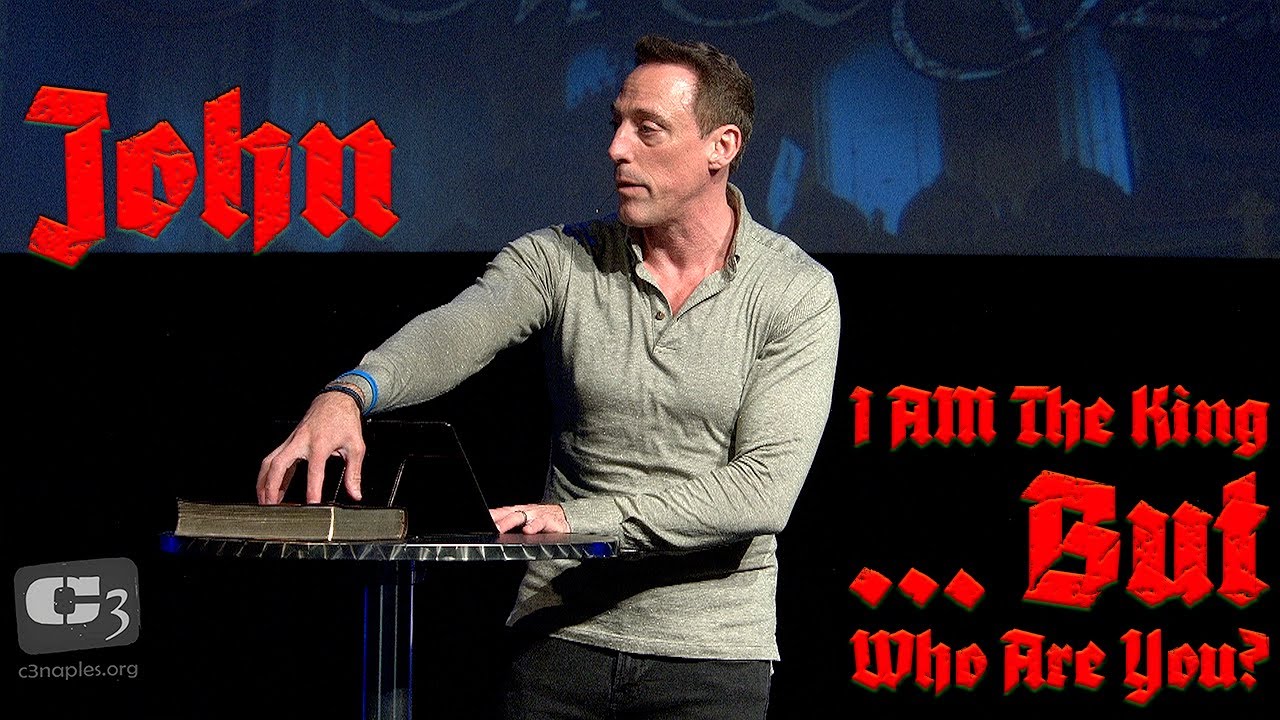
The Gospel of John - I AM the King But... Who Are You?
The Gospel of John isn’t written to simply tell us about Jesus—it’s written to confront us with who He is. From the opening words, “In the beginning was the Word,” John presents Jesus as eternal, divine, and unmistakably God. Through seven signs and seven powerful “I AM” statements, Jesus reveals Himself as the Bread of Life, the Light of the World, the Good Shepherd, the Resurrection and the Life, the Way to the Father, and the True Vine.But John doesn’t stop with revelation—he demands a response. Jesus came the first time to save, not to judge, yet He makes clear that the same Word will judge on the last day. Belief isn’t passive agreement; it’s allegiance. Sheep hear His voice, follow His lead, obey His commands, and love one another.If Jesus truly is the King, then identity begins with Him. The question John leaves us with isn’t just Who is Jesus?—it’s Who are you in light of Him?
Video can’t be displayed
Reader's Version
- John: I AM King … But Who Are you
- Sermon by Gene Simco
- Reader’s Version
- I hope you are all surviving the Christmas season.
- It has been said that Christmas can be a headache—and for me, it literally was.
- Just before Christmas last week, I was getting ready one day when I started seeing these shimmering lights in the peripheral of my vision. Sometimes they’re called auras. And immediately, it brought me way back.
- All of a sudden, my mind went to a season of life that I’m not living in anymore. You see, years ago I dealt with migraine headaches, and some of them were connected to substance abuse—or withdrawal from substance abuse. But it has been a long time since I experienced that. Thirty years or more. That’s not who I am anymore.
- Still, I recognized the feeling. I knew a migraine was coming, so I decided to ride it out.
- I closed the shades in my room and sat down, preparing myself for what felt like jail—like being struck in the temple with a tent peg. Except I wasn’t dying. Unfortunately.
- And during this time, I made a terrible decision. I checked my phone. That’s never recommended for many reasons. Your phone can actually make headaches worse, and sometimes it becomes the accuser.
- So now I’m having a conversation with my phone, and it starts accusing me.
- Why are you seeing these lights?
- Maybe you’re anxious.
- I’m not anxious. Stop it. Get behind me, Satan.
- Maybe you’re doing hard drugs.
- You’re a Pharisee, Mr. Phone. I knew that Apple logo meant something.
- That’s just not me anymore.
- Then it finally asks a question that made me pause:
- Have you recently reduced the amount of coffee you’re drinking?
- Now remember, a few weeks ago I told you about a coffee pod incident—where my weaker coffee pods were swapped out for what my wife and daughter consider normal coffee. Which is not normal coffee. It’s literally called Death Wish Coffee. That stuff could kill a Cuban horse.
- I usually drink the weaker coffee. But we “ran out” of mine, which left me no choice but to start doing the hard stuff.
- It started with one cup. Just a little bit. Give it a try.
- Then it turned into two cups.
- Until I was a full-blown addict. Again—that’s not me anymore.
- So, not wanting to end up on the streets again, I decided to quit the hard stuff—or go back to normal dosages—which is basically stopping. And that’s when I realized I was dealing with a drug-withdrawal migraine.
- So I texted my dealer.
- I mean—my daughter.
- And she replies, “Oh no, you can’t quit cold turkey.”
- Who are you? I don’t even know you anymore.
- Today, we’re going to talk about who we are in Christ.
- So what happened with my headache?
- Thank you for asking.
- I drank a cup of coffee—and I was just fine.
- Today we find ourselves in the Gospel of John.
- We’ve been in the Gospel of Luke, the last of what are called the Synoptic Gospels. Now we turn to John. So you have Matthew, Mark, and Luke—those are the Synoptic Gospels. As we’ve seen, they share many similarities, but each one gives us a different perspective on the life and ministry of Jesus Christ.
- We’ve already traced some of their major themes: the kingdom that can’t be canceled, the Gospel of “immediately,” and the Gospel for outcasts. Now, John shifts the focus.
- Now we’re going to talk about who that King is.
- John is not merely a biography of Jesus. It is a revelation of who He is. John writes so that “you may continue to believe that Jesus is the Messiah, the Son of God, and that by believing in Him you may have life in His name” (John 20:31).
- Unlike the Synoptics, John doesn’t begin in Bethlehem. He begins in eternity.
- He gives us seven signs, seven “I AM” declarations, and a front-row seat to the heart of God. If Matthew gives us the King, Mark gives us the Servant, and Luke gives us the Savior for everyone, then John gives us the eternal Word made flesh—the God who became man to make Himself known.
- So who is John?
- Like Matthew, John is one of the twelve disciples. Mark was not. Luke was not. Mark was a witness connected to eyewitnesses, and Luke interviewed witnesses in addition to being Paul’s travel companion and a firsthand witness to much of what unfolds in the book of Acts.
- John’s motivation is different. His aim is to make it unmistakably clear who Jesus is.
- John is likely written later than the other Gospel accounts, at a time when doubt was growing about whether Jesus was truly God. And John responds to that doubt directly—boldly—by recording Jesus’ “I AM” statements.
- To the original readers, those words would have been unmistakable. When Jesus says “I AM,” He is invoking the personal name of God given to Moses at the burning bush. Moses asks, “Who should I say sent me?” and God replies, “I AM has sent you.” Jesus is not merely saying, “I’m God.” He is invoking the personal, covenant name of the God of Israel. That makes these statements extraordinarily powerful.
- There are different ways to say the same thing.
- In the past, I’ve used the illustration of a man approaching a woman at a bar and asking if she’s married. She might not answer by simply saying, “Yes, I’m married.” She might say, “This is my husband.” Different words—same meaning—sometimes even stronger meaning.
- That’s what’s happening here. Jesus is affirming His identity in a way that is unmistakable to those who understand Scripture. And throughout John’s account, we see that His disciples clearly believe He is God.
- So let’s jump in.
- We begin in chapter one—and apparently, I’ve started a tradition of ruining Christmas traditions. Last week, I showed you the real birth account of Jesus in Luke. We talked about the problems with the manger.
- This week, we’re going to take a deeper look and see that while we celebrate the Incarnation at Christmas, the “birth” of Jesus—in quotes—happened long before that, as the Firstborn over all creation.
- So I’ll rip the bandage off right now and state a simple historical fact: Christmas was not a thing in the Bible or the early Church, because it isn’t Jesus’ birthday.
- It’s not celebrated anywhere in Scripture, and it doesn’t appear until around AD 336. The idea of celebrating Christmas as a holiday was unknown to the writers of the New Testament, the apostles, and several generations of early Christians.
- Just to put that in perspective—they were saved, faithful, and doing just fine without celebrating Christmas.
- Why?
- Because Jesus is God from the beginning.
- “Christ is the visible image of the invisible God. He existed before anything was created and is supreme—firstborn—over all creation” (Colossians 1:15).
- And that is exactly how the Gospel of John begins.
- John also uses a very specific word to describe Jesus. He calls Him the Word. The Greek term is Logos, a concept his original readers would have immediately understood. Jesus is called the Word of God at other points in Scripture, and John starts there—right out of the gate—making it unmistakably clear who Jesus is.
- John doesn’t warm up. He doesn’t ease into it. He starts immediately by telling us exactly who Jesus is.
- “In the beginning the Word already existed.
- The Word was with God, and the Word was God.
- He existed in the beginning with God.
- God created everything through him, and nothing was created except through him.”
- (John 1:1–3)
- A more literal rendering reads, “In the beginning was the Word, and the Word was with God, and the Word was God. He was in the beginning with God.”
- Now remember John’s motivation. He is making this absolutely clear. That’s why he comes out so strong. And it’s strong enough that people who deny the deity of Jesus today feel the need to change it.
- In fact, if you look into groups that call themselves Christian—but aren’t—like Mormonism, you’ll find that they claim the Bible is in error at this very point. They’ll argue that the King James Bible is wrong here. Now, while the King James Bible does have some translation limitations and reflects the scholarship of its time, this is not one of those errors.
- So what do they do?
- They rewrite it.
- They change the text to say that “the Word was a god.” Why? Because Mormon theology teaches that Jesus is a god, a created being, and even the brother of Satan—not the eternal, uncreated God.
- That tells you just how strong this passage is.
- And as a side note—you need to be aware of Mormon influence. It has quietly been creeping into mainstream Christianity, helped along by money-hungry evangelicals and popular media. Some well-known television shows often promoted in churches are produced by people who do not believe Jesus is God. They believe He is merely a god.
- If you want more information on that, there is an article available at BibleBelievingChristian.org that addresses it directly.
- https://www.biblebelievingchristian.org/post/mormonism-another-gospel-and-its-errors
- https://www.biblebelievingchristian.org/post/the-chosen-why-it-misrepresents-jesus
- But if there’s still any doubt, John doesn’t stop there. He doubles down.
- “He came into the very world he created, but the world didn’t recognize him.
- He came to his own people, and even they rejected him.
- But to all who believed him and accepted him, he gave the right to become children of God.
- They are reborn—not with a physical birth resulting from human passion or plan, but a birth that comes from God.
- So the Word became human and made his home among us.
- He was full of unfailing love and faithfulness. And we have seen his glory, the glory of the Father’s one and only Son.”
- (John 1:10–14)
- You can’t miss what John is saying. Jesus came into the world He created. That’s not the language of a prophet. That’s not the language of a created being.
- That is the language of God.
- And in John’s Gospel, John the Baptist declares this more extensively than in any of the other accounts. There are conversations and statements unique to John’s Gospel, and one of them is especially striking. John the Baptist says of Jesus, “He existed before me.”
- That’s significant. John the Baptist is Jesus’ older relative—likely an older cousin. He was born before Jesus. He leapt in Elizabeth’s womb when Mary came to visit, pregnant with Jesus. And yet he declares, “He existed before me.”
- That is a clear statement of divinity.
- As we continue through chapter one, we see familiar interactions with the disciples, similar to the other Gospel accounts, but also unique moments—like the almost humorous interaction with Nathanael, where Jesus seems to read his mind.
- And that’s where things really start to get interesting.
- As we continue through our movements, let’s look at chapters two through six. I’ll review what is familiar from the other Gospel accounts and highlight what is unique here in John—especially where some of the “I AM” statements begin to emerge.
- Let’s start with a brief chapter overview.
- In John chapter two, we see new wine and a new temple. Jesus makes it clear that the Kingdom is not about patching up the old—it’s about replacing it. Water jars used for ritual purification are transformed into overflowing wine. His mother requests this miracle because the wedding celebration is running out of wine, and notably, Jesus responds by saying, “My time has not yet come.” We dealt with this idea earlier in the Gospel of Mark.
- Then Jesus drives the money changers out of the temple, signaling judgment on corrupt worship. And this connects to something we’ve emphasized throughout this series: Jesus declares that He is the temple.
- “Destroy this temple, and I will raise it up in three days.”
- The disciples later realize He is not speaking about the building in Jerusalem, but about His own body. That matters—especially for those who insist there must be a future Third Temple. Scripture gives no such requirement. In fact, insisting on another temple is a denial of who Jesus says He is—both here in John and again at the end of Revelation.
- https://www.biblebelievingchristian.org/post/the-myth-of-a-third-temple-why-it-s-not-biblical
- In John chapter three, we see the conversation with Nicodemus. A spiritual leader cannot grasp spiritual rebirth. Jesus tells him that he must be born again, and Nicodemus struggles to understand what that means.
- The famous verse, John 3:16, sits inside a warning. Jesus comes now to save, but unbelief already condemns. Many Christians stop reading here and walk away with the idea that Jesus didn’t come to judge—only to save. But if you keep reading John, especially chapter five, Jesus clearly says He will return to judge.
- Light divides people now. Judgment comes later.
- Jesus comes first to save. He will return to judge.
- John the Baptist closes this section with a famous declaration: He must increase, and I must decrease.
- In John chapter four, we see living water offered to the unlikely. Remember how Luke highlighted Samaritans—outsiders despised by Jewish society. Jesus made a Samaritan the hero of His parable. A Samaritan leper was the one who returned to give thanks.
- Here, Jesus meets a Samaritan woman with a broken past. Like Nathanael earlier, Jesus reveals that He knows her life. “Go get your husband.” “I don’t have a husband.” “You’re right—you’ve had five, and the man you’re with now is not your husband.”
- Before that exchange, there is a powerful conversation about living water, the Holy Spirit, and true worship. And once again, this gift is offered to an outsider—already separating sheep from goats.
- In John chapter five, we see healing and authority to judge. At the pool of Bethesda, Jesus encounters a man who cannot walk. He cannot reach the pool in time. Jesus tells him, “Pick up your mat and walk.”
- Jesus then claims equality with God and authority to judge the living and the dead. The Judge stands in mercy now—but judgment is coming.
- In John chapter six, we see the feeding of the five thousand, the walking on water, and the first “I AM” statement. The crowds follow Him, but they want a free meal, not a King. They ask for bread, and Jesus responds, “I am the bread of life.”
- Many turn away. This is the first great sifting of false disciples.
- “Jesus replied, ‘I am the bread of life. Whoever comes to me will never be hungry again. Whoever believes in me will never be thirsty.’”
- (John 6:35)
- This is the first “I AM”: I am the bread of life.
- Now, this is where confusion often creeps in regarding works.
- Some people who want to opt out of obedience take something Jesus says here and run with it—out of context. The dialogue goes like this: Jesus says, “You want to be with me because I fed you.” Then they say, “We want to do works.” What they mean is miracles.
- Jesus responds, “The work God wants is that you believe in the one He sent.”
- But the context is signs and miracles. They’re asking for another display of power. Jesus is saying the only miracle God needs from you is faith—real trust in the King. And frankly, it’s almost an insult. As if to say, it would be a miracle for you to actually believe.
- This is not greasy grace.
- Belief in John’s Gospel means hearing His voice and following Him—not merely agreeing with Him in your head.
- People do the same thing with Ephesians chapter two. Yes, we are saved by grace through faith—not by works, so that no one can boast. But if you keep reading, we are created anew in Christ Jesus to do good works. Two sides of the same coin.
- And John will emphasize this over and over again.
- We are not saved by works—but works arethe proof of salvation.
- So our next movement is going to cover John chapter ten.
- In John 10, we encounter two “I AM” statements. Jesus explains the shepherd imagery in detail. There is sheepfold imagery, where the sheep recognize the shepherd’s voice. Strangers and thieves—false leaders and heretics—come to steal, kill, and destroy.
- The first “I AM” statement appears in John 10:9:
- “Yes, I am the gate. Those who come in through me will be saved. They will come and go freely and will find good pastures.”
- (John 10:9)
- Salvation and protection come through Him alone.
- Then we see the second identity claim in this section. Jesus declares that He is the Good Shepherd:
- “I am the good shepherd; I know my own sheep, and they know me, just as my Father knows me and I know the Father. So I sacrifice my life for the sheep.”
- (John 10:14–15)
- Here we see another “I AM” statement. Jesus lays down His life voluntarily. He knows His sheep, and they know His voice. The theme of one shepherd and one flock is clearly established.
- The response to these claims escalates. The crowd is divided once again. The Jews accuse Him of being demon-possessed. Jesus then claims unity with the Father—and if there were any doubt about what the “I AM” statements mean, it is settled here:
- “The Father and I are one.”
- Once again the people picked up stones to kill him.
- Jesus said, ‘At my Father’s direction I have done many good works. For which one are you going to stone me?’
- They replied, ‘We’re stoning you not for any good work, but for blasphemy! You, a mere man, claim to be God.’”
- (John 10:30–33)
- They are stoning Him because He is claiming to be God.
- Jesus then withdraws across the Jordan River.
- In our next movement, John chapters eleven through twelve, we see Jesus declare that He is the resurrection and the life.
- In John 11, Jesus receives word that His friend Lazarus is sick, but He delays intentionally. This reveals His purpose is for God’s glory. The disciples are confused, but Thomas is resigned: “Let’s go and die with Jesus,” sometimes rendered as sarcastic.
- Martha meets Him outside Bethany, and Jesus declares that He is the resurrection and the life. Martha said to Jesus, “Lord, if only you had been here, my brother would not have died. But even now, I know that God will give you whatever you ask.” Jesus told her, “Your brother will rise again.” “Yes,” Martha said, “he will rise when everyone else rises, on the last day.”
- Then in John 11:25, Jesus told her, “I am the resurrection and the life. Anyone who believes in me will live, even after dying.” This is a strong “I AM” statement—the ability to live forever through Him. And then comes the question: “Everyone who lives in me and believes in me will never ever die. Do you believe this, Martha?”
- Martha responds, “Yes, Lord,” she told Him. “I have always believed you are the Messiah, the Son of God, the one who has come into the world from God.”
- Now, a quick note about Martha’s bad rap from Luke 10:38–42. In that scene, Martha is portrayed as busy with many tasks—“Martha, Martha… you are worried and upset about many things”—while Mary sits at Jesus’ feet. Martha often gets remembered as the example of frantic work versus quiet faith. But here, Martha recognizes Jesus as the Messiah, and you don’t hear this emphasized nearly enough.
- Next, Jesus calls Lazarus from the tomb and raises him from the dead. Many believe. The religious leaders panic and plot to kill both Jesus and Lazarus. His identity forces a decision, and rejection intensifies.
- In John 12, we see the anointing, the triumphal entry, and judgment warnings. Mary anoints Jesus, Judas protests, and the triumphal entry fulfills Scripture as the King arrives publicly. The crowd misunderstands His kingship. Greeks ask to see Jesus, hinting at a global mission. Jesus predicts His death with seed imagery, and He warns that rejecting His words brings judgment later.
- So again, we see salvation now—judgment later—as Jesus’ public ministry transitions toward the cross.
- ________________________________________
- This brings us to movement six, John chapters thirteen through seventeen.
- In John 13, we see love in action. Jesus washes the disciples’ feet, redefining authority and leadership. Judas is identified and leaves to betray Him. Jesus gives a new command—to love one another as He has loved them—and Peter’s denial is predicted. True discipleship here is measured by love and humility.
- In John 14, Jesus comforts the troubled disciples and tells them He is going to prepare a place for them. Thomas asks for clarity, and Jesus declares:
- “I am the way, the truth, and the life. No one can come to the Father except through me. If you had really known me, you would know who my Father is. From now on, you do know him and have seen him.”
- (John 14:6–7)
- So again, Jesus is one with the Father—and the only way to the Father. When we put this together with the resurrection and the life statement, the message is clear: He is the only way to heaven, exclusive access to the Father.
- Now we come to some verses that often cause confusion. Jesus says that you can ask anything in His name in verses 13 and 14. But this is not about prosperity—it’s about the promise of the Holy Spirit. The word “anything” is clearly hyperbole. Jesus is not going to grant requests that lead to sin, greed, or self-indulgence. The pattern He gives is this: if you obey, He will ask the Father, and the Father will give the Holy Spirit.
- Luke gives us the direct clarification:
- “So if you sinful people know how to give good gifts to your children, how much more will your heavenly Father give the Holy Spirit to those who ask him.”
- (Luke 11:13)
- In John 15, Jesus declares that He is the true vine. This is union imagery—branches abiding in Christ.
- “I am the true grapevine, and my Father is the gardener. He cuts off every branch of mine that doesn’t produce fruit, and he prunes the branches that do bear fruit so they will produce even more.”
- (John 15:1–2)
- This is an “I AM” statement with a warning. Once again, Ephesians chapter two reminds us of the balance: we are saved by grace through faith, but we are created for good works. This fruit imagery echoes the parable of the sower and Galatians five—the fruit of the Spirit versus the works of the flesh. If we are not producing fruit but are producing the sins of the flesh, we do not inherit the kingdom of God. Fruit proves true discipleship, and unfruitful branches are cut off.
- Love is demonstrated through obedience. Jesus says, “When you obey my commandments, you remain in my love, just as I obey my Father’s commandments and remain in his love. I have told you these things so that you will be filled with my joy. Yes, your joy will overflow. This is my commandment: Love each other in the same way I have loved you. There is no greater love than to lay down one’s life for one’s friends.”
- In this chapter, Jesus also warns that hatred from the world is coming.
- In John 16, we see sorrow and the work of the Spirit. Jesus tells them persecution will come, but the Holy Spirit will convict the world and guide the disciples. Their grief will turn into joy.
- In John 17, we see the High Priestly Prayer. Jesus prays for Himself, prays for the disciples, and prays for future believers. Unity is grounded in shared truth and shared mission.
- Finally, in John chapters eighteen through twenty-one, we see the Passover, the cross, and the resurrection.
- In John 18, we see the arrest and the trials. Judas leads the soldiers to the garden. Jesus steps forward, and we see authority on display—when He says, “I am,” they fall to the ground. They have come to arrest Jesus. Peter lashes out and cuts off Malchus’ ear, and Jesus rebukes him. Jesus is taken first to Annas and then to Caiaphas. Peter denies Him three times, and finally Jesus is handed over to Pontius Pilate. The Shepherd lays down His life willingly.
- In John 19, we see the King crucified. There is flogging and mockery. The crowds choose Caesar over Jesus. Jesus is crucified, and the Scriptures are fulfilled. John places himself at the cross along with the women, emphasizing eyewitness testimony. Jesus declares, “It is finished.” His side is pierced, and the blood and water stand as witnesses. He is buried in a new tomb, and we see that it is not only Joseph of Arimathea, but also Nicodemus, who helps with the burial.
- The King reigns from the cross. Judgment is delayed by mercy.
- In John 20, we see the resurrection and faith. The empty tomb is discovered. Peter and John race to the tomb. Jesus appears to Mary, then to the disciples behind locked doors, breathing peace and commissioning them. He later appears to Thomas, who confesses, “My Lord and my God,” showing clearly that the disciples understand who He is.
- The resurrection demands a response—belief or refusal.
- In John 21, we have the epilogue: restoration and mission. There is a miraculous catch of fish as the risen Jesus appears to the disciples. They share breakfast with Him, and Peter is restored through a threefold commission—“Feed my sheep”—mirroring his three denials. There is a prophecy of suffering for the disciples and a final reminder: “Follow me.”
- The identity of Jesus’ followers is grounded in obedience, love, and mission—not self-definition.
- John doesn’t give us a Jesus we can mold into something comfortable. Every sign he records, every confrontation he highlights, and every “I AM” statement pulls back the curtain a little more. John isn’t interested in giving us a customizable Jesus. He isn’t presenting a rabbi offering advice or a prophet pointing to someone else. From beginning to end, John shows us the King.
- Jesus is the Bread who gives life (John 6:35). He is the Light that exposes darkness (John 8:12). He is the Shepherd who calls His own by name (John 10:3–4). He is the Resurrection who conquers death (John 11:25–26). He is one with the Father (John 10:30), and He is the Vine that gives true life (John 15:1–5). And John presses this truth until it demands a response.
- If He is the King, then you are not. If He is Creator, Savior, and Judge, then your identity doesn’t begin with self-expression or personal preference. It begins with hearing His voice and following Him (John 10:27). Those who believe receive life (John 3:16; John 20:31). Those who refuse are choosing judgment (John 3:18; John 12:48). John leaves no room for neutrality. There is no middle ground.
- This is where the entire Bible has been pointing—from Genesis to Revelation. So now we trace the Alpha to the Omega and see how the Scriptures consistently reveal the King who is, who was, and who is to come (Revelation 1:8).
- It begins with the divine name itself. When Moses asks God who sent him, God replies, “I am who I am. Say this to the people of Israel: I AM has sent me to you” (Exodus 3:14). That name isn’t just a label; it’s God revealing His eternal, self-existent nature. And John shows us that Jesus doesn’t merely reference that name—He claims it.
- Jesus says, “I tell you the truth, before Abraham was even born, I AM!” (John 8:58). That isn’t poetic language or metaphor. Jesus is using the same divine self-identification God gave at the burning bush. And the response tells us everything we need to know. “At that point they picked up stones to throw at him” (John 8:59). They understood exactly what He was claiming. Jesus was identifying Himself as Yahweh in the flesh.
- Throughout John’s Gospel, that identity is unfolded again and again. Jesus declares, “I am the bread of life” (John 6:35), “I am the light of the world” (John 8:12), “I am the gate” (John 10:9), “I am the good shepherd” (John 10:11), “I am the resurrection and the life” (John 11:25), “I am the way, the truth, and the life” (John 14:6), and “I am the true vine” (John 15:1). Each statement builds on the last, revealing more clearly who He is and what it means to belong to Him.
- One of those images carries particular weight. God promised through the prophet Ezekiel, “I will set over them one shepherd, my servant David” (Ezekiel 34:23). Jesus fulfills that promise when He says, “I am the good shepherd. The good shepherd lays down his life for the sheep” (John 10:11). He is the promised Shepherd-King, the descendant of David, gathering God’s scattered flock and laying down His life by choice.
- John also presents Jesus as the Passover Lamb. God commanded, “Do not break any of its bones” (Exodus 12:46). At the crucifixion, John carefully records, “When they came to Jesus, they saw that he was already dead, so they didn’t break his legs… These things happened in fulfillment of the Scriptures” (John 19:33–36). This is not coincidence. Jesus is God’s final deliverance, the true Passover fulfilled in flesh.
- And He is the Pierced One. Zechariah prophesied, “They will look on me whom they have pierced” (Zechariah 12:10). John records the fulfillment: “One of the soldiers pierced his side with a spear, and immediately blood and water flowed out” (John 19:34–37). Prophecy fulfilled, and more than that—atonement and new life flowing from the Second Adam (Romans 5:14; 1 Corinthians 15:45).
- From Alpha to Omega, the testimony is consistent. Jesus is not a concept. He is not a suggestion. He is not optional.
- He is I AM.
- John’s Gospel won’t let us stay neutral. Every sign, every “I AM,” every confrontation forces a response. If Jesus is the King—the Bread of Life, the Light in the darkness, the Way, the Shepherd, the Vine—then identity starts here.
- The sheep hear His voice. That means Scripture isn’t a suggestion; it’s our compass. His voice rises above culture, emotions, and personal preference. The sheep believe His words, and belief isn’t passive agreement. It’s trusting allegiance to the King whose word creates and commands loyalty. The sheep obey His commands. Jesus is clear about this: “If you love me, obey my commandments.” Love without obedience isn’t biblical love. It’s lip service.
- The sheep remain in His love through obedience. Following Jesus isn’t a moment—it’s endurance. It’s pruning. It’s abiding. The sheep love one another. Jesus declares that sacrificial love is the visible mark of those who belong to Him. And John presses the urgency: Jesus came the first time to save, not to judge, but the same word we reject today will judge us. So the question becomes unavoidable—whose voice are you following? Whose commands shape your habits? Whose love marks your relationships? If He is the King, then who are you?
- These aren’t abstract spiritual ideas. They’re daily practices for disciples living under a King.
- First, we must hear His voice daily. That means opening Scripture and praying intentionally to recognize His leading. Start with John. Slow down. Ask yourself, What is the Shepherd saying to me today?
- “My sheep listen to my voice; I know them, and they follow me.”
- (John 10:27)
- Scripture tells us why this matters. “All Scripture is inspired by God and is useful to teach us what is true and to make us realize what is wrong in our lives. It corrects us when we are wrong and teaches us to do what is right.”
- (2 Timothy 3:16)
- The Word of God is our ultimate guide. It cuts through speculation, bad teaching, and heresy. Everything must line up with Scripture, or it’s false. Knowing the Word of God is protection. Hearing His voice and recognizing His voice is how the sheep stay safe.
- Second, we must obey promptly. Jesus draws a sharp line when He asks, “Why do you call me ‘Lord, Lord,’ and don’t do what I say?”
- (Luke 6:46)
- If we aren’t doing what Scripture says, then we’re not living as His sheep. And if He isn’t our Lord, then He isn’t our Savior. When Jesus convicts you—through Scripture, through the Spirit, or through godly counsel—respond without delay. Partial obedience is disobedience.
- “Don’t just listen to God’s word. You must do what it says. Otherwise, you are only fooling yourselves… You see yourself, walk away, and forget what you look like.”
- (James 1:22–24)
- Jesus says it plainly: “If you love me, obey my commandments.”
- (John 14:15)
- And again, “When you obey my commandments, you remain in my love.”
- (John 15:10)
- Those are hard lines in the sand. We must produce fruit. Branches that don’t bear fruit are cut off and thrown into the fire.
- Third, we must choose visible love. Pick one relationship right now where love is costly—serve, forgive, give, reconcile. Love proves discipleship.
- “So now I am giving you a new commandment: Love each other. Just as I have loved you… Your love for one another will prove to the world that you are my disciples.”
- (John 13:34–35)
- Jesus says the world will recognize His followers by their love. Love is how we witness. Scripture calls us again and again not just to claim faith, but to prove it.
- Fourth, we must abide intentionally. That means staying connected to other believers for encouragement and accountability. Branches don’t bear fruit alone.
- “Remain in me, and I will remain in you… Yes, I am the vine; you are the branches… Anyone who does not remain in me is thrown away like a useless branch and withers… When you produce much fruit, you are my true disciples.”
- (John 15:4–8)
- We are the body of Christ, and He is the head of the Church. Remaining in Him is how life flows through us—and the warning about fruitlessness is real.
- Fifth, we must silence competing voices. We need to name the counterfeit shepherds in our lives—culture, comfort, ambition, sinful patterns, maybe even our phones—and deliberately turn from them.
- “They won’t follow a stranger; they will run from him because they don’t know his voice.”
- (John 10:5)
- This goes back to learning His voice. And yes, you can even listen to Scripture—apps can be used for good. It’s like music. Even if you’re not a musician, you can tell when a song isn’t sung by the original artist. Something sounds off. When you listen to Scripture regularly, you learn to recognize when it’s being twisted, misquoted, or misused. You cancel competing voices by listening to the true one—the Word of God.
- Finally, we must follow where He leads. Obedience always leads to action. Ask yourself, Where is Jesus calling me to move, to serve, to surrender, to speak? And then take the first step. Because when the King speaks, His sheep follow—His voice leads to life.
- Your confidence doesn’t come from who you are on your own. It comes from who He is—and who you are in Him.
- He is the Bread of Life—you are nourished in Him.
- He is the Light of the World—you no longer walk in darkness.
- He is the Gate—you are welcomed and protected.
- He is the Good Shepherd—you are known and led.
- He is the Resurrection and the Life—you are raised to live forever.
- He is the Way, the Truth, and the Life—you walk in His truth.
- He is the True Vine—you bear fruit that lasts.
- If He is the King, then you are His sheep—called to hear His voice, obey His commands, and love one another. Identity isn’t found; it’s received.
- He is I AM.
- Now is the time to step into who you are in Him.
- ________________________________________
- ©️ Copyright 2025 Gene Simco Most Scripture quotations are taken from the Holy Bible, New Living Translation, copyright ©1996, 2004, 2015 by Tyndale House Foundation. Used by permission of Tyndale House Publishers, Carol Stream, Illinois 60188. All rights reserved. Scriptures in brackets reflect the original Biblical languages.