Ezra/Nehemiah: Faith in Action
Ezra and Nehemiah tell one unified story of restoration—physically, spiritually, and communally. Ezra models spiritual leadership through prayer, fasting, teaching, and confession. Nehemiah models practical leadership through planning, building, reforming, and defending.Both teach us that faith and action are not enemies—they are partners. One without the other is incomplete. Together, they show us that following God means seeking Him first, obeying His Word, working diligently, and resting faithfully. And ultimately, this restoration points to Christ—the greater High Priest, the true Temple, and the One who leads us not just back to a ruined city, but forward to the eternal New Jerusalem.

Sermon Transcript
Ezra/Nehemiah: Faith In ActionSermon by Gene SimcoReader’s Version
I heard a story about two men riding a tandem bicycle up a steep hill. The man in front was struggling, pushing harder with every pedal, constantly urging the rider in the back to give it more effort. No matter how hard they worked, it seemed like the climb just kept getting tougher. Finally, after a grueling effort, they reached the top. The front rider, exhausted, said, “That was a really tough climb.”The second rider replied, “Sure was—and if I hadn’t kept the brake on the whole time, we might have slipped backwards!”Today, we’re going to talk about how two things that seem to be opposites can actually work in tandem—just like that bike ride. Specifically, we’ll see how faith and action, prayer and planning, rest and work, aren’t enemies—they’re partners in God’s design.We continue now in our Alpha and Omega series, where we trace God’s story from beginning to end. When we left off in 2 Chronicles, we witnessed the tragic fall of Judah. Israel had already fallen to the Assyrians, and about 130 to 150 years later, Judah was conquered by Babylon. God’s people were taken into exile.Israel, the Northern Kingdom, had already fallen to the Assyrians in 722 BC. Then, 136 years later, in 586 BC, Judah—the Southern Kingdom—fell to the Babylonians.(Quick Timeline: Israel falls in 722 BC ➔ Judah falls in 586 BC — a span of 136 years.)Let’s pick up where we left off in 2 Chronicles 36:17–20:"So the Lord brought the king of Babylon against them. The Babylonians killed Judah’s young men, even chasing them into the Temple. They had no pity on the people, killing both young men and young women, the old and the infirm. God handed all of them over to Nebuchadnezzar. The king took home to Babylon all the large and small articles used in the Temple of God, and the treasures from both the Lord’s Temple and the palace of the king and his officials. Then his army burned the Temple of God, tore down the walls of Jerusalem, burned all the palaces, and completely destroyed everything of value. The few who survived were taken as exiles to Babylon, and they became servants to the king and his sons until the kingdom of Persia came to power."Here we see the complete destruction of both the Temple and the walls of Jerusalem—the spiritual and physical heart of God’s people reduced to ruins.Now, remember, Chronicles was written after the seventy-year exile—likely by Ezra himself—as a reminder of both judgment and hope. If we read just a little further, we see how God begins to fulfill His promise of restoration.2 Chronicles 36:22–23 says:"In the first year of King Cyrus of Persia, the Lord fulfilled the prophecy He had given through Jeremiah. He stirred the heart of Cyrus to put this proclamation in writing and to send it throughout his kingdom: ‘This is what King Cyrus of Persia says: The Lord, the God of heaven, has given me all the kingdoms of the earth. He has appointed me to build Him a Temple at Jerusalem, which is in Judah. Any of you who are His people may go there for this task, and may the Lord your God be with you.’”This is where 2 Chronicles ends—and where the book of Ezra begins.So, let’s pick up exactly where we left off, as God’s people prepare to return from exile, and we discover how faith, leadership, obedience, and rest must work together to rebuild what was lost.Here are some charts to show how Ezra & Nehemiah intersect with other Biblical books on a chronological timeline:
I heard a story about two men riding a tandem bicycle up a steep hill. The man in front was struggling, pushing harder with every pedal, constantly urging the rider in the back to give it more effort. No matter how hard they worked, it seemed like the climb just kept getting tougher. Finally, after a grueling effort, they reached the top. The front rider, exhausted, said, “That was a really tough climb.”The second rider replied, “Sure was—and if I hadn’t kept the brake on the whole time, we might have slipped backwards!”Today, we’re going to talk about how two things that seem to be opposites can actually work in tandem—just like that bike ride. Specifically, we’ll see how faith and action, prayer and planning, rest and work, aren’t enemies—they’re partners in God’s design.We continue now in our Alpha and Omega series, where we trace God’s story from beginning to end. When we left off in 2 Chronicles, we witnessed the tragic fall of Judah. Israel had already fallen to the Assyrians, and about 130 to 150 years later, Judah was conquered by Babylon. God’s people were taken into exile.Israel, the Northern Kingdom, had already fallen to the Assyrians in 722 BC. Then, 136 years later, in 586 BC, Judah—the Southern Kingdom—fell to the Babylonians.(Quick Timeline: Israel falls in 722 BC ➔ Judah falls in 586 BC — a span of 136 years.)Let’s pick up where we left off in 2 Chronicles 36:17–20:"So the Lord brought the king of Babylon against them. The Babylonians killed Judah’s young men, even chasing them into the Temple. They had no pity on the people, killing both young men and young women, the old and the infirm. God handed all of them over to Nebuchadnezzar. The king took home to Babylon all the large and small articles used in the Temple of God, and the treasures from both the Lord’s Temple and the palace of the king and his officials. Then his army burned the Temple of God, tore down the walls of Jerusalem, burned all the palaces, and completely destroyed everything of value. The few who survived were taken as exiles to Babylon, and they became servants to the king and his sons until the kingdom of Persia came to power."Here we see the complete destruction of both the Temple and the walls of Jerusalem—the spiritual and physical heart of God’s people reduced to ruins.Now, remember, Chronicles was written after the seventy-year exile—likely by Ezra himself—as a reminder of both judgment and hope. If we read just a little further, we see how God begins to fulfill His promise of restoration.2 Chronicles 36:22–23 says:"In the first year of King Cyrus of Persia, the Lord fulfilled the prophecy He had given through Jeremiah. He stirred the heart of Cyrus to put this proclamation in writing and to send it throughout his kingdom: ‘This is what King Cyrus of Persia says: The Lord, the God of heaven, has given me all the kingdoms of the earth. He has appointed me to build Him a Temple at Jerusalem, which is in Judah. Any of you who are His people may go there for this task, and may the Lord your God be with you.’”This is where 2 Chronicles ends—and where the book of Ezra begins.So, let’s pick up exactly where we left off, as God’s people prepare to return from exile, and we discover how faith, leadership, obedience, and rest must work together to rebuild what was lost.Here are some charts to show how Ezra & Nehemiah intersect with other Biblical books on a chronological timeline:
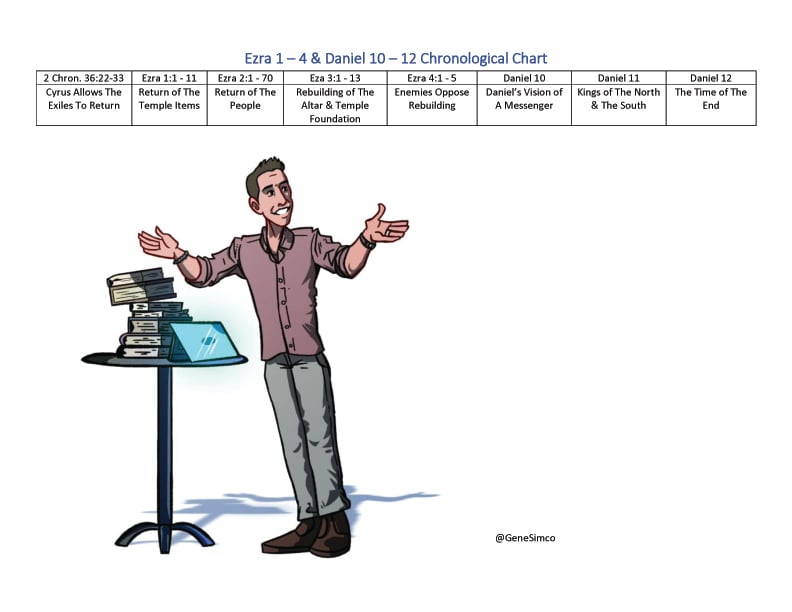


After 2 Chronicles, the next book of the Bible is Ezra. In our modern Bibles, this placement follows a clear chronological flow—Ezra picks up exactly where 2 Chronicles ends.
Ezra 1 begins like this:
“In the first year of King Cyrus of Persia, the Lord fulfilled the prophecy He had given through Jeremiah. He stirred the heart of King Cyrus to put this proclamation in writing and to send it throughout his kingdom: ‘This is what King Cyrus of Persia says: The Lord, the God of heaven, has given me all the kingdoms of the earth. He has appointed me to build Him a Temple in Jerusalem, which is in Judah. Any of you who are His people may go to Jerusalem in Judah to rebuild this Temple of the Lord, the God of Israel, who lives in Jerusalem. And may your God be with you! Wherever this Jewish remnant is found, let their neighbors contribute toward their expenses by giving them silver and gold, supplies for the journey, and livestock, as well as a voluntary offering for the Temple of God in Jerusalem.’” — Ezra 1:1–4
What’s important to understand is that in early Jewish and Christian tradition, Ezra and Nehemiah were considered a single book.In the Hebrew Bible, Nehemiah simply followed Ezra as a continuous narrative. This structure carried over into early Christian Bibles, including the Septuagint, where it was known as Ezra B, and even into Jerome’s Latin Vulgate in 405 AD, where he also treated them as one book. It wasn’t until much later—during the medieval period and through the divisions introduced in the Masoretic Text—that they were separated into two distinct books.This original unity is significant. Both Ezra and Nehemiah tell a single, continuous story of Israel’s return from exile, the rebuilding of Jerusalem’s Temple and walls, and the re-establishment of God’s law. Together, they present a powerful parallel between physical restoration—the city, the temple, the walls—and spiritual renewal—the covenant, worship, and the call to holiness.
The early Church would have read this as one narrative of restoration—a theme ultimately pointing to and fulfilled in Christ.Now, picture Jerusalem: the city in ruins, its protective walls torn down, the Temple destroyed, and God’s people scattered across foreign lands. This was the scene after the Babylonian exile.Into this devastation, God sends two leaders—Ezra and Nehemiah—but notice how differently they approach the mission.• Ezra focuses on spiritual restoration. He teaches the Law, calls the people to repentance, and trusts God completely for protection—even refusing to ask the king for military escort because of his faith.• Nehemiah, on the other hand, is a man of practical action. He rebuilds the walls, organizes workers, sets guards in place, and makes detailed plans to ensure the city’s defense and structure.
Both were faithful. Both were used by God. And together, they show us the essential balance between faith and action.
So the question for us today is this:Are you more like Ezra—trusting God fully, but sometimes neglecting practical steps?Or are you more like Nehemiah—a planner and builder, but prone to leaning on your own strength instead of God's?In truth, we’re called to be both. Ezra and Nehemiah remind us that prayer and planning, faith and works, trust and action are not opposing forces—they’re meant to work in tandem.
Let’s dive into the story.Our first movement begins with Ezra chapters 1 through 6.We opened with King Cyrus of Persia issuing a decree allowing the Jews to return to Jerusalem and rebuild the Temple. This moment is a direct fulfillment of prophetic promises—Jeremiah 29:10 and Isaiah 44:28—where God declared that Cyrus, a pagan king, would be used to restore His people and rebuild His house.The first wave of exiles is led by Zerubbabel, who serves as governor. Reconstruction of the Temple begins, but as with every work of God, opposition arises and progress is halted. During this time, the prophets Haggai and Zechariah emerge. Their voices echo in the background of Ezra, encouraging the people to continue the work. With their urging, and under the reign of King Darius, the Temple is finally completed.
In Ezra chapters 1–2, we’re introduced to two key figures: Jeshua the priest and Zerubbabel the governor. At first glance, this might feel like a political and religious partnership—but if we take a moment to hop over to the book of Zechariah, we begin to see something deeper.These two leaders represent spiritual and practical leadership in tandem. Zerubbabel leads the people physically, organizing and overseeing the construction. Jeshua leads spiritually, representing the priestly line and interceding for the people. This sets the stage for the parallel we’ll soon see in Ezra and Nehemiah themselves.
In Ezra 3, the foundation of the Temple is laid. The response is striking: the younger generation shouts with joy, while the older generation weeps—those who had seen the glory of the former Temple are overwhelmed. Joy and sorrow collide here, and both are sacred responses.In Ezra 4, the project faces political disruption. Kings change—Xerxes to Artaxerxes—and the work is suspended.But in Ezra 5, the prophets step in. Haggai and Zechariah prophesy with boldness, reigniting faith. In Ezra 6, King Darius confirms the decree, and the people get back to work. The Temple is completed, dedicated, and they celebrate Passover—connecting back to Exodus 12, where God first established that sacred tradition.Our second movement covers Ezra chapters 7 through 10.In Ezra 7, we’re introduced to Ezra himself—a priest, a scribe, and a man devoted to the law of the Lord. He sets his heart to study the law, obey it, and teach it to Israel.Ezra 8 recounts his journey and the list of those who traveled with him. What’s striking here is his choice: Ezra fasts and prays for protection, choosing not to ask the king for a military escort. He was ashamed to ask for help after telling the king that “the gracious hand of our God is on everyone who looks to Him” (Ezra 8:22). It’s a powerful moment of faith and conviction—one we’ll contrast later with Nehemiah’s more practical approach.In Ezra 9, the issue of foreign marriages arises. Ezra is devastated. He tears his clothing, pulls out his own hair, and falls to his knees, weeping over the sin of the people.Then comes Ezra 10, which contains one of the more rarely discussed and often misunderstood commands in Scripture. In response to the nation’s sin, the people are called to divorce their foreign wives.
Now, Ezra isn’t a book many Christians read regularly. It’s rarely quoted in devotionals or printed on coffee mugs. But here we encounter a real tension in Scripture. Most Christians are more familiar with Malachi 2:16—“I hate divorce,” says the Lord. And that’s true. But here, and again later in Nehemiah, divorce is actually commanded.
Context matters. The Israelites had been explicitly warned not to intermarry with foreign nations, not because of ethnicity, but because of idolatry. The issue wasn’t race—it was worship. These marriages led to the dilution of faith, much like what happened to Solomon in 1 Kings 11, where his many foreign wives led him to worship false gods.
Nehemiah later refers back to this, saying, “Was it not because of marriages like these that Solomon, king of Israel, sinned?” (Nehemiah 13:26). The concern was spiritual corruption, not cultural diversity.
So in Ezra 10, a national repentance takes the form of separation. It’s painful. It’s controversial. But it’s a reminder that repentance isn’t always comfortable—sometimes it requires difficult, even heartbreaking, obedience.Of course, this doesn’t mean divorce is celebrated. Even Jesus acknowledged in Matthew 19:8 that divorce was permitted because of the hardness of human hearts—but it was never God’s ideal.
Yet, here in Ezra, we find a unique historical moment. The people were rebuilding a holy identity. And in this moment, radical obedience was required—not because of prejudice, but because of purity. Because of covenant faithfulness.In our next movement, we enter the book of Nehemiah. But remember, as we've discussed, the early church and Jewish tradition read Ezra and Nehemiah as a single continuous narrative—not two separate books. Together, they tell one story of restoration, both spiritual and physical.Nehemiah hears that Jerusalem’s walls are still in ruins. His response? He prays and seeks favor from King Artaxerxes. God answers, and the king grants him permission to return. Nehemiah mobilizes the people, organizes the work, and despite opposition from enemies like Sanballat and Tobiah, he remains focused and gets the job done.________________________________________Timeline Note:There’s a 13-year gap between the end of Ezra 10 and the beginning of Nehemiah 1.• 457 BC — Ezra arrives in Jerusalem to lead spiritual reform.• 444 BC — Nehemiah hears about Jerusalem’s broken walls and begins his mission.This gap highlights that while the Temple had been rebuilt under Ezra’s leadership, the city’s defenses were still in shambles when Nehemiah enters the scene.________________________________________In Nehemiah 1–2, we see Nehemiah—cupbearer to King Artaxerxes—brokenhearted over Jerusalem’s condition after hearing the report from his brother Hanani. Like Ezra, his first instinct is to pray and fast. Nehemiah wasn’t just a planner—he was a man of faith. But when it came time to act, Nehemiah took a different approach than Ezra.When Nehemiah asks the king for permission to return, he also requests letters of safe passage and accepts a military escort. This is a sharp contrast to Ezra, who had been too ashamed to ask for soldiers because he had publicly declared his trust in God’s protection (Ezra 8:21–23).In Nehemiah 3–4, the work begins. The walls are rebuilt despite constant resistance. Nehemiah’s leadership is highly organized and practical—assigning families to specific sections, arming workers, and setting guards.In Nehemiah 5, internal reforms address injustice among the people. Nehemiah repeatedly uses a personal refrain:"Remember me, O my God, for what I have done."In Nehemiah 6, the wall is completed in just 52 days—a remarkable feat given the opposition.Here, we see the clear contrast between Ezra and Nehemiah:• Ezra relied fully on faith—fasting, praying, and trusting God without asking for earthly protection.• Nehemiah combined faith with practical strategy—praying, but also planning, defending, and leading with structure.Ezra leads with teaching and prayer:“Ezra had determined to study and obey the Law of the Lord and to teach those decrees...” — Ezra 7:10Nehemiah leads with strategy and defense:“Half my men worked while the other half stood guard... Each carried a sword at his side as he worked.” — Nehemiah 4:16–18When his enemies tried to distract him, Nehemiah famously replied:“I am engaged in a great work, so I can’t come.” — Nehemiah 6:3Our final movement, Nehemiah 7–13, focuses on spiritual renewal and reform.Once the walls were rebuilt, Ezra and Nehemiah worked together. In Nehemiah 8, Ezra reads the Law aloud during the Festival of Shelters (Booths), leading a national revival. For seven days, the people stood to hear God’s Word—a far cry from modern complaints about long sermons or uncomfortable pews!In Nehemiah 9, there’s a powerful scene of repentance:• Three hours of reading the Law.• Followed by three hours of confession and worship.In Nehemiah 10–12, the people reaffirm the covenant, dedicate the wall, and commit to tithes, Sabbath observance, and purity.But by Nehemiah 13, old sins resurface. Nehemiah enforces reforms—driving out compromise, ensuring proper worship, and, once again, dealing with the issue of foreign marriages.Here’s where we see another stark contrast between Ezra and Nehemiah’s leadership styles:• When Ezra discovered the people’s sin, he pulled out his own hair in grief:“I tore my cloak and pulled hair from my head and beard...” — Ezra 9:3• When Nehemiah faced the same issue, he pulled out theirs:“I confronted them, called down curses, beat some of them, and pulled out their hair...” — Nehemiah 13:25Ezra mourned. Nehemiah acted.Ezra focused on Scripture and revival:“They read from the Book of the Law and clearly explained the meaning...” — Nehemiah 8:8Nehemiah enforced practical reforms:“I assigned duties to the priests and Levites, making certain that everything was done properly.” — Nehemiah 13:30Throughout Nehemiah’s account, he repeats that refrain:"Remember me, O my God, for my good."It’s not that Nehemiah lacked faith—he just lived it out differently than Ezra. Together, they demonstrate how spiritual devotion and practical leadership must work side by side to accomplish God’s purposes.
Each moment in Ezra and Nehemiah foreshadows a greater truth fulfilled in Jesus Christ. He is the true Temple, the perfect Mediator, and the ultimate Protector—not merely restoring a city, but restoring all of humanity to God. Woven throughout these historical accounts are glimpses of Christ’s liberating, priestly, and kingly mission.
It begins with the exile and the surprising figure of Cyrus. A pagan king, yet uniquely called “His anointed one”—the Hebrew word Messiah, translated in Greek as Christos. In 2 Chronicles 36:22–23, Cyrus declares:“The Lord, the God of heaven, has given me all the kingdoms of the earth. He has appointed me to build Him a Temple at Jerusalem.”This is no accident. The prophecy in Isaiah 45 speaks directly to Cyrus:“This is what the Lord says to Cyrus, His anointed one... I will raise up Cyrus to fulfill My righteous purpose... He will restore My city and free My captive people without seeking a reward.” — Isaiah 45:1,13Cyrus is a type of Christ—an unexpected deliverer, chosen by God to release His people from captivity and commission the rebuilding of the Temple. But where Cyrus restored a physical structure, Jesus, the true Anointed One, proclaims a far greater liberation:“The Spirit of the Lord is upon me, for He has anointed me to bring Good News to the poor... to proclaim that captives will be released... and that the time of the Lord’s favor has come.” — Luke 4:18–19
Christ frees us from the captivity of sin, and instead of building a temple of stone, He establishes a living temple—His Church. As Paul reminds us, we are the body of Christ and temples of the Holy Spirit. Cyrus was a shadow; Jesus is the substance.
We also see Christ foreshadowed in the figures of Jeshua the high priest and Zerubbabel the governor. In Ezra 3:2, these two leaders begin rebuilding the altar of God. The prophet Zechariah reinforces their significance:“Listen to me, O Jeshua the high priest... Soon I am going to bring My servant, the Branch.” — Zechariah 3:8Jeshua, whose name in Greek is Jesus, leads the people in restoring worship and holiness. Alongside him, Zerubbabel, a descendant of David, leads them back to Jerusalem. Together, they prefigure Christ—the true High Priest and King from David’s line.The New Testament reveals the fulfillment:“Since we have a great High Priest who has entered heaven, Jesus the Son of God, let us hold firmly to what we believe.” — Hebrews 4:14And not to an earthly city:“You have come to Mount Zion, to the city of the living God, the heavenly Jerusalem.” — Hebrews 12:22“I saw the Holy City, the new Jerusalem, coming down from God out of heaven...” — Revelation 21:2Where Jeshua and Zerubbabel led a physical return to a broken city, Christ leads His people to an eternal city, restoring true worship and interceding forever as our High Priest. They rebuilt what was temporary; Christ completes what is eternal.We also see echoes of Christ in Ezra’s intercession. In Ezra 9:6, he prays:“My God, I am utterly ashamed... Our sins are piled higher than our heads...”Ezra stood in the gap for Israel, weeping over their sin. But his intercession, while sincere, was incomplete. It pointed forward to the true and final Mediator:“For there is one God and one Mediator who can reconcile God and humanity—the man Christ Jesus.” — 1 Timothy 2:5Where Ezra could only plead for mercy, Jesus provides it—bridging the gap through His perfect sacrifice, offering eternal reconciliation and atonement.Every stone laid, every prayer offered, every reform enforced in Ezra and Nehemiah whispers of a greater restoration—one that could never be accomplished by human hands alone. These leaders pointed forward to the One who would restore not just a city, but souls, bringing His people home—not to Jerusalem of old, but to a Kingdom that cannot be shaken.
Hebrews 12:27 - 29 This means that all of creation will be shaken and removed, so that only unshakable things will remain. Since we are receiving a Kingdom that is unshakable, let us be thankful and please God by worshiping him with holy fear and awe. For our God is a devouring fire.
Ezra and Nehemiah show us two sides of serving God—faithful devotion and practical action. Both are necessary, but both come with dangers if we lean too far in one direction.
Their ministries—and their books—are really two sides of the same coin. This is important because when we read the Bible, we often encounter what seem like paradoxes. It’s critical to understand that two things can be true at the same time. Ecclesiastes is a great example, where life’s tensions and seasons can seem contradictory, but both sides reflect God's wisdom.We see this especially in the ongoing debate of faith versus works. Yes, we are saved by grace through faith—not by works. But if we keep reading Ephesians 2, we get to verse 10:
"For we are God’s masterpiece. He has created us anew in Christ Jesus, so we can do the good things He planned for us long ago." — Ephesians 2:10Faith and works are not opposites—they're partners. The same idea is reinforced throughout Scripture. 1 John reminds us that while all have sinned, John also says:"I am writing this to you so that you will not sin." — 1 John 2:1John goes on to say that we can identify the children of God and the children of the devil by whether they continue in sin (1 John 3:9-10). Jesus Himself said:"You will know a tree by its fruit." — Matthew 7:16
And of course, we can't forget James 2, where James makes the relationship between faith and works abundantly clear:"What good is it, dear brothers and sisters, if you say you have faith but don’t show it by your actions? Can that kind of faith save anyone? Suppose you see a brother or sister who has no food or clothing, and you say, ‘Goodbye and have a good day; stay warm and eat well’—but then you don’t give that person any food or clothing. What good does that do? So you see, faith by itself isn’t enough. Unless it produces good deeds, it is dead and useless.""Now someone may argue, ‘Some people have faith; others have good deeds.’ But I say, ‘How can you show me your faith if you don’t have good deeds? I will show you my faith by my good deeds.’ You say you have faith, for you believe that there is one God. Good for you! Even the demons believe this, and they tremble in terror.""How foolish! Can’t you see that faith without good deeds is useless? Don’t you remember that our ancestor Abraham was shown to be right with God by his actions when he offered his son Isaac on the altar? You see, his faith and his actions worked together. His actions made his faith complete.""And so it happened just as the Scriptures say: ‘Abraham believed God, and God counted him as righteous because of his faith.’ He was even called the friend of God. So you see, we are shown to be right with God by what we do, not by faith alone." — James 2:14–24
The Bible consistently teaches that while we are saved by grace, true faith produces action.________________________________________The Danger of Doing NothingOn the other hand, there’s the danger of spiritual passivity.Ezra fasted and prayed—but he didn’t stay at the riverbank forever. He moved forward in obedience.Some people over-spiritualize their inaction. They say, “I’m waiting on God,” but in reality, they’re avoiding responsibility. Prayer without obedience is just spiritual procrastination.As James says:“Faith without works is dead.” — James 2:26How many Christians today are living with dead faith because they pray, but never obey? Because they ask God to move, while ignoring that He’s waiting for them to take the next step?In Matthew 21:28–31, Jesus tells the Parable of the Two Sons. A father asks both sons to work in his vineyard. One says “I will not,” but later changes his mind and goes. The other says “I will, sir,” but never follows through.Jesus asks, “Which of the two did what his father wanted?” The answer is clear—the one who acted, not the one who merely spoke the right words.This parable cuts to the heart of what it means to truly follow God. It’s not about good intentions or polite religious language—it’s about obedience. God isn’t impressed by those who say the right things but fail to move when He calls. It's the one who gets up and does the will of the Father who enters the Kingdom.
Jesus expands on this theme in Matthew 25 with parables that carry eternal weight:• The Parable of the Talents warns against doing nothing with what God has entrusted to us. The servant who buried his talent out of fear is condemned—not for what he did, but for what he failed to do.• The Sheep and the Goats shows that true righteousness is revealed in practical acts of love—feeding the hungry, clothing the naked, visiting the sick. Those who ignored these opportunities face judgment, not for overt evil, but for their inaction.
Both chapters reveal a sobering truth:Saying “I believe” without action is empty.Hearing God’s Word but refusing to respond leads to consequences.God calls us to more than belief—He calls us to obedient movement. Like the first son, repentance leads to action. Like the faithful servants in Matthew 25, we are expected to invest what God has given us—not hide it in fear or complacency.
The consistent message is this:Faith that does nothing is faith that is nothing.I’m reminded of a parable—not from Jesus, but one worth sharing:A man prayed daily, “Lord, make my garden grow.”The next day, a box of seeds arrived.He kept praying, “Lord, make my garden grow.”The following day, gardening tools showed up.He prayed again, “Lord, make my garden grow.”Then came a watering can.Sometimes, God delivers the tools, but expects us to get planting. God desires to work through us, not just around us.Faith isn’t sitting still forever. It’s trusting God as you walk forward.________________________________________The Danger of Doing Too MuchIf we lean too far into works-based religion, we risk becoming like those who believe activity equals faithfulness. Nehemiah was a man of strategy and action, but even he understood the importance of rest. He enforced Sabbath observance because he knew that work without worship leads to burnout, pride, and misplaced priorities.How often do we fill our schedules thinking we're building something "for God," when in reality, we’re avoiding stillness because we don’t trust Him to work when we stop? Busyness can be a badge of pride—or a subtle form of control.Ask yourself:• Are you working so hard that you've forgotten how to rest in God?• Do you believe everything will fall apart if you stop?Even God rested on the seventh day—not because He was tired, but because rest is holy.While Christians aren’t bound by the Mosaic Law’s Sabbath (see Romans 14 and Colossians 2), we must remember that Sabbath was established before the Law (Exodus 16). It’s a gift, not a burden. It’s also part of the Ten Commandments, which the Church has upheld throughout history.In my experience, no one is smarter than the Sabbath. I’ve seen pastors, ministry leaders, and believers burn out because they ignored God’s rhythm of rest. Like the airplane oxygen mask analogy—you have to secure your own mask before helping others. If you’re not spiritually and physically healthy, you can’t effectively serve anyone.Even Jesus, though fully God, observed the Sabbath and modeled regular rhythms of rest and prayer:• “Before daybreak the next morning, Jesus got up and went out to an isolated place to pray.” — Mark 1:35• “Jesus often withdrew to the wilderness for prayer.” — Luke 5:16• “One day soon afterward Jesus went up on a mountain to pray, and He prayed to God all night.” — Luke 6:12• “As soon as Jesus heard the news, He left in a boat to a remote area to be alone.” — Matthew 14:13• “Let’s go off by ourselves to a quiet place and rest awhile.” — Mark 6:31• “After sending them home, He went up into the hills by Himself to pray.” — Matthew 14:23• “One day Jesus left the crowds to pray alone. Only His disciples were with Him.” — Luke 9:18Our Lord made time for rest and instructed His disciples to do the same. While we aren’t commanded to observe a specific Sabbath day, a weekly rhythm of rest is a biblical pattern we are wise to follow—because Jesus did.
The Subtle Danger of PrideThere’s also the issue of pride. Who’s really getting the credit?• Nehemiah often prayed, “Remember me, O God, for this.”• Ezra would plead, “Lord, forgive us.”We must ask ourselves—how much of our service is truly about God, and how much is about us?I’ve seen ministry leaders—loaded with titles and public recognition—constantly doing, but making sure they’re seen doing it. It stands in direct opposition to Jesus’ teaching.This is where reading all of Scripture matters. Think about the Sermon on the Mount. Many love to quote Matthew 5:“You are the light of the world—like a city on a hilltop that cannot be hidden.”But if we stop there, it’s like walking out in the middle of Jesus' sermon. If we’d kept reading into Matthew 6, we’d hear His clarifying warning:“Don’t do your good deeds publicly to be admired by others... they have received all the reward they will ever get.”“Don’t let your left hand know what your right hand is doing.”Jesus wasn’t against public works—He was against self-glorifying motives.And it comes with a warning:““Watch out! Don’t do your good deeds publicly, to be admired by others, for you will lose the reward from your Father in heaven.” – Matthew 6:1In today’s world of social media, this warning hits even harder. Are we serving to glorify God—or to gather likes, followers, and applause? If we post every act of service, are we truly pointing to Jesus—or subtly building our own platform?Are you building God’s Kingdom—or your own reputation?________________________________________Rest is not laziness.Action is not control.Nehemiah knew when to pick up a sword—and when to put it down.Ezra knew when to drop to his knees—and when to stand up and lead.We need both.We need Sabbath rhythms that remind us we are not God, and we need obedient action that proves we trust God enough to build where He says, “Build.”If you never stop working, you're acting like God needs your help to keep the world spinning.If you never start moving, you're expecting God to do what He’s asked you to do.
Practical Steps• Are you guarding your Sabbath, or is rest always the first thing you sacrifice?• Are you fasting—like Ezra and Nehemiah did? Biblical fasting humbles us, recenters us, and reminds us that we rely on God. It may start with food, but in today’s world, many of us also need to fast from distractions—like social media—to check our motives.• Are you hiding behind spiritual language to avoid taking action?• Are you working from a place of faith—or from fear of losing control?• Do you trust God enough to stop—and trust Him enough to start?________________________________________The Call to BalanceEzra teaches us to seek God first.Nehemiah teaches us to act with courage and wisdom.Both remind us that God isn’t calling us to extremes—He’s calling us to a life of:• Prayerful dependence• Obedient action• Holy restEzra and Nehemiah show us that God is not just in the business of rebuilding cities—He’s in the business of rebuilding lives. No matter how broken your past may be, Jesus is the ultimate Restorer. Through Him, you are made whole, given purpose, and called into His work.Be encouraged:God has not forgotten you.Just as He remembered Israel, He remembers you.He is calling you to build with Him—trusting in His power while stepping forward in faith.So, let’s walk in obedience.Let’s balance faith with action.And let’s trust in the God who restores.
©️ Copyright 2025 Gene Simco Most Scripture quotations are taken from the Holy Bible, New Living Translation, copyright ©1996, 2004, 2015 by Tyndale House Foundation. Used by permission of Tyndale House Publishers, Carol Stream, Illinois 60188. All rights reserved. Scriptures in brackets reflect the original Biblical languages.
The Subtle Danger of PrideThere’s also the issue of pride. Who’s really getting the credit?• Nehemiah often prayed, “Remember me, O God, for this.”• Ezra would plead, “Lord, forgive us.”We must ask ourselves—how much of our service is truly about God, and how much is about us?I’ve seen ministry leaders—loaded with titles and public recognition—constantly doing, but making sure they’re seen doing it. It stands in direct opposition to Jesus’ teaching.This is where reading all of Scripture matters. Think about the Sermon on the Mount. Many love to quote Matthew 5:“You are the light of the world—like a city on a hilltop that cannot be hidden.”But if we stop there, it’s like walking out in the middle of Jesus' sermon. If we’d kept reading into Matthew 6, we’d hear His clarifying warning:“Don’t do your good deeds publicly to be admired by others... they have received all the reward they will ever get.”“Don’t let your left hand know what your right hand is doing.”Jesus wasn’t against public works—He was against self-glorifying motives.And it comes with a warning:““Watch out! Don’t do your good deeds publicly, to be admired by others, for you will lose the reward from your Father in heaven.” – Matthew 6:1In today’s world of social media, this warning hits even harder. Are we serving to glorify God—or to gather likes, followers, and applause? If we post every act of service, are we truly pointing to Jesus—or subtly building our own platform?Are you building God’s Kingdom—or your own reputation?________________________________________Rest is not laziness.Action is not control.Nehemiah knew when to pick up a sword—and when to put it down.Ezra knew when to drop to his knees—and when to stand up and lead.We need both.We need Sabbath rhythms that remind us we are not God, and we need obedient action that proves we trust God enough to build where He says, “Build.”If you never stop working, you're acting like God needs your help to keep the world spinning.If you never start moving, you're expecting God to do what He’s asked you to do.
Practical Steps• Are you guarding your Sabbath, or is rest always the first thing you sacrifice?• Are you fasting—like Ezra and Nehemiah did? Biblical fasting humbles us, recenters us, and reminds us that we rely on God. It may start with food, but in today’s world, many of us also need to fast from distractions—like social media—to check our motives.• Are you hiding behind spiritual language to avoid taking action?• Are you working from a place of faith—or from fear of losing control?• Do you trust God enough to stop—and trust Him enough to start?________________________________________The Call to BalanceEzra teaches us to seek God first.Nehemiah teaches us to act with courage and wisdom.Both remind us that God isn’t calling us to extremes—He’s calling us to a life of:• Prayerful dependence• Obedient action• Holy restEzra and Nehemiah show us that God is not just in the business of rebuilding cities—He’s in the business of rebuilding lives. No matter how broken your past may be, Jesus is the ultimate Restorer. Through Him, you are made whole, given purpose, and called into His work.Be encouraged:God has not forgotten you.Just as He remembered Israel, He remembers you.He is calling you to build with Him—trusting in His power while stepping forward in faith.So, let’s walk in obedience.Let’s balance faith with action.And let’s trust in the God who restores.
©️ Copyright 2025 Gene Simco Most Scripture quotations are taken from the Holy Bible, New Living Translation, copyright ©1996, 2004, 2015 by Tyndale House Foundation. Used by permission of Tyndale House Publishers, Carol Stream, Illinois 60188. All rights reserved. Scriptures in brackets reflect the original Biblical languages.