Reader's Version
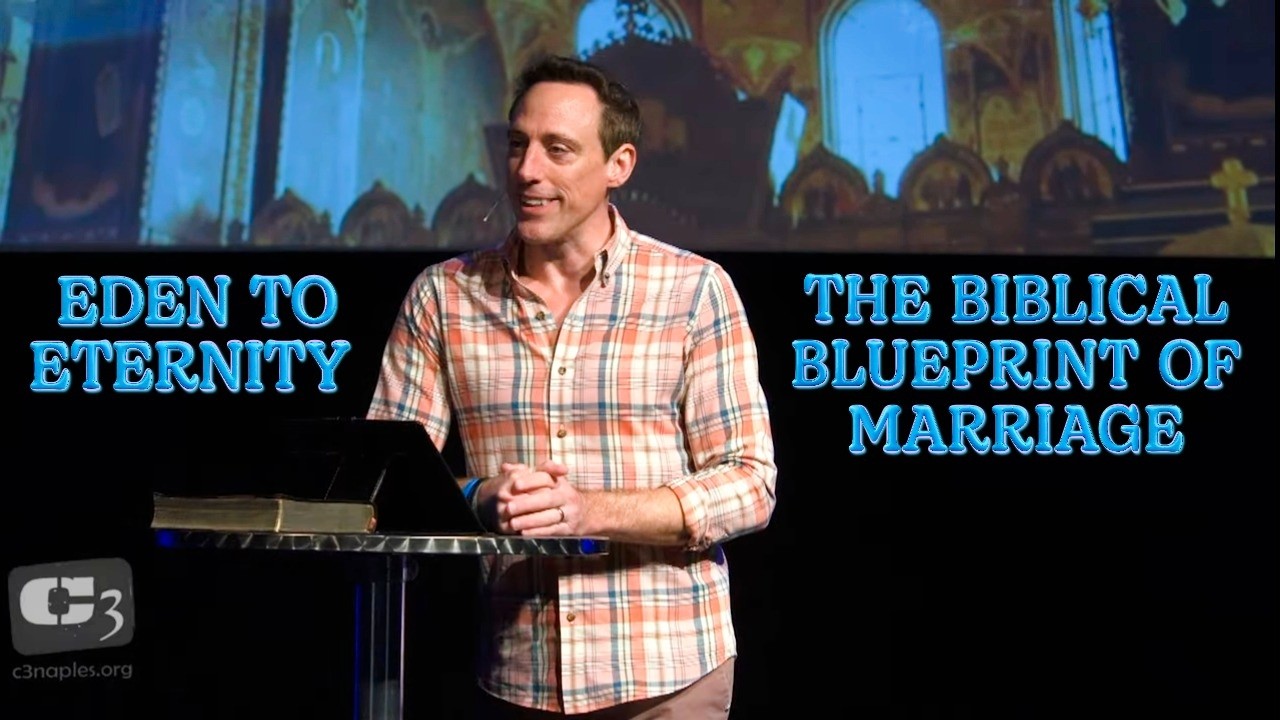
- Eden to Eternity: The Biblical Blueprint for Marriage
- By Gene Simco
- "Pizza be with you." (And also with you.)
- I am simply making up for last week. If you were here, you know that I did not say the word "pizza" in my entire sermon. It was a miracle to some that I got through a whole message without talking about it—and indeed, I love making pizza. We have it right here at the church in our wonderful café.
- But I want to talk about something else that happened in our café recently. Here at the church, we have complimentary condiments. I said condiments. Last week, we had hot dogs alongside some of the pizza products I like to make. I noticed we had the typical spread—mustard, ketchup—but I want to talk specifically about the kind of mustard we had.
- One of the most important kinds of mustard was absent: spicy mustard. I’m not talking about fancy mustard; they actually had Dijon up there, but that’s kind of a stuck-up mustard. When you are approaching a hot dog, ketchup is something babies put on it. Your children eat their hot dogs with ketchup. Standard yellow mustard just doesn't belong; that’s fake mustard. And Dijon doesn't quite fit the bill either. This week we are having bratwurst, and I hope there is spicy mustard in the café. In fact, I hear it is practically a crime to put anything other than good spicy mustard on hot dogs in Germany. (Don't quote me on that as a fact).
- Spicy mustard is so important to me that I have gone out of my way to make sure I am always prepared for a mustard emergency. I actually bought a case of spicy mustard packets. I made a habit of bringing them to different restaurants where I thought I might order a hot dog, knowing that here in Southwest Florida, they don't always carry the right kind.
- I was at one such restaurant with a friend. I ordered hot dogs, but I noticed the table only had that basic yellow mustard and ketchup for babies. They didn't have real mustard. So, I proceeded to use my emergency stash. My friend knows me well, so this didn't shock him, though he laughed. The waitress, however, was quite surprised when she saw the empty packets off to the side.
- She asked, "Did you bring your own mustard?" I said, "Yes." She replied, "You are one crazy..." I won't say the rest of her sentence, but I thought to myself, I’d rather be crazy than stupid.
- Today, we will be talking about a more important kind of pairing—a more important complementarian issue. That is, how we complement each other in marriage. We are taking a deep dive into a topic that affects almost every single one of us. Even if you aren't married and don't plan to be, you know people who are. We are going to look at what the Bible actually says about marriage.
- I can tell you from firsthand experience that understanding and applying this biblical design is the ultimate key to a lasting union. When we try to build a marriage on cultural trends, our own feelings, or pop psychology, the foundation eventually cracks. But when we build it on God's unredacted design, it stands. To understand this design, we have to clear up a lot of modern confusion.
- So we are going to trace the entire narrative of marriage from the very beginning in Genesis all the way through the New Testament. We are going to look at what it is, what it isn't, why it matters, and how we are supposed to live it out.
- To understand marriage, you have to go back to the blueprint. The original design was established right at creation in the Garden of Eden. God created one man and one woman.
- Genesis 1:26-27 Then God said, “Let us make human beings in our image, to be like us. They will reign over the fish in the sea, the birds in the sky, the livestock, all the wild animals on the earth, and the small animals that scurry along the ground.” So God created human beings in his own image. In the image of God he created them; male and female he created them.
- It is interesting to note here: we are created in God's image, male and female. What I want you to know is that these are two separate genders. This is important to note.
- Now, if we go to Genesis 2, we get a second telling, or a different perspective, of creation. You'll notice that the order of things is a little bit different here. We've talked about the problems with a strict, literal reading in the past, and this is one glaring example. When you line up Genesis 1 and 2, they don't actually match up chronologically. God is not trying to write a science textbook here. It's simply a zoom-in, a different perspective on this time. So let's take a look without digressing too much on that point.
- Genesis 2:4-7 This is the account of the creation of the heavens and the earth. When the Lord God made the earth and the heavens, neither wild plants nor grains were growing on the earth. For the Lord God had not yet sent rain to water the earth, and there were no people to cultivate the soil. Instead, springs came up from the ground and watered all the land. Then the Lord God formed the man from the dust of the ground. He breathed the breath of life into the man’s nostrils, and the man became a living person.
- If we look at the rest of the account as an overview, we see the trees in the garden, the fruit, the four rivers, and the man tending the garden. He can eat everything but the Tree of Knowledge. Then God said that it is not good for the man to be alone, and He would make a helper for him.
- So the Lord formed from the ground all the animals. Now the man gets animals to be companions. God brought them to the man, and he names all of the animals, the birds of the sky, and all the wild animals. But the text says there was still no helper just right for him.
- Genesis 2:21-24 So the Lord God caused the man to fall into a deep sleep. While the man slept, the Lord God took out one of the man’s ribs and closed up the opening. Then the Lord God made a woman from the rib, and he brought her to the man. “At last!” the man exclaimed. “This one is bone from my bone, and flesh from my flesh! She will be called ‘woman,’ because she was taken from ‘man.’” This explains why a man leaves his father and mother and is joined to his wife, and the two are united into one.
- Right here, before sin ever entered the world, God established the standard. But notice the order of operations here: the leaving must happen before the cleaving. A man must leave his father and mother before he is joined to his wife.
- I cannot tell you how much marital strife happens simply because spouses never truly left their families of origin. Whether it is emotional dependence, financial reliance, or simply prioritizing a parent's opinions over a spouse's, a new household cannot be established until your primary loyalty shifts to your spouse. You have to leave to join.
- As a disclaimer here, we are also told to honor our parents, so we have to balance this. We honor them, but the spouse is now our priority, and the parents' job is to support that. If they are doing anything to interfere with our marriage, or if they are harmful to it, they are abusing the command to "honor your father and mother" like a blanket command. If that is the case, you must love them from afar. You must love and honor an abusive parent from a safe distance.
- So again, we go back to the leaving and cleaving concept. This is very, very important. This is where a lot of marriages fail. It is absolutely crucial to understand that our spouse is now our new priority, and anything that gets in the way of that needs to be put aside. We are going to love and honor our parents, but if they are going to interfere with God's design, we must love them from afar.
- The Two Genders & Modern Confusion
- The Theological Context (For Sermon Expansion or Articles) When teaching on Genesis 1:27, the emphasis on "two separate genders" is a necessary anchor for modern culture. The biblical text makes it clear that gender is not a fluid social construct, but a biological and theological design directly established by the Creator. The image of God (the Imago Dei) is uniquely reflected in the complementary binary of male and female. When Jesus Himself is asked about marriage in Matthew 19:4, He points directly back to this unredacted Genesis design to shut down cultural arguments, stating clearly: "Haven’t you read the Scriptures?... They record that from the beginning God made them male and female."
- The Greek Connection If you want to pull the original language to show how concrete this binary is in Scripture, look at the Greek translation of the Old Testament (the Septuagint) and Jesus' exact words in Matthew 19:4.
- The Greek words used are:
- ἄρσεν (arsen): Male (Biological man)
- θῆλυ (thely): Female (Biological woman)
- These are not words of internal feeling or societal roles; they are definitive, biological terms. God’s blueprint for humanity and marriage requires this specific, complementary pairing. Any deviation from this—whether it is altering one's physical gender or seeking marriage outside of the male-female design—is a departure from the Edenic blueprint.
- Now let's talk about marriage's design and some common arguments surrounding it. From Genesis to Revelation, there are absolutely no other examples or definitions of marriage in the Bible outside of a man and a woman. That is the unredacted and consistent standard.
- People try to argue that the Bible presents alternative models, and they will often bring up the relationship between David and Jonathan. For some context here, Saul was the first king of Israel. This was actually a stated rejection of God. In 1 Samuel 8, the people want an earthly king. God tells Samuel the prophet to make this announcement: "They are not rejecting you; they are rejecting me." So they pick Saul, who seems like a worthy candidate. He is a head taller than everyone else, but he turns out to be the wrong guy. His disobedience causes him to lose the kingship, and he has a son named Jonathan.
- When David is chosen and anointed as the new king, he is not quite on the throne yet. During this time, David and Jonathan develop a very strong bond, a deep friendship. That is the context for them. So let's look at the text.
- 1 Samuel 18:3 And Jonathan made a solemn pact with David, because he loved him as he loved his own soul.
- People begin to take this and read a modern, romanticized lens into this verse, but historically and biblically, that is completely false. This was a covenant of deep, platonic loyalty. It was a strategic political alliance between the current king's son and the future king of Israel. It was a brotherly bond of survival, not a marital or sexual relationship. The biblical design of marriage remains exclusively between a man and a woman.
- Later, when Jonathan and Saul are killed, David mourns with the Song of the Bow. Within that song, we read this verse.
- 2 Samuel 1:26 How I weep for you, my brother Jonathan! Oh, how much I loved you! And your love for me was deep, deeper than the love of women!
- Here, David is expressing profound grief at losing his brother-in-arms. In the ancient world, the bond between warriors who fought, bled, and forged political survival covenants together was considered the highest form of loyalty and brotherly love. This surpassed the culturally arranged marriages of the day, which were often more about property and politics than romance. It was a covenant of ultimate loyalty, not a sexual relationship.
- But let's play devil's advocate. Even if David did engage in that, as we saw last week when we were discussing Judas Maccabeus, we don't copy sin. We are not going to copy David's sin. David was guilty of a lot of things. He murdered men, women, and children. His pride caused him to take a census that got 70,000 people killed. Everyone knows about the adultery with Bathsheba, and that also involved the murder of Uriah. We don't copy his mistakes. So even if David was engaging in homosexual activity, it wouldn't make it right. It is not a command from God anywhere in the Old or New Testament. It is never permissible, and it is always condemned.
- That doesn't mean we hate people who are engaging in that. We hate the sin, not the sinner. But there is no command for it, and no biblical example of it being blessed. We go back to the beginning. Anything else is a rejection of God's purpose and God's design.
- Addressing Common Arguments on Homosexuality
- For those wanting to dig deeper into this, you can find more resources and articles on biblebelievingchristian.org, but we need to address a few common cultural arguments right here.
- The most frequent claim you will hear today is: "Jesus never actually denounced homosexuality."
- This is a profound misunderstanding of first-century Jewish language and theology. Jesus did not need to list every specific sexual sin because He frequently condemned porneia, the Greek word for sexual immorality. To a first-century Jewish audience, porneia was an umbrella term that automatically encompassed any and all sexual activity outside of the covenant of marriage between one man and one woman, exactly as it was strictly defined in Leviticus.
- Furthermore, we know that times have not changed and God's standard has not evolved. If we look forward to the Book of Revelation, when Jesus returns in the future, the text is explicit that the sexually immoral will not be permitted in the new heavens and the new earth. People try to argue that biblical sexual ethics are outdated and merely a product of their time. They are not. Jesus is the same yesterday, today, and forever. He does not change His nature, and He has not changed His design.
- Another common argument centers around the Apostle Paul. Critics claim that the concept of homosexuality didn't exist back then, so Paul couldn't have been writing about it.
- When Paul addresses sexual sin in the New Testament, he uses a very specific Greek word: arsenokoitai. Where did Paul get this word? He coined it directly from the Greek Septuagint translation of the Old Testament. If you look at Leviticus 18:22 and 20:13 in the Greek, the text uses two specific words to condemn a man lying with a man: arsen (meaning male) and koite (meaning bed).
- Paul took those two exact words from the Levitical law and smashed them together to create arsenokoitai—literally, "males who share a bed with males." It is undeniably clear. Paul was directly applying the timeless moral law of God regarding sexuality to the New Testament church.
- For More On This Topic:
- https://www.biblebelievingchristian.org/post/homosexuality
- Let's get back to the idea of being "one flesh." Let's explain this mystery here. What is amazing is that this Old Testament standard remains perfectly consistent in the New Testament. Jesus Himself grounds His teaching on marriage right back in Genesis.
- Matthew 19:4-6 “Haven’t you read the Scriptures?” Jesus replied. “They record that from the beginning ‘God made them male and female.’” And he said, “‘This explains why a man leaves his father and mother and is joined to his wife, and the two are united into one.’ (one flesh) Since they are no longer two but one, let no one split apart what God has joined together.”
- Now, the Apostle Paul echoes this exact same reality, but he adds a profound revelation regarding the purpose of marriage.
- Ephesians 5:31-32 As the Scriptures say, “A man leaves his father and mother and is joined to his wife, and the two are united into one.” This is a great mystery, but it is an illustration of the way Christ and the church are one.
- So why did God create marriage? Well, it wasn't just for human happiness, although it certainly provides that. It was for our holiness. The ultimate purpose of the "one flesh" design is to be an illustration. Paul is saying that our marriages are meant to be a living, breathing sermon to the world about how Jesus loves His people. When the world looks at a Christian husband and wife, and how they unconditionally love, forgive, and serve one another, they are supposed to catch a glimpse of the Gospel. It is a way in which we witness.
- But this raises a massive question: If the design is exclusively one man and one woman, why is there so much polygamy in the Old Testament? We see guys with multiple wives all over the place. Let's look at where it started.
- Genesis 4:19 Lamech married two women. The first was named Adah, and the second was Zillah.
- Lamech was from the rebellious, murderous line of Cain, who murdered Abel. He was the very first person in Scripture to deviate from Eden's design. Remember, this is after God's original design was rejected through free will. God gave us Paradise, but we rejected it. Lamech's arrangement is not the ideal.
- This human rebellion slowly became the cultural norm, peaking centuries later with King Solomon.
- 1 Kings 11:3 He had 700 wives of royal birth and 300 concubines. And in fact, they did turn his heart away from the Lord.
- Here is the answer to the polygamy problem: The Bible accurately records these events as cultural adaptations and political alliances, but it never prescribes them. God allowed it, but He never endorsed it. In every single biblical instance—from Abraham to Jacob to David to Solomon—polygamy leads directly to disaster, family strife, and even idolatry.
- We see this exact problem with Abraham and Hagar. It was a rushed attempt to usher in the fulfillment of a covenant promise. They end up bickering with one another, causing deep problems with Ishmael again and again. It is highly problematic. The biblical record of polygamy is a record of human brokenness, not a recommendation for human flourishing.
- When we get to the New Testament, the early church completely clears up the polygamy confusion and returns firmly to the Edenic ideal. Jesus is leading us back to Paradise. We have looked at Revelation and what Jesus does. The heavens and earth as we know them are destroyed, melted in flames, and we get a new heavens and a new earth, which greatly resembles the Paradise of Eden.
- We see a consistent standard restored here.
- 1 Corinthians 7:2 But because there is so much sexual immorality, each man should have his own wife, and each woman should have her own husband.
- We will get back to that section later, but you can clearly see the one-to-one standard. And for those leading the church, the standard was absolute.
- 1 Timothy 3:2 So a church leader must be a man whose life is above reproach. He must be faithful to his wife.
- In the original Greek text, the phrase translated as "faithful to his wife" literally reads as a "one-woman man" (μιᾶς γυναικὸς ἄνδρα / mias gynaikos andra). One man, one woman. The blueprint is fully restored.
- Just a quick note on divorce and polygamy regarding this passage. Some will make this verse strictly about divorce, claiming a church leader cannot have ever been divorced. However, the text does not actually say that. The Greek words for "bound" or "loosed" (the terms used for marriage and divorce) are not operative there, nor is divorce part of the immediate context.
- This requirement is primarily about faithfulness, but it is also highly probable that Paul was directly addressing the issue of polygamy. Think about it: if there were so many patriarchs in the Old Testament living in polygamy, Paul would have had to clear that up for the New Testament church. Interestingly, if you look at the 1560 Geneva Bible, the translators actually included a footnote in the margins specifically addressing this, noting that in ancient days, men often had many wives. Paul was shutting that door.
- The Mandate to Multiply
- Now, a lot of people in the church feel like if they aren't married, they are somehow missing the mark, and they will point back to Genesis.
- Genesis 1:28 Then God blessed them and said, “Be fruitful and multiply. Fill the earth and govern it.”
- We have to read this in context. When God said this, the earth was completely empty. There were exactly two people on the planet. This was a biological and cultural mandate for early humanity to populate the entire globe. It wasn't a rigid, universal requirement that every individual in human history must get married. This happens again with Noah as well. Context is key here; it is very important. We need to know the who, what, when, where, and why.
- Actually, the New Testament gives us a completely different principle on this. If we read it, we get a totally different perspective.
- The High Calling of Singleness
- In fact, the greatest man who ever lived, Jesus Christ, was not married. So, is Jesus sinning by not following this mandate? Impossible. It is because it's not a universal mandate for us today. Jesus actually praises those who remain single for the sake of the mission.
- Matthew 19:12 "Some are born as eunuchs, some have been made eunuchs by others, and some choose not to marry for the sake of the Kingdom of Heaven. Let anyone accept this who can."
- In our modern cultural climate, some people attempt to read this verse and misapply Jesus's reference to "eunuchs" as some sort of biblical endorsement of transgenderism or fluid gender identities. That is a complete misinterpretation of the text. Jesus is not talking about altering one's gender or identity; He is speaking specifically about the capacity and choice to physically reproduce and marry. A eunuch in the ancient world was a biological male who was physically unable to reproduce, often due to castration for royal service. Jesus uses this reality to describe those who voluntarily abstain from marriage and sexual relations—living as celibates—for the sake of focusing entirely on the Kingdom of Heaven. It is about a vow of devotion, not a change in gender identity. (For a more exhaustive breakdown of this, you can read the articles available at biblebelievingchristian.org).
- https://www.biblebelievingchristian.org/post/created-male-and-female-a-biblical-response-to-transgenderism
- So, singleness here is for the sake of the Kingdom. When Jesus is dialoguing with the Sadducees in Mark chapter 12 about the resurrection, they ask Him, "Who will a person be married to if they've had seven husbands?" Jesus points out that they will be like the angels. They will neither marry nor be given in marriage in heaven. It is very important to understand that earthly marriage is temporary.
- The main idea is being devoted to the Lord. The Apostle Paul echoes this and wishes more people would remain single so that they could serve God with undivided attention.
- Paul’s Counsel on Marriage and Singleness
- When we go to 1 Corinthians, Paul has to deal with the idea of sexual sin. There are some severe problems occurring in the church. In chapter 5, he deals with a guy who is sleeping with his stepmother, breaking that covenant, among other issues along the way. He addresses sexual sin heavily in chapter 6, and then he talks about divorce, marriage, and remarriage in chapter 7.
- He says something very interesting here:
- 1 Corinthians 7:7 But I wish everyone were single, just as I am. Yet each person has a special gift from God, of one kind or another.
- Paul actually wishes people wouldn't get married! But he immediately balances it by calling both marriage and singleness a special gift. Then, we can jump down to verses 32 through 35 to explain why he prefers singleness: it removes divided interests.
- 1 Corinthians 7:32-35 I want you to be free from the anxieties of this life. An unmarried man can spend his time doing the Lord’s work and thinking how to please him. But a married man has to think about his earthly responsibilities and how to please his wife. His interests are divided. In the same way, a woman who is no longer married or has never been married can be devoted to the Lord and holy in body and in spirit. But a married woman has to think about her earthly responsibilities and how to please her husband. I am saying this for your benefit, not to place restrictions on you. I want you to do whatever will help you serve the Lord best, with as few distractions as possible.
- Notice this: "I want you to do whatever will help you serve the Lord best." So what is serving the Lord best? Well, for some, singleness—like Paul—is the ideal. Like Jesus, we have seen over and over again in scriptures (1 Peter 2 comes to mind) how we are called to be like Him.
- But for others, if you will fall into sin, that was the point we looked at before at the top of this chapter. If you are going to fall into sexual sin, get married. That is 1 Corinthians 7:2. Marriage is also a gift and a protection from sin.
- Marriage is beautiful, but it requires a massive amount of earthly energy, compromise, and divided attention to do it right. Singleness is not a curse or a waiting room for your real life to begin. According to Paul, it is the ultimate strategic advantage for the Kingdom of Heaven because it allows you to be 100% undivided in your devotion to the Lord.
- Is it wrong to remain single? Absolutely not. It is a high, honored, and completely biblically supported calling to be devoted exclusively to the Lord.
- The Forgiveness Clause
- But for those who do choose to marry, the New Testament is packed with practical instructions on how to make it work. Before we even talk about roles in marriage, we have to look at the prerequisite for a healthy home: the forgiveness clause.
- Ephesians 4:32 Instead, be kind to each other, tenderhearted, forgiving one another, just as God through Christ has forgiven you.
- A thriving marriage isn't one where two people never mess up. It is one where two people have mastered the art of rapid forgiveness. You will make mistakes; I can tell you this from personal experience.
- The Golden Rule of Christian Marriage
- Once that foundation is set, Paul drops the golden rule of Christian marriage. He addresses the marriage itself with a vital disclaimer.
- Ephesians 5:21-33 And further, submit to one another out of reverence for Christ.
- (In the original Greek, this phrase literally translates to the "fear of Christ"—ἐν φόβῳ Χριστοῦ / en phobō Christou).
- For wives, this means submit to your husbands as to the Lord. For a husband is the head of his wife as Christ is the head of the church. He is the Savior of his body, the church. As the church submits to Christ, so you wives should submit to your husbands in everything. For husbands, this means love your wives, just as Christ loved the church. He gave up his life for her to make her holy and clean, washed by the cleansing of God’s word. He did this to present her to himself as a glorious church without a spot or wrinkle or any other blemish. Instead, she will be holy and without fault. In the same way, husbands ought to love their wives as they love their own bodies. For a man who loves his wife actually shows love for himself. No one hates his own body but feeds and cares for it, just as Christ cares for the church. And we are members of his body. As the Scriptures say, “A man leaves his father and mother and is joined to his wife, and the two are united into one.” This is a great mystery, but it is an illustration of the way Christ and the church are one. So again I say, each man must love his wife as he loves himself, and the wife must respect her husband.
- Remember that prior disclaimer—the forgiveness clause—and you see that this is entirely about mutual respect for one another. These are not verses that make abuse or unevenness permissible.
- Mutual Submission and Respect
- This comes up in Colossians as well.
- Colossians 3:18-19 Wives, submit to your husbands, as is fitting for those who belong to the Lord. Husbands, love your wives and never treat them harshly.
- This mutual submission is then fleshed out in specific ways for husbands and wives. Let's take a look at that.
- 1 Peter 3:1-2 In the same way, you wives must accept the authority of your husbands. Then, even if some refuse to obey the Good News, your godly lives will speak to them without any words. They will be won over by observing your pure and reverent lives.
- 1 Peter 3:7 In the same way, you husbands must give honor to your wives. Treat your wife with understanding as you live together. She may be weaker than you are, but she is your equal partner in God’s gift of new life. Treat her as you should so your prayers will not be hindered.
- Note the warning to the men here. A lot of people don't realize that your prayers can actually be hindered. This is how seriously we must love, respect, and absolutely not abuse our wives. Remember that picture of the Gospel we are supposed to be painting.
- Paul also talks about this in 1 Corinthians 7. If someone comes to Christ while they are already married, he instructs them not to leave their unbelieving spouse, but to be a witness to them. They might be saved because of you. Why? Because they might just observe your honorable behavior and decide to become Christians themselves. Another profound purpose of marriage is witnessing from within.
- The Biblical Formula and Practical Application
- So, what is the biblical formula here? Mutual submission plus sacrificial servant leadership equals a thriving biblical marriage.
- Let's think about this practically. This servant relationship naturally ties into concepts like the Five Love Languages. Now, I am not a big fan of extra-biblical programs, and I don't think we should rely on them entirely. But this is a good frame of reference to start with. Submitting to and serving your spouse means intentionally loving them in the language they understand. It means dying to your own preferences to serve theirs. It is putting them first every single day.
- The Love Languages framework looks at the ways in which people feel loved: words of affirmation, gifts, acts of service, quality time, or physical touch. You are going to fall primarily within one or two of those categories. That is how you prefer to be treated by your spouse. What you can do, just on your own, is think about the ways in which you like to be served, share them with your spouse, and have them do likewise.
- This aligns perfectly with Scripture.
- Matthew 7:12 Do to others whatever you would like them to do to you. This is the essence of all that is taught in the law and the prophets.
- This is the Golden Rule, and it opens the door to allow us to serve each other beautifully. While Jesus says to treat others the way you want to be treated, applying this to marriage means taking it a step further to acknowledge the details of how they specifically want to be loved. Not everyone receives love the way you receive it. For example, if you prefer physical touch—as most men do—but your wife really doesn't want to be touched today, pouncing on her is not going to be helpful. She might just want an act of service. Maybe just do the dishes.
- Narrowing the Golden Rule
- Let's go back to Matthew 7:12 for a moment. Jesus says to do to others whatever you would like them to do to you. He is painting with a broad, foundational brush here. But in the day-to-day reality of marriage, we have to narrow that brush. While Jesus gives us the baseline principle of treating others well, applying this to your spouse means taking it a step further: you have to treat them the way they specifically need to be treated.
- We actually see this exact kind of tailored, specific love modeled throughout the New Testament. Think about Jesus and Thomas after the resurrection. The other disciples had already seen the risen Christ, but Thomas needed something highly specific.
- John 20:25 They told him, “We have seen the Lord!” But he replied, “I won’t believe it unless I see the nail wounds in his hands, put my fingers into them, and place my hand into the wound in his side.”
- When Jesus finally appears to Thomas, He doesn't rebuke him for needing a different approach than the other disciples. He doesn't give Thomas a theological lecture, which would be Words of Affirmation, and He doesn't just sit in the room with him to offer Quality Time. Jesus meets Thomas exactly in the "language" Thomas requested.
- John 20:27 Then he said to Thomas, “Put your finger here, and look at my hands. Put your hand into the wound in my side. Don’t be faithless any longer. Believe!”
- Jesus adjusted His approach to give Thomas exactly what Thomas needed to feel secure and loved, even though the other disciples didn't require it.
- The Apostle Paul took this exact same approach. His entire strategy for ministry was based on adapting to the recipient rather than forcing everyone to adapt to him. He literally learned to speak the emotional and cultural languages of the people he was serving.
- 1 Corinthians 9:20-22 When I was with the Jews, I lived like a Jew to bring the Jews to Christ... When I am with those who are weak, I share their weakness, for I want to bring the weak to Christ. Yes, I try to find common ground with everyone, doing everything I can to save some.
- In a marriage context, this means that when you are with a wife who needs Acts of Service, you become a servant. When you are with a husband who needs Quality Time, you put the phone away and you become present. You find the common ground that speaks directly to them. Paul makes this a direct command later on, perfectly capturing the shift from "what I prefer" to "what my spouse needs."
- Romans 15:1-2 We who are strong must be considerate of those who are sensitive about things like this. We must not just please ourselves. We should help others do what is right and build them up in the Lord.
- You might prefer one way of doing things, but in a thriving biblical marriage, you willingly restrict your own preferences to build up your spouse in the way they need it most. You learn to speak their language.
- The Biblical Reality of Wedding Ceremonies
- Now, here is a fascinating part about all of this. For as much as modern Christianity makes of the wedding industry—the dresses, the flowers, the massive church services—there are zero marriage ceremonies or instructions for weddings anywhere in the Bible.
- Now, some, thinking they know the Bible well, will point to John 2 and object.
- John 2:1-2 The next day there was a wedding celebration in the village of Cana in Galilee. Jesus’ mother was there, and Jesus and his disciples were also invited to the celebration.
- Yes, Jesus attended a wedding, and this is where His first miracle occurred. But historically, this was a cultural community feast lasting several days. It was not a religious ceremony instructed by Scripture. Historically, biblical marriages were contractual unions between families. This continued for quite some time.
- If you read the Book of Tobit, it provides the most robust historical example of an ancient marital contract and prayer. But it is clearly a familial, legal agreement, not a church service. There was no church then. (Remember, last week we looked at some of the apocryphal books. If you are questioning why I am mentioning this, you can go back to last week's teaching where we saw that this book was a part of the Bible of the early church). But even there, it is not instructive for a ceremony.
- Even the Didache, which is an ancient manual of the early church written just after the New Testament that gives incredibly strict instructions for things like baptism, fasting, and communion, is completely silent on wedding ceremonies.
- The True Seal of the Covenant
- We need to talk about what actually seals a marriage in the eyes of God. In our modern culture, we think you are married the second you sign a legal document, or the pastor says, "I now pronounce you husband and wife." But biblically, the seal of the covenant is much, much deeper.
- If you look at the Greek word used for "marry" or "marriage" in the New Testament, you find the word gamos (γάμος). You have to be very careful because culturally, depending on how it is translated or spoken, you could very easily say a vulgar word. So gamos is really the exact root you want to use for marriage or wedding.
- To our modern, sanitized ears, the etymological root of this word and how it translates across languages can almost sound crude, because it points directly and unapologetically to the physical act of sexual intercourse. But the Bible isn't being vulgar; it is being brutally honest about the design.
- While we hear the word and think of a ceremony, the ancient Greek root carries a profound physical reality. In fact, it is from this exact Greek word that modern science gets the biological word gamete. A gamete is a male or female reproductive cell that is designed physically to unite with the opposite sex to create life. Key words: opposite sex to create life. God is letting us know that it is the act of consummation that actually seals the union.
- The Promise vs. The Consummation
- You see, a wedding ceremony is the promise of the covenant, but the marriage bed is the consummation of the covenant. That is very important to remember. When the Bible speaks of marriage, the language itself is inescapably tied to the biological, physical coupling of a man and a woman. Anything outside of that design is outside the definition. It isn't just a legal contract or an emotional feeling. The word itself points to the physical union.
- This brings us full circle to Genesis 2:24.
- Genesis 2:24 This explains why a man leaves his father and mother and is joined to his wife, and the two are united into one.
- God didn't say a man will leave his father and mother, sign a piece of paper, and they will be legally recognized. He said, "...and the two are united into one flesh." That is the male and the female. The physical union isn't a byproduct of being married. Biblically speaking, it is the literal, physical seal of the covenant. It is the moment when the two actually become one.
- Why Do We Have a Ceremony?
- So, if a wedding ceremony isn't biblically mandated, why do we do it?
- Well, we do it because it is a beautiful cultural preference, but more importantly, it shifts our culture's broken perspective on marriage. Our culture treats marriage like a consumer contract: "I will stay as long as you meet my needs, and as long as I am happy."
- A Christian ceremony shifts this perspective back to a biblical covenant: "I am making this vow before God, and my love is steadfast regardless of the circumstances." Much like baptism, a Christian wedding ceremony serves as a public announcement of a sacred covenant. It secures the affirmation, the prayer, and the accountability of the church as a supportive community. We stand together to witness two people stepping into the great mystery of illustrating Christ's love to the world.
- The Covenant Complete
- As we close, consider that just as I go out of my way to ensure I have the right complement for the meal—the exact spicy mustard that fits the bratwurst—God has gone to infinite lengths to provide the perfect design for our lives. Marriage is not a cultural accessory, a consumer contract, or an afterthought. It is a holy, unredacted covenant. Whether you are single and devoted to the mission, or married and striving to reflect the love of Christ, the call is the same: to walk in obedience to the original blueprint. We are not here to chase the fleeting trends of a broken world; we are here to honor the design of the One who created us. Let us be a people who hold fast to the covenant, who pursue holiness above happiness, and who live as a living, breathing illustration of the Gospel to a world that desperately needs to see what true, sacrificial love looks like.
- ________________________________________
- ©️Copyright 2026 Gene Simco Most Scripture quotations are taken from the Holy Bible, New Living Translation, copyright ©1996, 2004, 2015 by Tyndale House Foundation. Used by permission of Tyndale House Publishers, Carol Stream, Illinois 60188. All rights reserved. Scriptures in brackets reflect the original Biblical languages.