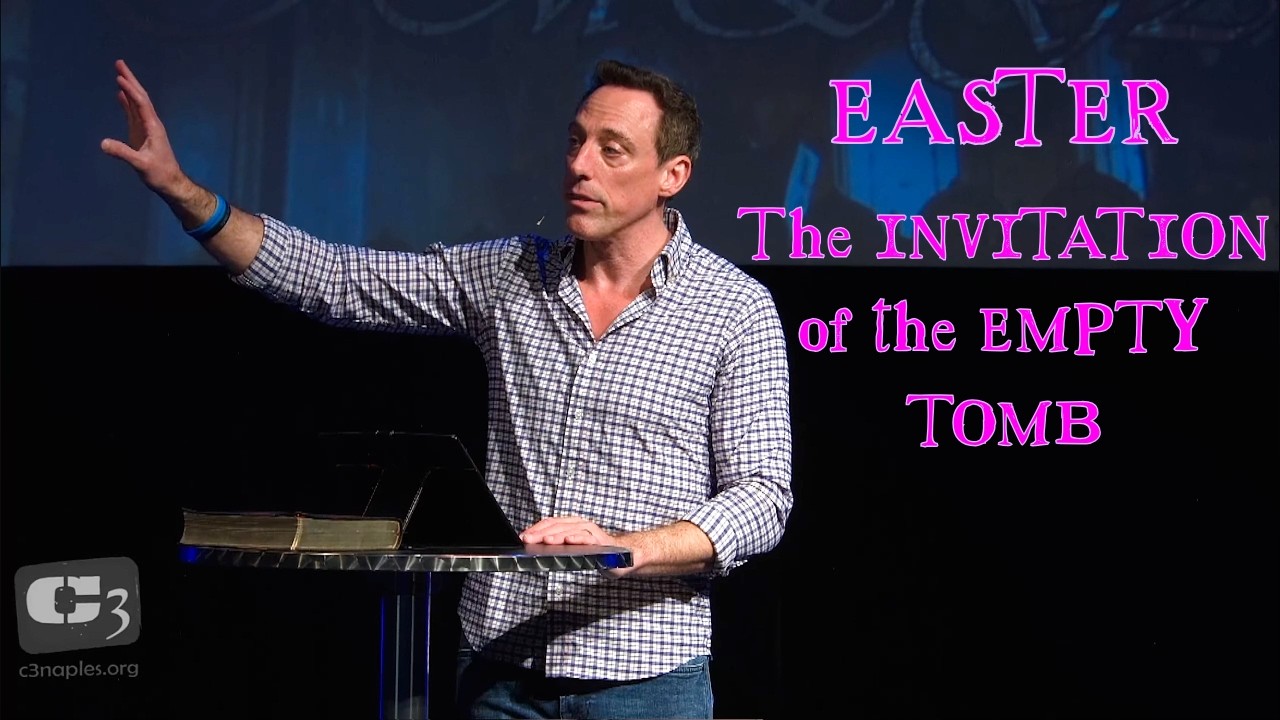
Easter: The Invitation of the Empty Tomb
This Easter sermon, "The Invitation of the Empty Tomb," explores the historical and apologetic foundations of the resurrection. It argues that the Gospels are reliable eyewitness accounts, harmonizes the resurrection timeline, and demonstrates that Christianity has far stronger historical backing than major figures like Alexander the Great or other world religions. By highlighting Jesus's fulfillment of Old Testament prophecy, His explicit claims to divinity (the "I AM" statements), and the overwhelming testimony of the Apostles, the message concludes that the resurrection is a guaranteed receipt of eternal life, offering a powerful invitation to leave the "hamster wheel" of worldly pursuits and step into a new life and family through Christ.
Reader's Version
- Easter: The Invitation of the Empty Tomb
- Sermon by Gene Simco
- Reader’s Version
- I heard a story recently about a man and his five-year-old son who were driving past a local cemetery. As they drove by, the little boy noticed a massive pile of dirt next to a freshly dug grave. The boy immediately pointed out the window to the grave and shouted, "Look, Dad! One got out!"
- Today, we celebrate the One whom the grave could not hold.
- Before we dive fully into our message this Easter morning, I want to do a little bit of housekeeping, have a quick family talk, and acknowledge something very special.
- Family Talk & The Pizza Oven
- A couple of weeks ago, I mentioned a pizza oven during a sermon. If you are new among us to the church, you need to know that we believe in doing things exactly the way the early church did them.
- Biblical Insight: The Early Church Blueprint When we talk about doing things like the early church, we are pointing directly to the blueprint found in Acts 2:42 (NLT): "All the believers devoted themselves to the apostles’ teaching, and to fellowship, and to sharing in meals (including the Lord’s Supper), and to prayer." We have dispensed with the exhausting modern church programs and simply focus on the Word, fellowship, and eating together like a family!
- Because we eat together after every service, one of the ways I love to serve—because I'm not just a pastor here, I am a member of this church family—is by cooking. One of my favorite hobbies is baking and making pizza from scratch. I love the whole process of making the dough, and I love sharing it with our church family.
- During our recent study of 1st and 2nd Timothy, we looked at Paul's harsh warnings about pastors who try to get rich off the church. Today, we constantly see pastors buying mansions or asking their congregations to buy them private jets. During that message, I slipped in a little joke. I said, "Well, maybe the church could buy me a pizza oven!" The oven I currently have is really for personal use, so cooking for thirty or more people puts a heavy strain on it and stretches my limited abilities.
- I jokingly asked for a pizza oven, not knowing that someone from the church would actually go out and buy it!
- It completely amazed me. It was totally unexpected. I want you to know it will absolutely be used to serve the church.
- I thanked them personally but will not be announcing who it was because pastorally, we never want to build an air of competition in the church. There are many people here who simply can't afford a pizza oven (myself included, which is why I didn't buy it!). We never want to make people jealous or stir up unnecessary financial competition, which is exactly why we keep these generous gifts anonymous. But, with that being said, they will be eating pizza for life and so will all of you … if you show up on Sundays!
- Today after church, we will be having pizza with fresh dough made from scratch. It is a three-day dough. In other words, I make it on day one... and on day three, it rises like Jesus.
- And that is exactly what we are going to talk about today.
- The Witnesses to the Resurrection
- Today's Easter message might sound familiar if you have been here every year.
- It is because this is a critically important message in the vein of apologetics that every single Christian should know. We repeat it every year because it is that important. While it won't be identical to years past, the core elements will be very similar. This is something I really want those of you who consider yourselves a part of this church family—my students here—to completely commit to memory.
- We are witnesses, and witnesses must know the why.
- We looked at 1 Peter 3:15 recently:
- "And if someone asks about your hope as a believer, always be ready to explain it. But do this in a gentle and respectful way." (1 Peter 3:15b-16a, NLT)
- We have to be able to make a defense for what we know, and we are commanded to do it with gentleness and respect. But at the same time, your facts have to be tight! If you haven't already committed these historical facts to memory, I highly encourage you to do so today.
- The Gospels as Testimony
- In our current Alpha and Omega series, we have been talking extensively about the New Testament. We are hitting the pause button on that series for a second today, but we have recently learned what the Gospels actually are: they are ancient, Greco-Roman biographies of the life and ministry of Jesus Christ.
- From an apologetics perspective, scholars call them witnesses.
- This is because they were written primarily by eyewitnesses, or by people who directly interviewed the eyewitnesses. This will be very important to understand in today's message. Let's look at the books of the New Testament specifically as witnesses to Jesus:
- Matthew: Some modern scholars might try to debate this today, but that is not at all how the early church understood it. This is the Gospel of Matthew. He was an Apostle, a direct disciple of Jesus who knew Him intimately and wrote this firsthand account about Him.
- Mark: Mark was likely a young boy who witnessed Jesus firsthand (we see him appear later in the book of Acts). He was a witness to many of the events surrounding Jesus and the birth of the early church.
- Luke: Luke was a brilliant physician and a traveling companion of Paul. While he wasn't an original disciple, he had direct access to the Apostles who were alive at the time. He spent his time mingling with and interviewing the actual eyewitnesses to compile his historical account!
- John: He is explicitly referred to as "the disciple whom Jesus loved." This is clearly a direct, intimate, eyewitness testimony.
- Paul: Clearly, Paul is a witness. He had a miraculous, blinding encounter with the resurrected Jesus well after His ascension into heaven, and he became responsible for planting many of the early churches. We will look closely at his testimony today.
- Apologetics Insight: Interviewing the Witnesses When we say that some Gospel writers "interviewed the witnesses," we are pointing directly to the opening lines of the Gospel of Luke. Luke outright states his historical method in Luke 1:2-3 (NLT): "Several biographies of Christ have already been written using as their source material the reports circulating among us from the early disciples and other eyewitnesses. Having carefully investigated everything from the beginning, I also have decided to write an accurate account for you..." Our faith is not built on blind myths; it is built on careful, investigated, eyewitness testimony!
- We are going to look at the books of the New Testament today as witnesses to Jesus. That is going to be a very important word for us today!
- Putting the Chronology Together
- What we celebrate today is the resurrection. Some people rightly call this Resurrection Sunday instead of Easter Sunday.
- What we are going to do right now is look at the resurrection chronology and put it all together. This can be very confusing for people, because the four Gospels are all coming at the events from different perspectives.
- These are not contradictions; they are like different camera angles on the exact same event.
- If we had multiple security cameras set up here in the church today, those cameras would capture different things. If you are looking only at "Camera 1," you might see something happen on Sunday that "Camera 2" or "Camera 3" completely missed. If each of those camera angles was a witness in a trial, you might be tempted to say, "Wait, their stories are different!" Well, yes, they are different, but when we put them together, they are all recording different angles of the exact same event!
- That is exactly how the Gospels work. When we put them together, they form one harmonized, historically powerful testimony. This timeline reflects real witnesses, real events, and most importantly, a real resurrection.
- The Passion Week Recap
- I developed a chart a long time ago for a series called The Rest of the Story. (If you are looking at the chart today, you will notice a cartoon version of me in the picture. You might be tempted to say I've been working out! I think if I keep doing "leg day," I'm going to have to get a new chart. But we will wait for next year for that!)
- In the meantime, you can use this chart to roughly follow along with the chronological sequence of the Gospels.
- First, let's recap the Passion Week. This is the timeline of events leading up to the crucifixion:
- The Last Supper: Jesus shares the Passover meal with His disciples.
- The Predictions: He predicts His betrayal by Judas and Peter's denial.
- The Arrest & Trials: Jesus is arrested in the garden. He goes through a series of trials—first before the Jewish religious leadership (Annas and Caiaphas), and then He is handed over to the Roman governor, Pontius Pilate, who reluctantly orders His crucifixion.
- The Crucifixion & Burial: He is crucified and dies. He is then buried by some very unlikely people! Joseph of Arimathea (a wealthy member of the Jewish council who owned the empty tomb) and Nicodemus (a Pharisee we read about in the Gospel of John) step forward to bury Him.
- This brings us directly to Sunday morning.
- The Resurrection Timeline
- 1. The Earthquake & The Guards According to Matthew, there is a massive earthquake. An angel of the Lord comes down, rolls the heavy stone away, and the Roman guards are so terrified they literally faint like dead men.
- 2. The Women Set Out for the Tomb Mark, Luke, and John record that early Sunday morning, Mary Magdalene and the other women set out for the tomb carrying burial spices. As they walk, they are wondering, "Who is going to roll the stone away for us?" 3. The Empty Tomb Discovered They arrive and find the stone already rolled away!
- 4. The Footrace (John & Peter) At this point, Mary Magdalene immediately turns around and runs to tell Peter and John. The two men sprint to the tomb. John arrives first and looks in at the linen clothes. Peter arrives behind him and barges right in.
- Biblical Insight: John's Easter Egg There is a funny little "Easter egg" buried in John's account of the resurrection. When John is writing his Gospel decades later, he makes absolute sure to record for all of history that he won the footrace between him and Peter! (John 20:4)
- Luke tells us that Peter leaves the tomb completely amazed.
- 5. The Angels Speak to the Women The other women then enter the tomb. (Mark describes seeing a young man in a white robe; Luke and John specify they are angels). Inside the tomb, the angels speak one of the most famous lines in history: "Why do you seek the living among the dead? He is not here. He has risen!" The women flee the tomb with a wild mix of fear and joy to go tell the rest of the disciples.
- 6. Jesus Appears to Mary Magdalene In the meantime, Mary Magdalene has returned to the tomb. She is weeping outside, and she actually sees Jesus! Initially, through her tears, she mistakes Him for the gardener. Then Jesus says her name: "Mary." She immediately clings to Him, and He tells her not to hold on to Him because He has not yet ascended to the Father.
- 7. Jesus Appears to the Women Shortly after, Jesus meets the other women who are running from the tomb, and they fall down and worship Him—a critically important theological detail.
- 8. The 40 Days of Appearances From here, Jesus spends 40 days appearing to many different people:
- The Road to Emmaus: Luke famously describes Jesus appearing to Cleopas and his friend. He walks with them, teaches them, and eats with them.
- The Disciples (Without Thomas): He appears to the disciples in a locked room. Again, He eats a piece of broiled fish to prove He is not a ghost.
- Doubting Thomas: A week later, He appears again when Thomas is present. Thomas sees the wounds and confesses, "My Lord and my God!" (Explicitly confessing that Jesus is God).
- The Sea of Galilee: He appears to them while they are fishing. They catch exactly 153 fish, and Jesus cooks them breakfast on the beach.
- The Apostle Paul: Years later, He miraculously appears to Paul on the road to Damascus.
- Key Takeaways for Apologetics
- When we look at these resurrection events as a legal, historical case, there are several key takeaways every Christian needs to know:
- 1. A Massive Amount of Witnesses The book of Acts records that Jesus appeared to many people over a period of 40 days. Paul will later record in 1 Corinthians 15 that Jesus appeared to over 500 people at one time! This was not a localized, isolated "mass hallucination." There are multiple, overlapping layers of testimony and confirmation.
- 2. The Women as Primary Witnesses The women were the absolute first witnesses to the empty tomb and the risen Christ. You have to understand the ancient culture: in the first century, the testimony of a woman was not even considered valid in a court of law. To record women as your primary, foundational witnesses in an ancient document is astonishing. It actually adds an incredible level of historical credibility to the Gospels. If Peter and the disciples were making this story up as a hoax to gain power, they would never have used women as their primary witnesses. You would only write it that way if it was the absolute, unvarnished truth!
- 3. The Principle of Embarrassment Historians look for "embarrassing accounts" as proof of authenticity. Think about Peter's role in this story! If Peter and the men were inventing this religion to make themselves look like heroes, why would Peter write himself as a coward? He completely abandons Jesus. He isn't even there for Jesus's funeral! He flees the scene. John's account shows us that the women are the only ones brave enough to stand at the cross. The men are all hiding. You don't invent a story that makes the founders look this bad unless it actually happened.
- 4. The Anchor of Scripture When Jesus appears to the disciples on the road to Emmaus, He doesn't just show off miracles. He points them directly back to the Scriptures! He anchors His resurrection in the Old Testament prophecies written about Him. He constantly relates everything back to the Word of God, which perfectly sets up exactly what Paul is going to preach to the Corinthians.
- The "Game of Telephone" Myth
- When we look at the records of the New Testament, we are looking at real, historic events. Yet, the modern claim against the New Testament is that it is just a giant game of telephone. When skeptics talk about the Bible, they will often ignorantly say, "It's just a game of telephone. These things were written down really far away from the initial events." That is the main, popular charge leveled against the New Testament.
- But what if I told you that the resurrection of Jesus actually has more historical support than some of the most famous figures in world history? For instance, let's look at Alexander the Great.
- When looking for the history of Alexander the Great, we have to look at something similar in order to compare the two. For Alexander, the most famous and widely accepted historical account is found in Plutarch’s Life of Alexander. Plutarch's account was written around 100 AD. The Gospels were also written in the first century, so Plutarch is writing roughly in that exact same time frame.
- But there is one massive problem: Alexander the Great died in 323 BC.
- The main writing that we rely on for his life—the most credible account in 100 AD—was written roughly 400 years after his death! We do have another historical account (from Diodorus Siculus in his Library of History) that was written roughly 300 years after Alexander, but that is still a 300-year gap!
- Historical Insight: The Time Gap Comparison To truly understand how strong the Gospels are, you have to compare the historical "time gaps" (the time between the actual event and the first surviving written record of that event).
- Alexander the Great: Died in 323 BC. The best surviving historical records (Plutarch and Arrian) were written 400+ years later. The original eyewitness accounts are completely lost to history. Yet, no modern historian doubts the events of Alexander's life.
- Jesus of Nazareth: Died roughly 30-33 AD. The Gospels were written between 60 AD and 90 AD—a gap of only 30 to 60 years! Furthermore, the Apostle Paul wrote his letters even earlier (around 50-55 AD), meaning we have written records circulating while the eyewitnesses to the resurrection were still alive and walking the streets!
- When you look at the writings of Alexander, people believe them implicitly. The exact charge that skeptics level against the Gospels (that they were written "too far" from the events) is actually true of the writings of Alexander the Great! Yet, the secular world believes everything that is said about him.
- Now, were there writings about Alexander before Plutarch? Yes, but we do not have them! They are lost to history. So, secular historians have to rely entirely on Plutarch’s writing and just assume that everything he sourced and everything he is saying about Alexander is true. We have to believe him at face value. We are historically believing facts from one person’s gathering of information. It is a case of one person writing centuries later, with no surviving eyewitness accounts, yet no one doubts that Alexander existed or did the things recorded about him.
- The Superior Evidence of the New Testament
- Now consider this: the resurrection of Jesus is attested to in multiple Gospels, all written within a few decades of Jesus’s death.
- We do not have just one person's summary written 400 years later. We have multiple, independent accounts that act as actual legal witnesses, written in the lifetime of the people who saw it happen.
- But the absolute strongest historical claim of all comes from the Apostle Paul in 1 Corinthians, chapter 15.
- The Historical Gold of 1 Corinthians
- When we look at 1 Corinthians, it is included in the corpus of writings by the Apostle Paul. This follows the history we see in the book of Acts, where we are introduced to him first as a violent persecutor of the church, and then as a radical church planter.
- When we get to 1 Corinthians, we find a church in a region that is having a lot of problems. Paul is writing to address many severe, foundational issues within the congregation. If you break down the letter, it looks like this:
- Chapters 1–4: Pastor worship and church division.
- Chapters 5–7: Severe issues of sexual immorality and marriage.
- Chapters 8–10: Divisions over secondary doctrines and cultural issues of the day.
- Chapters 11–14: Chaos and disorder within the worship service.
- And then we get to Chapter 15, and Paul is dealing directly with the resurrection.
- He places it here because everything in the Christian faith lives or dies on whether the resurrection actually happened. Paul knew this all the way back in the first century. There were people actively saying that the resurrection didn't happen, or that it had already happened spiritually, and Paul sets out to write an extremely in-depth chapter dedicated entirely to the physical resurrection of Jesus.
- Apologetics Insight: The Case for Christ If we look at modern history, the investigative journalist Lee Strobel set out to completely dismantle Christianity. He was told by leading scholars and experts that if he wanted to destroy the Christian faith, he had to target the resurrection. If the resurrection didn't happen, then Christianity isn't true—it falls apart like a house of cards. But during his rigorous historical investigation, Strobel ended up finding out that there is actually more historical evidence for the resurrection than against it, and he surrendered his life to Christ! Even today, the historical reality of the resurrection is the absolute lynchpin of our faith.
- The Primary Document
- The other incredible thing about 1 Corinthians is that it is a primary document.
- This means it was written by an eyewitness, within the witness period. In historical terms, this is what is known as "historical gold." Even deeply secular, non-Christian scholars will universally accept 1 Corinthians as a highly reliable historical document. There are no serious historical scholars today who would reject it! They all agree that Paul was a real person, he was a primary leader in the early church, and he absolutely believed what he was writing.
- So, let's look closely at what Paul believed in the context of 1 Corinthians being a reliable historical document.
- 1 Corinthians 15:1–8 (NLT):
- "Let me now remind you, dear brothers and sisters, of the Good News I preached to you before. You welcomed it then, and you still stand firm in it. It is this Good News that saves you if you continue to believe the message I told you—unless, of course, you believed something that was never true in the first place.
- I passed on to you what was most important and what had also been passed on to me. Christ died for our sins, just as the Scriptures said. He was buried, and he was raised from the dead on the third day, just as the Scriptures said. He was seen by Peter and then by the Twelve. After that, he was seen by more than 500 of his followers at one time, most of whom are still alive, though some have died. Then he was seen by James and later by all the apostles. Last of all, as though I had been born at the wrong time, I also saw him."
- The Eyewitness Challenge
- This is not a myth. This is early, verifiable eyewitness testimony.
- Unlike the biographies we have for Alexander the Great, this is a primary document written by a witness within the historical period. This is an eyewitness writing about the risen Jesus and boldly calling on other living witnesses to back him up!
- Paul is, in essence, putting his sources right on the table. He is telling the Corinthians, "If you don't believe me, you can go check with all of these other prominent leaders in the church! Go talk to Peter. Go talk to James. Go talk to the 500 people who saw Him at the exact same time—most of them are still alive today, and they will verify it for you as well!"
- The Problem with Other Religions
- Just like the historical records of Alexander the Great, where there are no surviving eyewitness accounts, the major problem with other world religions is that they also follow this exact same trend. No other religion on earth can make the historical claims that Christianity makes. From a purely historical and legal perspective, the origins of other religions lack verifiable eyewitnesses.
- When you look at the origins of most other belief systems, you are dealing with a private, unrepeatable event. Someone goes off alone, claims to have a divine revelation, comes back, and you just have to believe that one person's word at face value.
- The Contrast with Islam
- One of the most popular religions in the world today—and one that is fundamentally at odds with Christianity—is Islam.
- In order to subscribe to Islam, you have to believe what Muhammad said at face value. There were no witnesses to his initial revelations. He claimed to be visited by an angel in a cave, but no one else was there to verify it. You are dealing with one man going into a cave, having a private revelation, coming back, and demanding that millions of people believe his singular, uncorroborated view of it.
- The Contrast with Mormonism
- You even see this same pattern in subsets that claim to be forms of Christianity, or cults that add things to the Bible. A perfect example is Mormonism.
- Mormonism rests entirely on the claims of one person: Joseph Smith. In the 1820s, he claimed to go off into the woods in upstate New York and have a private vision of God and Jesus. Later, he claimed an angel led him to buried golden plates, which he translated privately (often looking into a hat with a "seer stone"). While he later produced friends who claimed to be "witnesses" to the plates, the foundational revelation of the entire religion was a completely private, unverified encounter. People simply had to take Joseph Smith at his word.
- Apologetics Insight: The Historical Gap of Buddhism If we apply the same "time gap" test we used for Alexander the Great to other major religions, Christianity's uniqueness becomes even more stunning. Consider Buddhism. Siddhartha Gautama (the Buddha) lived and taught roughly in the 5th to 4th century BC. However, his teachings were passed down strictly by oral tradition for centuries. The earliest written records of his teachings (known as the Pali Canon) were not written down until the 1st century BC! That is a historical time gap of around 400 years between the life of the founder and the first written records.
- The Unique Credibility of Christianity
- Christianity is entirely unique in this way. Think about this: there are no surviving writings from Jesus Himself. Instead, the historical foundation of our faith is built on other people recording what He did.
- You have multiple, independent people who surrounded Him, lived life with Him, watched Him perform public miracles, saw Him die, and saw Him resurrected. They then recorded what He did, and all of their accounts match up beautifully within the actual eyewitness period. Jesus didn't rise from the dead privately in a cave and tell one person to spread the word; He appeared publicly to hundreds of people!
- So whether you are comparing it to ancient secular history or to other world religions, Christianity is far superior in historical credibility than any of them.
- This is not like any other religious myth or spiritual resume. This is verifiable history. Nothing matches Christianity in either of these regards.
- The Book of Acts: History in Action
- If we look past the Gospels and step into the book of Acts, we see the dynamic history of the early church.
- This history was recorded by Luke. It is important to understand that the Gospel of Luke and the book of Acts are actually a two-part historical volume. Luke was a meticulous physician. He was incredibly careful to interview the eyewitnesses and record a highly detailed, historically verifiable account of everything that went on.
- When we look at the book of Acts, we see the disciples stepping up to give powerful public defenses of the faith. Stephen gives a massive sermon before he is martyred. Paul gives brilliant defenses before Roman governors. But the very first public sermon of the church is given by Peter on the Day of Pentecost.
- Look closely at Peter’s sermon in Acts 2:22–32 (NLT):
- "People of Israel, listen! God publicly endorsed Jesus the Nazarene by doing powerful miracles, wonders, and signs through him, as you well know. But God knew what would happen, and his prearranged plan was carried out when Jesus was betrayed. With the help of lawless Gentiles, you nailed him to a cross and killed him. But God released him from the horrors of death and raised him back to life, for death could not keep him in its grip. > King David said this about him: ‘I see that the Lord is always with me. I will not be shaken, for he is right beside me. No wonder my heart is glad, and my tongue shouts praises! My body rests in hope. For you will not leave my soul among the dead or allow your Holy One to rot in the grave. You have shown me the way of life, and you will fill me with the joy of your presence.’
- Dear brothers, think about this! You can be sure that the patriarch David wasn’t referring to himself, for he died and was buried, and his tomb is still here among us. But he was a prophet, and he knew God had promised with an oath that one of David’s own descendants would sit on his throne. David was looking into the future and speaking of the Messiah’s resurrection. He was saying that God would not leave him among the dead or allow his body to rot in the grave. > God raised Jesus from the dead, and we are all witnesses of this."
- Old Testament Insight: The Two Tombs When Peter quotes King David in this sermon, he is pulling directly from Psalm 16. Peter makes a brilliant, undeniable historical argument to the Jewish crowd. He points out that David couldn't have been writing about himself, because David's tomb was right there in Jerusalem! Everyone knew where David was buried, and his bones were still in it. Therefore, David had to be prophesying about his future descendant, the Messiah. Peter contrasts the occupied tomb of King David with the empty tomb of King Jesus to prove that prophecy had been perfectly fulfilled.
- Liars Make Poor Martyrs
- From ancient prophecy to New Testament fulfillment, every single step of Jesus’s death, burial, and resurrection was foretold and subsequently documented by eyewitnesses.
- The early church did not begin as some vague, spiritual philosophy. It began entirely because people truly believed that Jesus physically rose from the dead. And here is the ultimate apologetics proof: almost all of those witnesses were brutally killed for that belief.
- They did not die for political power. They did not die for money. They did not die for worldly gain. People will sometimes die for a lie if they believe it to be true, but no one willingly dies for a lie that they know they invented. These men were tortured and executed because they had physically seen the risen Christ with their own eyes, and they simply couldn't deny the truth.
- You see, the witnesses didn't just believe Jesus was a good teacher. They believed that Jesus was God.
- Did Jesus Ever Claim to Be God?
- People will often make another major claim against the Bible. They will confidently say, "Well, Jesus never actually said that He was God."
- Let me give you a quick illustration to show why this argument falls apart. There are many different ways to claim your identity. Let's say that you are out to dinner with your wife at a restaurant. Someone comes up to your table and asks your wife if you are married. Your wife might point to you and say, "He is my husband." Now, she didn't directly say the exact words, "I am married." She said, "He is my husband." A skeptic could technically argue, "Well, she never actually said she was his wife!" But anyone listening knows that by affirming your identity as her husband, she was absolutely declaring that she is your wife.
- The exact same thing happens in the Gospels. People look for one highly specific, twenty-first-century English sentence ("I am God") and miss the massive, undeniable declarations of identity Jesus makes on every page.
- For example, look at the opening of John's Gospel. John writes: "In the beginning was the Word, and the Word was with God, and the Word was God... He was in the beginning with God." John doesn't initially call Him "Jesus"; he identifies Him as "the Word." But as you read the context, you know undeniably that the Word is Jesus. John is explicitly affirming that Jesus is God.
- The "I AM" Statements
- To truly understand how Jesus claimed to be God, you have to understand the Old Testament.
- When God appears to Moses in the burning bush in Exodus 3:14, Moses famously asks God what he should call Him.
- "God replied to Moses, 'I AM WHO I AM. Say this to the people of Israel: I AM has sent me to you.'" (NLT)
- I AM is the holy, personal name of God.
- Throughout the Gospels, Jesus repeatedly takes that holy, personal name and applies it directly to Himself. Famously, there are seven distinct "I AM" statements in the Gospel of John (and even more depending on how you count!). Jesus says:
- "I am the bread of life." (John 6:35)
- "I am the light of the world." (John 8:12)
- "I am the gate for the sheep." (John 10:7)
- "I am the good shepherd." (John 10:11)
- "I am the resurrection and the life." (John 11:25)
- "I am the way, the truth, and the life." (John 14:6)
- "I am the true grapevine, and my Father is the gardener." (John 15:1)
- But there is one specific "I AM" statement that I intentionally left off that list.
- Greek Insight: Ego Eimi (I AM) In John 8:58, Jesus is having a heated debate with the religious leaders. He says to them: "I tell you the truth, before Abraham was even born, I AM!" Grammatically, this sentence makes absolutely no sense. You would normally say, "Before Abraham was born, I was." But Jesus intentionally breaks the grammar to use the Greek phrase Ego Eimi (ἐγώ εἰμι)—the exact Greek translation of the divine name given to Moses at the burning bush. He is not just claiming to be older than Abraham; He is claiming to be the eternal, uncreated God.
- Jesus didn't just claim to be a "good teacher" or a "moral leader." He claimed to be the exclusive way to God, the resurrection itself, and perfectly equal with the Father.
- Did the people of His day understand what He was saying? Yes—and they actually tried to kill Him for it! Look at their reaction in John 10:33 (NLT):
- "They replied, 'We’re stoning you not for any good work, but for blasphemy! You, a mere man, claim to be God.'"
- They certainly understood that by using this "I AM" statement, Jesus was calling Himself God. During His final trial, the High Priest asks Him directly if He is the Messiah, the Son of the Blessed One. Mark 14:62 (NLT) records His answer:
- "And Jesus said, 'I AM. And you will see the Son of Man seated in the place of power at God’s right hand and coming on the clouds of heaven.'"
- That is the statement that got Him executed.
- The Testimony of the Disciples
- So, as we saw, the enemies of Jesus clearly believed He was claiming to be God. But what about His followers?
- Not only did Jesus use the name of God, but the disciples repeatedly and explicitly called Him God because they truly believed He was God. Skeptics who claim the early church didn't view Jesus as divine have to completely ignore the writings of the New Testament. Let's look at the overwhelming testimony of the Apostles:
- John 20:28: When Doubting Thomas sees the resurrected Jesus, he falls down and declares: "My Lord and my God!"
- Romans 9:5: Paul writes, "Christ himself, who is God over all, blessed forever. Amen."
- Titus 2:13: "While we look forward with hope to that wonderful day when the glory of our great God and Savior, Jesus Christ, is revealed."
- 2 Peter 1:1: Peter writes, "This faith was given to you because of the justice and fairness of Jesus Christ, our God and Savior."
- Hebrews 1:8: The Father speaks directly to the Son: "But to the Son he says, 'Your throne, O God, endures forever and ever.'"
- Colossians 1:15: "Christ is the visible image of the invisible God."
- Colossians 2:9: "For in Christ lives all the fullness of God in a human body."
- 1 Timothy 3:16: "Christ was revealed in a human body and vindicated by the Spirit."
- The historical record is absolutely clear. Jesus claimed it, His enemies understood it, and His disciples preached it to the ends of the earth: Jesus Christ is God.
- The Validation of the Resurrection
- The physical resurrection of Jesus validated all of these massive claims. Not only did He promise to raise others, but He explicitly said that He would raise Himself!
- After the resurrection, the Apostles no longer spoke of Him merely as the Messiah; they boldly called Him God. Paul, Peter, John, and even God the Father in the book of Hebrews all explicitly declare the divinity of Jesus. If Jesus is not God, none of these verses make any sense! But Jesus rose from the dead, proving His claims and giving you eternal hope. Because He lives, you will live too.
- The Promise of Eternal Life
- Jesus repeatedly promises us eternal life. Look at His own words:
- John 11:25 (NLT): "Jesus told her, 'I am the resurrection and the life. Anyone who believes in me will live, even after dying.'"
- John 14:19 (NLT): "In just a little while the world will not see me again, but you will. Since I live, you also will live."
- John 14:2–3 (NLT): "There is more than enough room in my Father’s home. If this were not so, would I have told you that I am going to prepare a place for you? When everything is ready, I will come and get you, so that you will always be with me where I am."
- John 3:16 (NLT): "For this is how God loved the world: He gave his one and only Son, so that everyone who believes in him will not perish but have eternal life."
- The Apostolic Confirmation
- The Apostles passionately confirm this eternal hope throughout their letters. If we continue in 1 Corinthians 15, we see the absolute necessity of the resurrection:
- 1 Corinthians 15:17 (NLT): "And if Christ has not been raised, then your faith is useless and you are still guilty of your sins."
- 1 Corinthians 15:20 (NLT): "But in fact, Christ has been raised from the dead. He is the first of a great harvest of all who have died."
- Old Testament Insight: The First of the Harvest When Paul calls Jesus the "first of a great harvest" (traditionally translated as "firstfruits"), he is pointing directly back to the Old Testament Jewish festival of Firstfruits. During the harvest, the priest would take the very first sheaf of grain and wave it before the Lord. This first sheaf was a guarantee that the rest of the massive harvest was coming right behind it! Paul is saying that Jesus's resurrection is the "firstfruit"—the absolute guarantee that a massive resurrection of believers is coming right behind Him!
- The rest of the New Testament echoes this undeniable guarantee:
- 1 Corinthians 6:14 (NLT): "And God will raise us from the dead by his power, just as he raised our Lord from the dead."
- 2 Corinthians 4:14 (NLT): "We know that the same God who raised the Lord Jesus will also raise us with Jesus and present us to himself together with you."
- 1 Peter 1:3 (NLT): "All praise to God, the Father of our Lord Jesus Christ. It is by his great mercy that we have been born again, because God raised Jesus Christ from the dead. Now we live with great expectation."
- The Divine Receipt
- This living hope is for you.
- The resurrection wasn't just a dramatic exit; it was a divine receipt. Jesus didn't just claim to forgive sin; He proved He had the total authority to do so by completely conquering death itself! And because of this, those who believe will conquer death too.
- For us, death is not the end. It has no victory, and it has no sting.
- In this life, the cross wiped out our record of debt, and the empty tomb sealed the deal. Because He rose, we can be absolutely sure that our sins are forgiven. And because He lives, we know that we will live too.
- This is not wishful thinking. This is a hope grounded in history, backed by eyewitnesses, fulfilled by prophecy, and confirmed by an empty tomb. The resurrection declares that death is not the end. Brokenness doesn't get the last word. And your past does not define your future.
- The Invitation to New Life
- So at this point, if you have not accepted Jesus, you have now heard the Gospel. You have heard the truth and the historical facts about Jesus Christ.
- The biblical next step for you would be baptism. If you are reading this right now on our website, you can head over to the baptism section and simply read through some of the things you will be asked to affirm. We don't have long, complicated classes or anything like that, but I want to urgently invite you to consider being baptized.
- If you are done with the world and all the lies it is telling you... If you are done with the hate, division, anger, and self-destruction... If you are done with the pain and the deception out there in the world, and you want to become a part of something grounded in truth, joy, and hope—away from the heavy shame of regret—there is an alternative.
- If you are tired of the constant disappointment of putting your ultimate hope in relationships, in wealth, or perhaps in political candidates instead of Jesus... there is a better way.
- You see, we have a hope that no matter what happens to us here, it is completely overshadowed by the hope of a better life to come! And it brings a better life here as well—a life marked by love, joy, peace, patience, kindness, gentleness, and self-control. The key to that hope is the fact that death no longer has a sting.
- In 2 Corinthians 4:17 (NLT), Paul declares:
- "For our present troubles are small and won’t last very long. Yet they produce for us a glory that vastly outweighs them and will last forever!"
- It is the reality that we, too, will rise from the dead someday in Jesus. And here and now, we are filled with the Holy Spirit, who gives us a joy that will not disappoint like all the other temporary things of this world will.
- More About Baptism & Connecting with Us:
- https://c3naples.org/baptism/
- The Hamster Wheel of the World
- If you are looking to experience that joy, please connect with us. We get it here at C3 Church.
- I have chased all the things of the world in my past. You name it, I've chased it. I have experienced what the world tells you will bring a person joy and wealth, but I found out it was just like running on a hamster wheel. I can remember buying really expensive cars, and I wasn't even driving out of the dealership parking lot before I was already looking at the next expensive car! It was just a miserable, exhausting hamster wheel of unfulfilled desire.
- My wife will be sharing her testimony with the church soon. She has been in recovery for 11 years, but before that, she was trying to douse her pain and fill that unfulfilled desire with substances.
- Many of us have been exactly there.
- If you are new here to C3 Church, you need to know: we understand. We understand what it is like to be in the world and try to fulfill these massive desires with cheap things where God should be. That manufactured joy and manufactured hope will always, always disappoint. We get it.
- So, we are inviting you today to move from realization to relationship.
- Let that relationship shape your perspective so you can experience the power of the resurrection and a life of change—filled with hope and fueled by love. This is the absolute truth, and it sets you free from all of that exhaustion. Jesus is the Way, the Truth, and the Life, who provides a life of joy, peace, and hope through the Holy Spirit—the seal of our salvation that never disappoints.
- Because He lives, you are not defined by your past. You are invited into His future... and into a new family!
- Welcome to C3 Church
- If you are not a member already, I just want to take a moment to explain what we do here at C3 Church.
- We are a family-based church. We are deeply rooted in the Bible; that means we devote ourselves to the Word, to fellowship, and to the breaking of bread. We have no exhausting programs. We are not about money. We are not about just filling seats.
- We are about family.
- We are a community-based church with a massive heart for people in recovery. We use the building that we are in for community services as a bridge to this church. We allow recovery meetings to happen right here in our beautiful cafe so it doesn't feel like a punishment or a basement exile. We radically love people no matter where they come from, who they are, or what they’ve done. Regardless of their past, we embrace them as family. We create a bridge here so that they can find an eternal hope once their earthly lives are in repair and recovery.
- After church today, you are invited to join us in our cafe where, as I mentioned at the beginning of the message, we are going to enjoy some fresh, three-day-dough pizza together, exactly as a family would do!
- Regardless of where you come from, your socioeconomic status, or what you've done, you are welcome here. We want to break bread with you. We want to get to know you. We want to do life with you.
- The King is Calling Your Name
- History bends at the empty tomb.
- The resurrection isn't just something we celebrate; it's something we stake everything on. He is risen. Not symbolically. Not emotionally. Actually. Historically. Eternally.
- And that means your life doesn't have to stay buried in sin, in shame, and in yesterday. The resurrection is not just His story—it is your invitation.
- The grave is empty. The throne is occupied. And the King is calling your name.
- So don't just stand at the tomb. Step into the life He opened.
- Because if Jesus walked out of the grave, you don't have to stay in yours.
- ________________________________________
- ©️Copyright 2026 Gene Simco Most Scripture quotations are taken from the Holy Bible, New Living Translation, copyright ©1996, 2004, 2015 by Tyndale House Foundation. Used by permission of Tyndale House Publishers, Carol Stream, Illinois 60188. All rights reserved. Scriptures in brackets reflect the original Biblical languages.
