Reader's Version
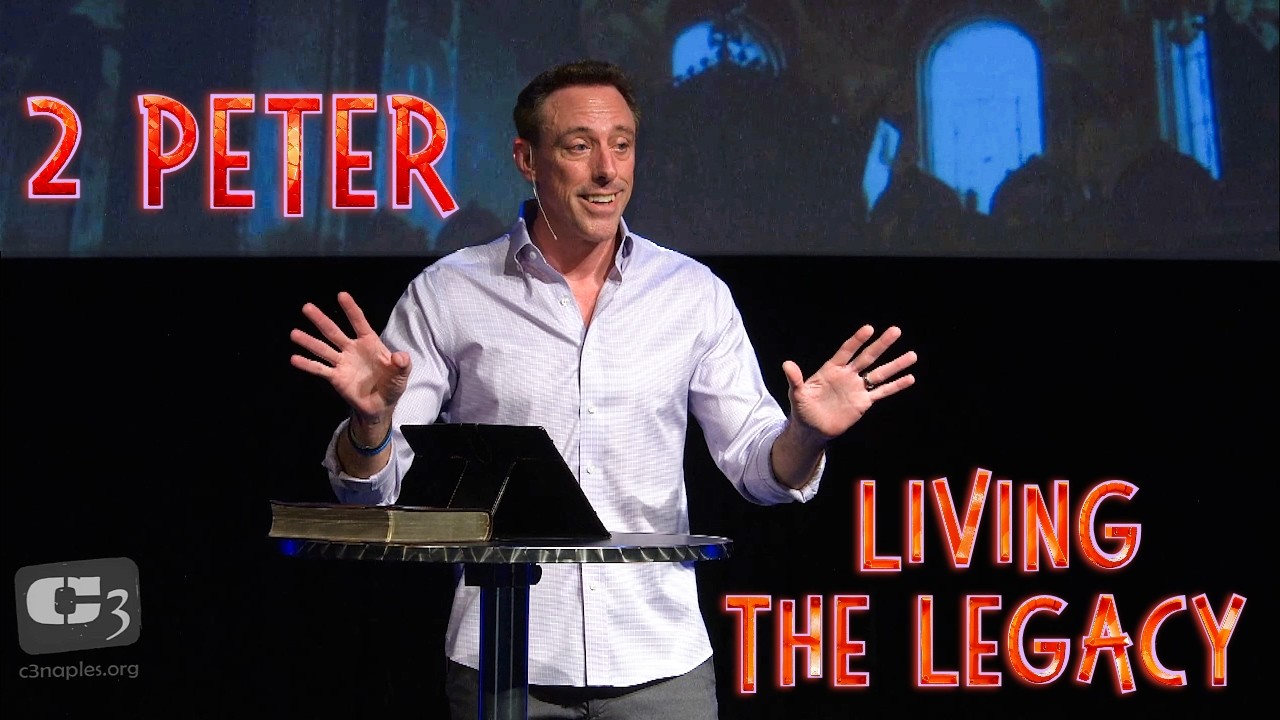
- 2 Peter: Living The Legacy
- Sermon by Gene Simco
- Reader’s Version
- I heard a story about a man whose father had just passed away. The father had spent his whole life trying to build a legacy, mostly through his career rather than his family. As a result, his son was not very close to him.
- At the funeral, it was no surprise that he was not connected—literally. He asked the pastor for the Wi-Fi password at the church.
- The pastor looked at him and said, "Have some respect."
- The man replied, "Is that in capital or lowercase letters?"
- Clearly, this son was in need of therapy. So at a therapy session later on, the therapist asked him, "What would you say to your dad if he were still alive today?"
- The son said, "Sorry for cremating you. I honestly thought you were dead."
- Indeed, this week we will talk about the futility of an earthly legacy, and how everything will eventually go up in flames.
- The End of the World
- Last week we looked at 1 Peter, and we talked about being stuck in the terminal. Now, in 2 Peter, we are going to look at the end of the world.
- Remember the history here. This is a severely persecuted church, likely suffering under the madness of Emperor Nero, who was literally burning Christians alive. Those were the fiery trials we talked about last week. Peter knows that his own end is drawing near, and he is preparing the church to endure that exact same possibility themselves.
- While the major theme of suffering carries over into this letter, Peter shifts his focus toward the end times and the ultimate return of Jesus Christ.
- Historical Insight: Introduction to 2 Peter If 1 Peter was a survival guide for external persecution, 2 Peter is a battle manual against internal corruption. Peter is writing his final farewell address. He knows he is about to be executed in Rome. Because he is about to leave them, he is urgently warning the church about false teachers infiltrating their ranks, twisting the grace of God, and mocking the promised return of Christ. He writes to anchor their faith in the absolute authority of Scripture and the undeniable reality of the coming judgment.
- A Faith That Cannot Be Stolen
- If we hop right into the text, we see exactly how Peter frames this final message.
- 2 Peter 1:1–2 (NLT):
- "This letter is from Simon Peter, a slave and apostle of Jesus Christ. I am writing to you who share the same precious faith we have. This faith was given to you because of the justice and fairness of Jesus Christ, our God and Savior. May God give you more and more grace and peace as you grow in your knowledge of God and Jesus our Lord."
- We have some immediate carryover themes here. Your faith is precious. Moths cannot destroy it, and thieves cannot steal it! We also see the justice of Jesus, which is exactly what we are waiting for. And we see the command to grow in knowledge, a theme that will be critically important throughout this letter.
- Also, make a quick theological note here: this is one of the places in the New Testament where Jesus is explicitly and clearly called God. We get other very clear examples of this in Romans 9:5 and Titus 2:13. The apostles fully understood and taught that Jesus was God in the flesh.
- The Power for Godly Living
- Now Peter puts it all together, along with some strict action steps.
- 2 Peter 1:3–4 (NLT):
- "By his divine power, God has given us everything we need for living a godly life. We have received all of this by coming to know him, the one who called us to himself by means of his marvelous glory and excellence. And because of his glory and excellence, he has given us great and precious promises. These are the promises that enable you to share his divine nature and escape the world’s corruption caused by human desire."
- Here he is talking about the world's corruption again. Notice that the world and the Word are always opposed to one another. But the good news is that we have the power to live godly lives in the middle of a corrupt culture!
- Greek Insight: The Power of God
- When Peter says, "By his divine power," the Greek word used for power is dthynamis (δύναμις). This is the exact same word used to describe the explosive, miraculous power of the Holy Spirit. It is where we get the English word "dynamite." Peter is telling the church: you are not trying to live a holy life on your own limited, human strength. You have been equipped with the miraculous, divine dthynamis of God to escape the corruption of the world!
- The Progression of Faith
- Because we have this power, here is the required response.
- 2 Peter 1:5–7 (NLT):
- "In view of all this, make every effort to respond to God’s promises. Supplement your faith with a generous provision of moral excellence, and moral excellence with knowledge, and knowledge with self-control, and self-control with patient endurance, and patient endurance with godliness, and godliness with brotherly affection, and brotherly affection with love for everyone."
- We see a clear required response here. We get a progression: moral excellence, knowledge, self-control, patient endurance, godliness, affection, and love. We see a lot of these exact same themes coming up elsewhere, whether it be the fruit of the Spirit in Galatians 5 or in Peter's first letter. And once again, we see the critical theme of self-control!
- Working Hard to Prove It
- So, what happens if we actually do this?
- 2 Peter 1:8–11 (NLT):
- "The more you grow like this, the more productive and useful you will be in your knowledge of our Lord Jesus Christ. But those who fail to develop in this way are shortsighted or blind, forgetting that they have been cleansed from their old sins. So, dear brothers and sisters, work hard to prove that you really are among those God has called and chosen. Do these things, and you will never fall away. Then God will give you a grand entrance into the eternal Kingdom of our Lord and Savior Jesus Christ."
- There is that theme of knowledge again!
- Theological Insight: The Pursuit of Knowledge The pursuit of godly knowledge and wisdom has been a major thread in our study. In James 1:5, we were commanded, "If you need wisdom, ask our generous God, and he will give it to you." In 1 Peter 1:14, Peter told the church, "Don't slip back into your old ways of living to satisfy your own desires. You didn't know any better then." A lack of knowledge leads to sinful desires, but growing in the knowledge of Jesus Christ makes us productive, useful, and absolutely unshakeable in our faith.
- If we grow in this knowledge, we will be useful, and we won't be bad, sinful witnesses to the world.
- Notice again this theme of working hard to prove we are Christians. That is not exactly a mainstream concept in the modern church, but there is a clear formula here: do these things, and God will give you a grand entrance into the eternal Kingdom!
- As we saw earlier in Ephesians 2:8-10, we completely believe that we are saved by God's grace through our faith in Jesus Christ. But if we keep reading to verse 10, we see that we are created anew in Christ Jesus for the very purpose of doing the good works He planned for us long ago!
- Peter's True Legacy
- Peter applies this exact standard to himself.
- 2 Peter 1:14–15 (NLT):
- "For our Lord Jesus Christ has shown me that I must soon leave this earthly life, so I will work hard to make sure you always remember these things after I am gone."
- This is the background reality of the letter. Peter knows he is going to die. But in the meantime, he is working hard, too. He reminds us that he is subject to these exact same commands.
- Peter knows exactly where his true legacy lies. It is not in building an earthly career like the man in our opening story. His legacy is found through discipleship, through working hard to pass the torch of truth to the next generation before he goes home.
- The Threat of False Teachers
- As we turn the page to what we now call chapter two, Peter directly addresses the issue of false teachers. He just finished establishing that true prophecy never came from the prophet's own initiative, but from the Holy Spirit. Now, he introduces the dark contrast to that truth.
- 2 Peter 2:1–3 (NLT):
- "But there were also false prophets in Israel, just as there will be false teachers among you. They will cleverly teach destructive heresies and even deny the Master who bought them. In this way, they will bring sudden destruction on themselves. Many will follow their evil teaching and shameful immorality. And because of these teachers, the way of truth will be slandered. In their greed they will make up clever lies to get hold of your money. But God condemned them long ago, and their destruction will not be delayed."
- We have seen this concept before. False teachers can completely slander the way of truth with their wicked actions and twisted teachings. False teachers are a severe problem that the New Testament simply does not ignore, yet it is an issue we dismiss entirely too easily in the mainstream, modern church.
- Notice the primary motivation Peter exposes: it is almost always about the money. You can usually spot a false teacher quickly because, beneath the clever lies, they are driven by greed.
- Echoes of Ancient Judgment
- Peter then moves on to some heavy examples of judgment from the Old Testament to prove that God does not let this kind of rebellion slide.
- He talks about the angels who sinned and the flood of Genesis 6, pointing right back to that picture of Noah and baptism that we saw last week. He gives the fiery example of Sodom and Gomorrah. He points to Balaam, a notorious false teacher from the book of Numbers who loved the wages of wickedness.
- Peter then unleashes a scathing description of these corrupt leaders that sounds exactly like the Book of Jude—which we will get to later in this series. He describes them as irrational animals headed for destruction, a disgrace and a stain on the church, adulterous, and completely useless.
- A Terrifying Warning
- Then Peter issues a severe warning that perfectly mirrors the terrifying passages we studied in Hebrews 6 and 10.
- 2 Peter 2:20–22 (NLT):
- "And when people escape from the wickedness of the world by knowing our Lord and Savior Jesus Christ and then get tangled up and enslaved by sin again, they are worse off than before. It would be better if they had never known the way to righteousness than to know it and then reject the command they were given to live a holy life. They prove the truth of this proverb: 'A dog returns to its vomit.' And another says, 'A washed pig returns to the mud.'"
- This definitely sounds an awful lot like Hebrews 6 and Hebrews 10! Peter says they are actually worse off than before. They have tasted the truth, known the way to righteousness, and then deliberately rejected the command to live a holy life. They have disdained and trampled on the Son of God.
- Historical Insight: The Dog and the Pig At the end of this severe warning, Peter quotes two vivid proverbs. The first one is a direct quote from the Old Testament. Proverbs 26:11 says, "As a dog returns to its vomit, so a fool repeats his folly."
- But the second phrase—"A washed pig returns to the mud"—is not actually found anywhere in the canonical Bible! So where did Peter get it? Peter is quoting a well-known secular proverb from the ancient world. Scholars note that variations of this pig proverb were incredibly common in Hellenistic culture and ancient Near Eastern wisdom literature, most notably in the ancient Story of Ahikar (an Aramaic wisdom text that was widely read in the 1st century). Peter uses this popular cultural saying alongside Scripture to make a devastating pastoral point: you can wash the outside of a pig, but if its fundamental nature hasn't changed, it will always go right back to the mud. A false teacher might look clean on the outside for a season, but without a true, born-again heart, they will always return to their worldly corruption.
- The Final Day of the Lord
- As we turn the page again and enter into what we now call chapter three, we see a heavy reminder of the Day of the Lord.
- Theological Insight: The Day of the Lord In biblical prophecy, the phrase "the Day of the Lord" does not always refer to the end of the world. In the Old Testament, the prophets frequently used it to describe a localized, historical event of God's judgment happening closer in time (such as the Babylonian invasion or the destruction of Jerusalem). However, Peter is looking far beyond those historical events. He is pointing exclusively to the ultimate, final Day of the Lord in Jesus Christ—the definitive end of human history and the final judgment of the world.
- Peter reminds us about the flood again. But he says that the current world is being stored up—not for water this time, but for fire.
- But when exactly will this happen? Remember what Jesus said about setting dates: no one knows, and no one should pretend to know! Jesus made this incredibly clear in Matthew 24:36, stating, "However, no one knows the day or hour when these things will happen, not even the angels in heaven or the Son himself. Only the Father knows." He repeated it right before His ascension in Acts 1:7, telling the disciples, "The Father alone has the authority to set those dates and times, and they are not for you to know."
- Since we do not know the day, Peter gives us some very reassuring points to anchor our faith.
- 2 Peter 3:8–10 (NLT):
- "But you must not forget this one thing, dear friends: A day is like a thousand years to the Lord, and a thousand years is like a day. The Lord isn’t really being slow about his promise, as some people think. No, he is being patient for your sake. He does not want anyone to be destroyed, but wants everyone to repent. But the day of the Lord will come as unexpectedly as a thief. Then the heavens will pass away with a terrible noise, and the very elements themselves will disappear in fire, and the earth and everything on it will be found to deserve judgment."
- While that last part about everything disappearing in fire may not sound very reassuring to the world, it is reassuring for us if we are Christians!
- Remember that theme we saw last week: judgment begins with God's household. We will all be judged. But note the profound heart of God in this passage: the Lord is being incredibly patient. He wants everyone to be saved. This is another massive reason why we need to be very good witnesses! We should have a genuine, urgent love for our neighbors, knowing that God's patience is their window of salvation.
- The New Heavens and the New Earth
- Now, this language about the end of the world perfectly echoes both Jesus and Paul. We come to a highly visual and often ignored scriptural truth: the heavens and the earth will literally be destroyed by fire.
- 2 Peter 3:11–13 (NLT):
- "Since everything around us is going to be destroyed like this, what holy and godly lives you should live, looking forward to the day of God and hurrying it along. On that day, he will set the heavens on fire, and the elements will melt away in flames. But we are looking forward to the new heavens and new earth he has promised, a world filled with God’s righteousness."
- Theological Insight: The Futility of Earthly Legacies This passage completely crushes modern dispensationalist obsessions with building a third physical temple in Jerusalem or trying to establish a permanent earthly kingdom. Peter is explicitly clear: everything on this earth is going to burn. Trying to build a permanent theological or personal legacy on a planet that is literally marked for destruction is the ultimate futility. Our hope is not in the restoration of a physical nation; our hope is entirely in the New Heavens and the New Earth!
- The first major point I want to make about this is that Peter's description is not a one-off in the Bible. It is a consistent, foundational truth.
- Jesus said in Matthew 24:35 (NLT), "Heaven and earth will disappear, but my words will never disappear."
- John recorded the exact same reality in Revelation 21:1–2 (NLT): "Then I saw a new heaven and a new earth, for the old heaven and the old earth had disappeared. And the sea was also gone. And I saw the holy city, the new Jerusalem, coming down from God out of heaven like a bride beautifully dressed for her husband."
- Because we have this hope, we are given a clear action step: since everything will be destroyed, we should live godly lives with the unshakeable hope that there will be an uncorrupted New Heavens and New Earth.
- 2 Peter 3:14 (NLT):
- "And so, dear friends, while you are waiting for these things to happen, make every effort to be found living peaceful lives that are pure and blameless in his sight."
- There it is again: making every effort to live peaceful lives and being blameless!
- Verifying the Apostle Paul
- Peter then closes his letter by reminding them again that the Lord desires for everyone to be saved. But he issues one final warning about false teachers who constantly twist the Scriptures. Interestingly, he specifically points out that these false teachers twist the writings of the Apostle Paul!
- This is an incredibly important point. A lot of people today will try to dismiss Paul's writings, especially those involved in the modern Hebrew Roots movement. They do this because you cannot read Paul without knowing that the Old Testament Law is completely finished! Christ is the end of the law, as Paul clearly writes in Romans , Galatians and many other places. So, false teachers try to dismiss Paul and claim his writings are not actually Scripture.
- But look at what Peter does right here: he officially verifies Paul's writings as holy Scripture, placing them on the exact same level as the Old Testament prophets!
- 2 Peter 3:17–18 (NLT):
- "You already know these things, dear friends. So be on guard; then you will not be carried away by the errors of these wicked people and lose your own secure footing. Rather, you must grow in the grace and knowledge of our Lord and Savior Jesus Christ. All glory to him, both now and forever! Amen."
- Final Pastoral Charge: Between the Promise and the Fulfillment
- Peter's final letter leaves us with a stark but ultimately triumphant reality. We are living in the space between the promise and the fulfillment.
- This world, with all its corruptions, its false teachers, and its temporary legacies, is fading. It is destined to pass away in the fire of God's final judgment. But we are not a people without hope, and we are certainly not a people without power! By His divine power, God has already given us everything we need for a life filled with godliness.
- Because of that truth, we simply cannot afford to be spiritually complacent. We are called to work hard and build on our faith! We must relentlessly pursue moral excellence, knowledge, self-control, patience, endurance, and love. If we do this, Peter promises, we will not stumble, and God will give us a grand entrance into the eternal Kingdom of our Lord.
- So, while we wait for the Day of the Lord—a day that will bring a New Heavens and a New Earth completely free of sin—how should we live?
- We live distinct. We live holy. We make every effort to be found peaceful, pure, and blameless in His sight. Let the futility of this world's earthly moments drive you to store up your treasures in heaven, and continually, fiercely grow in the grace and knowledge of our Lord and Savior, Jesus Christ.
- Alpha and Omega Fulfillments: The Illusion of Permanence
- We find some powerful Old Testament connections throughout 2 Peter, including his mentions of Noah, Sodom, and Balaam. He is constantly looking back to the Old Testament to prove his points. But I want to draw your attention to one specific connection regarding our main theme today.
- Isaiah 65:17 (NLT):
- "Look! I am creating new heavens and a new earth, and no one will even think about the old ones anymore."
- That is right there in the Old Testament! Now look at how Peter fulfills it.
- 2 Peter 3:13 (NLT):
- "But we are looking forward to the new heavens and new earth he has promised, a world filled with God’s righteousness."
- This is the ultimate cure for the illusion of permanence. Isaiah promised it in the Old Testament, and Peter commands us to anchor our hope to the new, not the old things of this earth.
- When you spend your life building earthly legacies, when you hope for the old and trust in the monuments of this world, you are investing your entire life in something destined for the fire. True faith recognizes that the current heavens, the current earth, and all the things in it are actively passing away. We must stop trying to make a permanent home in a temporary, corrupt world! Instead, we must live holy, godly lives as we look forward to the uncorrupted New Heavens and New Earth where God's righteousness dwells.
- The Attempt to Purchase Permanence
- This is a very good time to share with you the history of our own church, and how this congregation went through a season where it desperately attempted to purchase permanence.
- The church originally started in 1980. That might seem like a long time ago to some people, but it was built like most congregational-type churches of that era. It was fairly traditional, complete with stained glass and all the usual religious trappings.
- However, because the church governance was congregational, and the voting members were largely not Bible-believing Christians, they eventually started chasing out pastor after pastor whenever they didn't get exactly what they wanted. Many faithful pastors came in and rightfully pointed out that the church was spending far too much money on earthly things and physical buildings. In response, the congregation would simply vote them out every two years—a practice that is entirely unbiblical.
- They expanded the church into a massive 45,000-square-foot facility, taking out a crushing second mortgage to do it. Ironically, they built what they called a "community center," but they completely refused to use it for the community! It had a beautiful basketball court and a full professional kitchen—everything you could possibly want to invite the surrounding neighborhood in for true outreach. But they kept it entirely to themselves.
- They were far more interested in building their own legacy through a physical building. There was absolutely no discipleship. They did not invest in a relationship legacy; they exclusively invested in an earthly, material thing.
- The Indoor Graveyard
- They were actively trying to purchase permanence. One of the most glaring ways they did this, especially as the congregation aged, was by deciding to build a columbarium.
- What is a columbarium? It is essentially an indoor graveyard for cremated remains. The church members would have these expensive little marble plaques made for themselves. Some very old, traditional churches have outdoor graveyards on the property, but this was a dedicated, expensive indoor space.
- The massive problem with this specific columbarium was its location. It was placed right up front, directly to the side of the altar! Instead of putting it in a separate room or a quiet outdoor area, these people wanted their names to be front and center during the actual worship service. You could even purchase different spots based on a financial hierarchy depending on how much money you had.
- In my opinion at the time, it was extremely distasteful. At first, I thought it might be a good thing—a sobering, visual reminder of inevitable death. But then, as I saw the prideful clamoring, the buying of premium spots, and the way the whole fund was set up, I realized exactly what it was: it was an attempt at immortality apart from Christ. It was a desperate attempt to be permanently remembered in a physical building.
- Well, the irony of earthly legacies is that years later, God orchestrated a way for us to swap buildings with another church, and the new owners promptly ripped the columbarium out!
- Saved From the Terminal Trap
- You see, God actually saved us from that old building. He gave us a miraculous opportunity to start fresh in a new place. He gracefully relieved us from the pressure, the crushing mortgage, and the financial weight of all the mistakes that the earlier crowd had made.
- Theological Insight: Warnings from the Wilderness
- When looking back at the early history of this church building project, it mirrors the rebellion of the Israelites in the wilderness. The Apostle Paul addressed this exact concept in 1 Corinthians 10. Speaking of the Israelites who were judged for their idolatry and worldliness, Paul writes in verse 6 (NLT), "These things happened as a warning to us, so that we would not crave evil things as they did." The massive debt and the prideful columbarium serve as a stark, historical warning to our current congregation!
- Once we got set up in our new spot, we took those hard lessons to heart. We now completely understand that the building is just a building. The true church is the body of Christ!
- Now, we invest fully in discipleship. We invest in relationships. We invest in the body of Christ over the physical bricks and mortar. We strive to do exactly what the early Acts 2 church did: we are devoted to the Word of God (which is that pursuit of holy knowledge Peter commanded), to true fellowship, to the breaking of bread, and to prayer (which is the ultimate demonstration of trust in God).
- You see, that columbarium was the perfect picture of the terminal trap.
- We spend so much time, money, and emotional energy trying to secure a permanent memorial in a world that is literally destined for fire. This is the ultimate futility of an earthly legacy. The profound truth of 2 Peter is this: the only monuments that will survive the final Day of the Lord are the ones we build in the Spirit.
- Storing Up Treasure in Heaven
- So, how do we actually store up our treasure in heaven? Peter reminds us in his second letter that we build our legacy through discipleship and character.
- Remember what he said in 2 Peter 1:14-15: "For our Lord Jesus Christ has shown me that I must soon leave this earthly life. So I will work hard to make sure you always remember these things after I am gone." You see, we must stop obsessing over the physical monuments we leave behind and start building our faith and our relationships. Peter gives us that exact formula in chapter one.
- Here is how we actively develop those traits and live them out.
- Moral Excellence
- This isn't just avoiding sin; it is the active pursuit of virtue. We should choose integrity when no one is looking. It means refusing to engage in the gossip at work, or choosing to be completely honest in a business deal, even if it costs you money.
- Knowledge
- Peter emphasizes that grace and peace are multiplied through the knowledge of God. This is the absolute key to not falling for false teachers. If we have knowledge of the Word, we will not be led astray, and we saw earlier that following false teaching has very serious consequences. Move beyond surface-level reading. Dig deeply into the full context of Scripture to truly understand the author's intent and to know God more intimately. Set a reading plan for yourself this week.
- Practical Insight: How to Read the Bible Here are two effective reading strategies to help you grow in biblical knowledge:
- Read by Movements: Remember, there were no chapter breaks in the original text! Instead of reading one chapter a day, pick a select amount of chapters that make up a whole movement. For example, read Genesis 1 through 5 as one section. Then read the flood account in chapters 6 through 11. Then read the Abraham narrative starting in chapter 12. In the New Testament, read the entire Sermon on the Mount (Matthew 5 through 7) in one sitting.
- The Expanded Daily Plan: If you have about an hour a day, read one chapter movement from each major section of Scripture: a movement from the Torah (Genesis-Deuteronomy), a movement from History (Joshua-Esther), one Psalm or Proverb, a movement from the Prophets, and a movement from the New Testament.
- When you read, apply basic comprehension skills. Ask: Who, what, when, where, and why? Most importantly, always develop the original audience's view. Do not put modern overlays on the text. Fully engage with the Scripture to get the actual historical context of what you are reading.
- Self-Control
- The world's corruption is caused by human desire. Self-control is actively cutting those influences off. Put a strict limit on what you consume. What is robbing you of your joy? What is setting you off? What is causing you to sin? It might be certain apps on your phone, social media, or the internet. There is a lot of corruption out there, and we need to have the self-control to actively cut it off. Turn off the news, put down the phone, intentionally say no to fleshly impulses this week, and say yes to the Spirit.
- Patient Endurance
- This is not giving up when doing the right thing gets exhausting. We need to keep serving, keep praying for that prodigal child, and keep showing up to your marriage or your ministry even when you do not see the immediate results, trusting that God is working in the waiting.
- Godliness
- Godliness is a life oriented entirely toward pleasing God. Bring God into your mundane routines. Turn your daily commute into a time of worship, prayer, or listening to the Bible. Constantly acknowledge His presence through your Tuesday afternoon, not just on Sunday morning!
- Brotherly Affection and Love
- You cannot be godly and hate your brother. Love is the absolute capstone of Peter's progression. Jesus said these are the greatest commands: love God with all your heart, soul, mind, and strength, and love your neighbor as yourself. He said that treating others the way you want to be treated fulfills the law and the prophets.
- Outside the church, love your neighbor! Remember, God is being patient for the sake of your neighbor's salvation, and so should you. Inside the church, remember that relationships are the key to a gospel legacy. It is very important to develop one-on-one, biblical discipleship relationships. Practically, be the first to apologize. Meet a physical need for someone in the church who can offer you absolutely nothing in return.
- Final Pastoral Charge: A Grand Entrance
- If you fail to develop these things, Peter says that you are blind. You are like the people obsessing over a stone box in a fading church building! But if you make every effort to respond to God's promises and build this kind of spiritual legacy, you will never fall away. Instead of a temporary nameplate on a wall, God Himself will give you a grand entrance into the eternal Kingdom.
- I know this world is loud. It demands our attention, it demands our allegiance, and it constantly tries to convince us that what we can see, touch, and buy is all that matters. Do not fall for the illusion. The monuments of this world are a passing shadow.
- The beautiful, triumphant truth of Peter's letter is not just a warning about what is passing away; it is an invitation into eternal glory.
- God has not left you alone to figure this out. By His divine power, He has already equipped you with absolutely everything you need for life and godliness. The same Spirit that raised Jesus from the dead is living in you right now, giving you the strength to choose moral excellence, the wisdom to grow in knowledge, and the endurance to keep loving when it gets hard.
- You do not have to exhaust your life striving for a temporary memorial on this fading earth. When you build your life on the imperishable promises of Jesus Christ, you are investing in a legacy that will outlast the stars.
- So, keep building. Keep growing in grace. Do not grow weary of doing good, because Peter promises that if you pursue these things, the King of Kings will not just let you slip through the back door of heaven. He will welcome you with a grand, triumphant entrance into His Kingdom!
- Let us be people who live distinct. Let us live holy. And let us look forward with absolute, unshakeable confidence to the New Heavens and New Earth. To Him be the glory, both now and forever.
- Amen.
- ________________________________________
- ©️Copyright 2026 Gene Simco Most Scripture quotations are taken from the Holy Bible, New Living Translation, copyright ©1996, 2004, 2015 by Tyndale House Foundation. Used by permission of Tyndale House Publishers, Carol Stream, Illinois 60188. All rights reserved. Scriptures in brackets reflect the original Biblical languages.