1 Timothy: Guard the Gospel or Lose the Church
What happens when a church prioritizes comfort, popularity, or charisma over truth and character? It quietly, and then publicly, implodes.
In this message, we dive into Paul's first letter to Timothy, a young pastor stationed in the massive, pagan city of Ephesus. Paul isn't writing a theology textbook; he is writing urgent triage instructions to a church standing in the blast radius of false teaching and cultural compromise. We explore why Jesus Christ is the one and only Mediator, why the church must function as a devoted family rather than a corporate service provider, and why sound doctrine must be fiercely protected.
Take Christ out, and the church becomes a club. Keep Christ central, and the church becomes a powerful witness to the world.
In this message, we dive into Paul's first letter to Timothy, a young pastor stationed in the massive, pagan city of Ephesus. Paul isn't writing a theology textbook; he is writing urgent triage instructions to a church standing in the blast radius of false teaching and cultural compromise. We explore why Jesus Christ is the one and only Mediator, why the church must function as a devoted family rather than a corporate service provider, and why sound doctrine must be fiercely protected.
Take Christ out, and the church becomes a club. Keep Christ central, and the church becomes a powerful witness to the world.
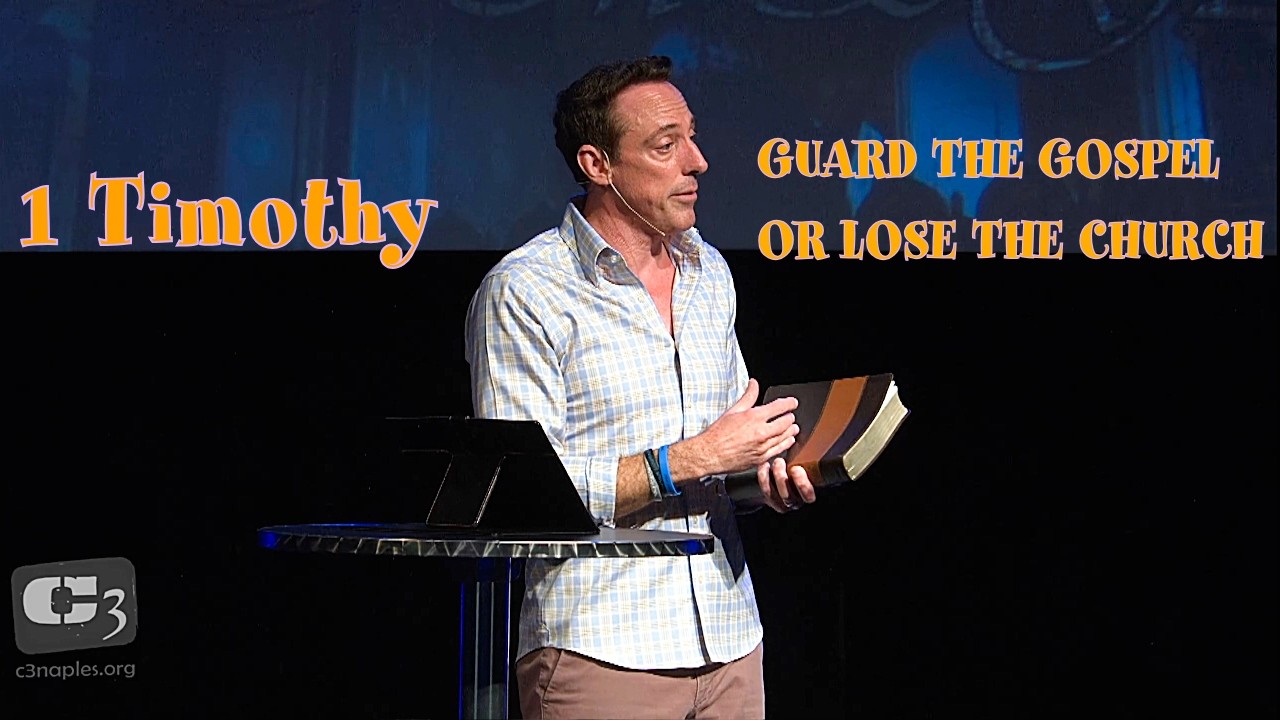
Video can’t be displayed
Reader's Version
- 1 Timothy: Guard the Gospel or Lose the Church
- Sermon by Gene Simco
- Reader’s Version
- I heard a story about a young pastor reading his Bible. Looking up from his reading, he asked his wife, "How many really great preachers do you think there are?"
- She replied, "Well, I don't know, but there is probably one less than you think."
- Today, we will be looking at what the Bible actually says about a good pastor.
- In this series, we've arrived at the New Testament and looked at the Gospels—Matthew, Mark, Luke, and John—the biographies about the life and ministry of Jesus Christ. Acts was a history of the early church which focused heavily on Paul. We then arrived at the corpus of Paul's letters, Romans through Philemon. These were letters, some back to the places Paul had visited in Acts, and some to churches that he had not yet been to.
- And now, we are arriving at letters to people. We were just in 1st and 2nd Thessalonians, where we saw a prominent theme of suffering. We uncovered some of the untruths about the "rapture" teaching, the Tribulation, and the persecutors of the church, such as the man of lawlessness.
- Now we arrive at 1 Timothy.
- Standing in the Blast Radius
- Paul isn't writing a theology textbook here; he is writing triage instructions. First Timothy is Paul's letter to a young pastor standing in the blast radius of false teaching, ego-driven leadership, cultural pressure, and spiritual burnout. Timothy isn't weak; he's faithful. But faithful leaders still need reinforcement.
- This letter answers a question the modern church often avoids: What happens when the church prioritizes comfort, popularity, or charisma over truth and character? The short answer: it implodes. First quietly, and then publicly.
- Paul writes to steady Timothy's spine, sharpen his discernment, and remind him that the church is not a performance venue. It is God's household.
- So the author here is Paul, and the recipient here is Timothy, Paul's spiritual son. Timothy is stationed in Ephesus—a theological mess with a religious resume. Remember Acts 16? That is where Paul picked up Timothy; we saw him join the missionary journey there. As we continue along in the book of Acts, we reach the massive, pagan city of Ephesus in chapters 18 and 19. That is where Timothy ultimately finds himself as a pastor or an elder of the church.
- The purpose of this letter is to confront false teachers, establish qualified leadership, protect sound doctrine, and teach the church how to behave as God's family. Ephesus loves spirituality, but they do not love submission. Sound familiar?
- Appointed, Not Elected
- Let's hop right into the letter, into chapter one.
- First Timothy 1:1–2 (NLT):
- "This letter is from Paul, an apostle of Christ Jesus, appointed by the command [ἐπιταγή] of God our Savior and Christ Jesus, who gives us hope. I am writing to Timothy, my true son in the faith. May God the Father and Christ Jesus our Lord give you grace, mercy, and peace."
- So there are some similar features here. We see that "grace and peace" that we've seen in Paul's other letters, the beautiful combination greeting to the Jews and Gentiles.
- But remember this for later—an incredibly important feature here is that Paul says he is appointed by the command of God. This is something that we see directly in the book of Acts, and we will continue to see it throughout what scholars call Paul's "Pastoral Letters" (1 Timothy, 2 Timothy, and Titus).
- When Jesus knocked Paul to the ground on the road to Damascus, He gave a direct command. In Acts 26:16 (NLT), Jesus tells Paul: "Now get to your feet! For I have appeared to you to appoint you as my servant and witness."
- Greek Insight: The Royal Command When Paul says he is an apostle by the "command" of God, he uses the Greek word epitagē [ἐπιταγή] (pronounced eh-pee-tah-YEE). This wasn't a mild suggestion or a gentle nudging. In the ancient world, epitagē was a strict, royal injunction or a non-negotiable military mandate. Paul isn't in ministry because he thought it was a good career move; he is under divine orders.
- Remember this concept of being appointed. This is how true biblical leaders are chosen. They are called by God, ~~elected by men~~.
- Now, just a quick note here. Because this is a pastoral letter, reading some of this will feel exactly like reading a private email from Paul directly to Timothy.
- Missing the Point
- Paul opens swinging. The false teachers in Ephesus weren't denying God outright. They were repackaging truth with myth, speculation, and law abuse. That is always how error works. Nobody drinks poison labeled "poison."
- First Timothy 1:3–6 (NLT):
- "When I left for Macedonia, I urged you to stay there in Ephesus and stop those whose teaching is contrary to the truth. Don’t let them waste their time in endless discussion of myths and spiritual pedigrees. These things only lead to meaningless speculations, which don’t help people live a life of faith in God. The purpose of my instruction is that all believers would be filled with love that comes from a pure heart, a clear conscience, and genuine faith. But some people have missed this whole point. They have turned away from these things and spend their time in meaningless discussions."
- This is extremely relevant today. We have many Christians who have completely missed the whole point. Paul's purpose is love. But many, if not most, Christians today spend way too much time addicted to myths and speculations that aren't helpful, and they have missed the whole point: love.
- As we move forward, we will see these key themes emerge without Paul even picking on a particular sin yet:
- Doctrine matters.
- The Law is good if used correctly.
- The Gospel produces gratitude, humility, and obedience—not arrogance.
- Paul reminds Timothy that the Gospel isn't about flexing your religious knowledge; it is about transformed lives.
- The Prodigal Strategy
- To prove this, Paul drops his own testimony. He isn't bragging; it's proof. If grace can save him, no one is out of reach. Remember, Paul violently persecuted the church, setting out to kill Christians. Yet he was redeemed and made a prominent leader in the church.
- Then, Paul does something jarring. He explicitly calls out two men, Alexander and Hymenaeus, by name, saying that they have shipwrecked their faith.
- This is something we see in Paul's letters that pastors don't necessarily do today: he actually calls people out publicly by name. But look at what he says he did with them. He says he "handed them over to Satan" [παραδίδωμι τῷ Σατανᾷ].
- We have seen this in our recent sermons. For example, back in 1 Corinthians 5, Paul told the church to hand an unrepentant man over to Satan. I call this the "Prodigal Strategy." The purpose of handing someone over to the destruction of their flesh isn't ultimate condemnation; it is so that they will hit rock bottom in this life, be corrected, and ultimately be saved for eternity!
- Now, as we enter into chapter two, before Paul talks leadership, he talks prayer. Why? Because prayer exposes whether the church trusts God or trusts control.
- He says to pray for all people, including rulers that you didn't vote for, right? God desires all to be saved. And Jesus is the one Mediator, not spiritual influencers.
- First Timothy 2:5–6 (NLT):
- "For, There is one God and one Mediator who can reconcile God and humanity—the man Christ Jesus. He gave his life to purchase freedom for everyone. This is the message God gave to the world at just the right time."
- Greek Insight: The One Mediator
- When Paul calls Jesus the "Mediator," he uses the Greek word mesitēs [μεσίτης] (pronounced meh-SEE-tees). This is an arbitrator, a go-between, or one who intervenes to restore peace between two opposing parties. Paul is establishing an absolute theological boundary: there is only one acceptable go-between for a holy God and sinful humanity.
- So there is only one Mediator. Not a pastor, not a priest, not a pope, not a saint, not Mary. As we are a non-denominational church, we do broadly respect other people's traditions and perhaps other people's secondary doctrines. But this is really crossing the line not to a secondary doctrine, but to a primary doctrine. This is radically Gospel-centric: Jesus is the Mediator. He is God. He is the Savior.
- So while we do respect certain theological differences—such as varying views on the Lord's Supper (whether you believe in transubstantiation, consubstantiation, the real presence, or just an act of remembrance)—this issue of mediation is one we will respect others on, but we will not argue over it. We can point out that it is completely wrong to put our trust in any other person but Jesus Christ Himself as a mediator. Here's the point everyone misses: He gave His life for everyone.
- Order, Authority, and the Ephesian Culture
- Paul then addresses public worship, order, and authority. His goal here is not to suppress, but to protect the mission. He specifically addresses women in worship. These are probably the strongest verses for those who don't feel women should be pastors, elders, or teachers of men in the church.
- Let's look at what Paul actually writes in 1 Timothy 2:11–14 (NLT):
- "Women should learn quietly and submissively. I do not let women teach men or have authority over them. Let them listen quietly. For God made Adam first, and afterward he made Eve. And it was not Adam who was deceived by Satan. The woman was deceived, and sin was the result."
- To properly understand this, we have to understand exactly what was happening in Ephesus.
- Historical Insight: The Cult of Artemis
- Ephesus was the global epicenter for the worship of the pagan goddess Artemis (also known as Diana). The Temple of Artemis was one of the Seven Wonders of the Ancient World. Unlike many other Greco-Roman cults, the Artemis cult was entirely female-dominated. Female priestesses ruled the religious culture, asserting absolute spiritual superiority and authority over men, often engaging in aggressive fertility rites and ritual prostitution.
- When women in Ephesus were converting to Christianity, they were bringing this toxic, culturally ingrained attitude of female religious domination into the newly formed church. Furthermore, false teachers were actively targeting the women in Ephesus, filling them with theological myths and deceiving them.
- This historical background is crucial. Paul is shutting down an Ephesian cultural invasion of the church. However, notice that he also moves to a marital, creation context. He uses Adam and Eve as an example. Paul roots his instruction in the original created order (Adam being made first) to show that God's design for male headship in the family and the church isn't just a cultural reaction to Ephesian paganism—it is a timeless theological principle. And just as Eve was deceived by the serpent in the garden rather than Adam, the women in Ephesus were currently being deceived by false teachers.
- Navigating Leadership and Roles
- Since we are a non-denominational church, we respect the secondary beliefs of others, and this debate over church government is one of them. At some churches, they firmly believe women can be pastors or elders. At other churches, they believe they cannot.
- Here, we proceed with caution. We do see women speaking in church. In 1 Corinthians 11:5, we see women prophesying and praying aloud in church as an encouragement. We also see female leadership to a certain level, specifically to deacons. Phoebe was explicitly called a deacon [διάκονος] of the church in Romans 16:1.
- So yes, women can absolutely be leaders at that level! Can they serve at administrative levels, serving levels, and share a testimony? Absolutely, yes. We see women prophesying and praying in church.
- But as an overseer [ἐπίσκοπος] or elder [πρεσβύτερος]? No, you do not see that in the Bible. This would be the direct equivalent of the primary pastoral role today. So, out of an abundance of caution and a deep respect for the Word of God, we are very, very cautious about women occupying that specific role.
- This chapter, though, isn't fundamentally about silencing voices. It's about ensuring the Gospel stays central, instead of being hijacked by ego, status, or rebellion.
- As we enter into chapter three, we hit an area where modern churches get a little bit uncomfortable. It is vital to note what Paul says here about church leadership structure.
- A lot of people today will say they can just "have church with friends," right? They treat church as something you can just do by yourself or casually hang out. But that is an oxymoron because the very word for church is ecclesia [ἐκκλησία] (pronounced eh-klee-SEE-ah), which literally means the assembling together as a body. You cannot just "have church" with a couple of friends because the biblical church requires a leadership structure.
- In order to function as a church, the body must have overseers or elders (or the direct equivalent of that). We have looked at different giftings in the past—there is a beautiful variety of them in 1 Corinthians 12, Ephesians 4, and Romans 12. But the church must have a leadership structure and it must have teachers. These are the two most important functions for the structure of the local church. If a gathering does not have an active Elder (the equivalent of what we call a pastor today) who can teach, you are not doing church.
- The next issue people will debate is whether there should be a plurality of elders or a singular leader. These two concepts are not mutually exclusive, yet they are constantly treated as such by the modern church. What we actually see in the biblical text is both.
- Here, Paul is writing to a singular leader (Timothy). We are going to see the exact same thing when we study Titus. A singular leader is in charge, and he plants a plurality. He is there to appoint more elders, but a singular leader is generally the one in charge. In Acts 15, we see this exact same example: there is a plurality of leaders in the Jerusalem church, but James functions as the singular leader who makes the final, decisive decision.
- So, at c3, we use the biblical model with modern titles. I serve as the singular leader, much like a Timothy or a Titus, and then we have a plurality of other leaders actively functioning as elders and deacons (even if we don't always use those formal titles).
- Character Over Skill
- Here in the text, Paul lists the qualifications for these leaders. He highlights a few skills, but mostly, it is about character.
- First Timothy 3:1–7 (NLT):
- "This is a trustworthy saying: 'If someone aspires to be a church leader, he desires an honorable position.' So a church leader must be a man whose life is above reproach. He must be faithful to his wife. He must exercise self-control, live wisely, and have a good reputation. He must enjoy having guests in his home, and he must be able to teach. He must not be a heavy drinker or be violent. He must be gentle, not quarrelsome, and not love money. He must manage his own family well, having children who respect and obey him. For if a man cannot manage his own household, how can he take care of God’s church? A church leader must not be a new believer, because he might become proud, and the devil would cause him to fall. Also, people outside the church must speak well of him so that he will not be disgraced and fall into the devil’s trap."
- This is a standard the modern church desperately needs to get back to applying.
- Notice a couple of things we have already talked about. These men are appointed; they are not voted in or voted out by a congregation. Second, this role is addressed specifically to men. In the literal translation, the terms used are overseer, elder, husband, and man.
- These overseers and pastors must be above reproach, self-controlled, and hospitable (literally, lovers of strangers). They must be able to teach (we will talk more about that in chapter four). They must not be addicted to wine or be a heavy drinker. They must not love money (we will see more of this in chapter six).
- And crucially, they must be faithful at home. This is a direct reflection of how a man will run the church. It is the very first test: you look at his family as a picture of what his church is going to be.
- Greek & Historical Insight: "Husband of One Wife" (The Nerd Note) Let's look closer at the phrase the NLT translates as "faithful to his wife." The literal Greek is the "husband of one wife" (μιᾶς γυναικὸς ἄνδρα). Many people immediately jump to the conclusion that this verse is exclusively about divorce, but let's dig into the historical and linguistic context.
- Think about the Old Testament. Most of the prominent men and patriarchs in the Old Testament had a plurality of wives. If a new Gentile or Jewish convert simply read the Old Testament Scriptures, they might easily conclude that having multiple wives was acceptable for a leader. Paul had to clear this up. He is establishing a firm boundary against polygamy for New Covenant church leadership.
- In fact, the famous 1560 Geneva Bible included a fascinating note right in the margins next to this verse that said: "For then many people had many wives." Furthermore, if Paul's primary, explicit target here was divorce, he would have used the specific Greek vocabulary for it. When Jesus talks about divorce in the Gospels, He uses the word apolyō [ἀπολύω] (to send away/divorce). When Paul talks about divorce and separation in 1 Corinthians 7, he uses words like chōrizō [χωρίζω] (to separate) and the concepts of being bound or loosed (deō / lyō [δέω / λύω]). He does not use any of those words here. This verse is fundamentally a prohibition against polygamy and a mandate for absolute marital fidelity.
- The Pastoral Restoration Reality: However, we must apply the full weight of this passage. Even if this specific Greek phrase isn't strictly the "divorce clause," the overarching mandate is that a leader must be above reproach and manage his household well.
- If a pastor's family falls apart and is not in order after he has become a Christian, it is a disqualifying trait. This absolutely includes divorce occurring post-conversion. While there is grace and forgiveness in Christ, there really is no biblical process or mandate for "pastoral restoration" back into the pulpit after this kind of family breakdown. If a pastor's marriage fails, he should humbly step down and seek another serving role in the church. No one "needs" to be a pastor, and the integrity of the office must be protected.
- The Qualifications for Deacons
- Now, this next section is what many churches forget. Paul moves from the overseers to the deacons.
- First Timothy 3:8–11 (NLT):
- "In the same way, deacons must be well respected and have integrity. They must not be heavy drinkers or dishonest with money. They must be committed to the mystery of the faith now revealed and must live with a clear conscience. Before they are appointed as deacons, let them be closely examined. If they pass the test, then let them serve as deacons. In the same way, ~~their wives~~[the women - τὰς γυναῖκας] must be respected and must not slander others. They must exercise self-control and be faithful in everything they do."
- So again, these positions are appointed. They must be closely examined, not heavy drinkers, and if they pass the test, they can serve. That is a big "if."
- Notice the crucial correction I made to verse 11 in the text above. The NLT translates it as "their wives," assuming Paul is talking about the deacons' spouses. But the actual Greek text simply says tas gynaikas [τὰς γυναῖκας] (pronounced tahs yee-NEH-kahs), which means "the women." Here again, just like we saw with Phoebe (the deaconess) in Romans, we see the biblical precedent for female deacons. They are held to the exact same high character standards of being respected, self-controlled, and faithful.
- The bottom line of Chapter 3 is this: If the Gospel hasn't transformed your private life, you are not qualified to lead publicly.
- Paul then anchors everything with one of the clearest Christological statements in the letter. The church exists to hold up the truth, not reinvent it.
- In chapter four, Paul tells Timothy to watch his life and doctrine. This is the absolute heart of the chapter.
- False teachers in Ephesus were promoting legalism disguised as spirituality—self-denial without Christ, and strict rules that look holy on the outside but completely deny grace. Paul tells Timothy not to let anyone despise his youth. Instead, he must train for godliness, not applause. Scripture, teaching, example, and perseverance are what truly matter.
- And then Paul delivers the mic-drop line for every pastor and believer: pay close attention to your life and your teaching. In the midst of this powerful charge, we get some incredible insights in the Greek text. Look at 1 Timothy 4:6 (NLT):
- "If you explain these things to the brothers and sisters, Timothy, you will be a worthy servant of Christ Jesus, one who is nourished [ἐντρεφόμενος] by the message of faith and the good teaching you have followed."
- Greek Insight: Constantly Nourished The word the NLT translates as "nourished" is the Greek word entrephomenos [ἐντρεφόμενος] (pronounced en-tref-OH-meh-nos). This is a very rich Greek word constructed as a present passive participle. It doesn't just mean getting a quick bite to eat; it means to be constantly, continuously nourished and trained up. A pastor cannot just rely on an old seminary degree or a past revelation. He is supposed to be in the Word all the time, feeding his own soul continually so he can feed the flock.
- Paul continues to emphasize this absolute priority in 1 Timothy 4:13 (NLT):
- "Until I get there, focus on reading the Scriptures to the church, encouraging the believers, and teaching them."
- Here again, we circle back to the qualifications for leadership. If you remember from chapter three, what was the one specific skill required in the pastoral qualifications? Teaching. Teaching the Word is the primary function of an elder or pastor. If you remember our study in Acts 6, this is exactly why the office of deacon was created in the first place! The primary leaders of the early church—the Apostles (who functioned as the first pastors, overseers, and elders)—were being pulled away from studying the Word to manage daily administrative tasks like serving food to the widows.
- So, they appointed the deacons to handle the vital physical needs of the church, allowing the leaders to devote their time fully to the Word of God and to prayer. Why is this relentless focus on the Word so essential?
- Because doctrine without integrity corrupts. But integrity without truth collapses.
- We get another brief reminder in the text about not arguing before we enter into chapter five. Now, as we move into chapter five, Paul shifts the focus from theology to relationships.
- We have seen this kind of flow before in Paul's writings. Just like we saw in Ephesians and Colossians, the church is not an institution first; it is a family. So, the instructions here cover deep relational dynamics, starting with respect across generations.
- Compassion Without Exploitation
- Paul addresses the care for widows. The church is called to meet their real needs, but Paul puts strict boundaries in place so there is no manipulation or exploitation of the church's generosity. Funny enough, there are some very specific rules.
- Look at 1 Timothy 5:9 (NLT):
- "A widow who is put on the list for support must be a woman who is at least sixty years old and was faithful to her husband."
- Historical Insight: The Widow's List In the first-century Roman world, there was no governmental social security or life insurance. If a woman's husband died and she had no children to take her in, she was virtually guaranteed to face extreme poverty or starvation. The early church stepped up to create a formal welfare system (the "list for support"). However, the age requirement of sixty was highly intentional. In ancient times, sixty was considered the official age of retirement and old age. Younger widows were expected to remarry, work, or rely on extended family rather than draining the church's limited resources.
- Accountability and Honoring Leadership
- Next, Paul moves to the accountability of elders and honoring faithful leadership. Let's look at a summary of 1 Timothy 5:17–22 (NLT):
- "Elders who do their work well should be respected and paid well, especially those who work hard at both preaching and teaching... Do not listen to an accusation against an elder unless it is confirmed by two or three witnesses. Those who sin should be reprimanded in front of the whole church; this will serve as a strong warning to others. I solemnly command you in the presence of God and Christ Jesus and the highest angels to obey these instructions without taking sides or showing favoritism to anyone. Never be in a hurry about appointing a church leader."
- So there are a few major issues here that we have seen before.
- First, we talked about pastor pay back in 1 Corinthians 9, right? The Lord ordered that those who preach the Gospel be paid.
- Greek Insight: Paid Well When Paul says the elders should be "paid well," the literal Greek phrase is diplēs timēs [διπλῆς τιμῆς] (pronounced dee-PLEES tee-MEES), which translates to "double honor." In the ancient context, "honor" wasn't just a pat on the back or a title; it referred directly to an honorarium or financial compensation. Paul is commanding the church to financially sustain the leaders who labor in the Word.
- Second, notice the instruction about reprimanding leaders who sin in front of everyone. That is something you rarely, if ever, see in the church today, but it is entirely biblical. There is to be absolutely no favoritism.
- And again, notice the vital principle: leaders are appointed. Paul tells Timothy not to be in a hurry to appoint them. This is an incredibly important thing. Leaders are appointed, not rushed or voted in by popularity contests.
- The "Thorn" of Illness
- As we continue, Paul gives a fascinating personal note.
- 1 Timothy 5:23 (NLT):
- "Don’t drink only water. You ought to drink a little wine for the sake of your stomach because you are sick so often."
- He tells Timothy to drink wine for his illnesses. Again, this proves that wine is okay to drink. It is drunkenness that is a sin.
- But here is another massive note: Paul and Timothy got sick! We see this in Galatians as well, where Paul talks about preaching to them while he was severely ill (Galatians 4:13).
- Some modern prosperity preachers will claim that sickness is always a lack of faith, but that is simply not true. Look at the Apostle Paul himself. We don't know exactly what his "thorn in the flesh" was in 2 Corinthians 12, but we know it was a physical ailment. And it wasn't given to him because he lacked faith!
- Remember, Paul was given that ailment—that disruption—specifically because of his incredible spiritual revelations, to keep him from becoming proud. The text specifically says it was to keep him from pride.
- This chapter brilliantly dismantles two extremes in the modern church: exploitation masked as compassion, and authority masked as untouchable. Biblical leadership is neither abusive nor spineless.
- In chapter six, Paul ends exactly where many churches quietly fall apart: money and influence. He talks about false teachers using godliness for financial gain. They promise blessing without obedience and preach comfort without the cross.
- He says such a person has an unhealthy desire to quibble over the meaning of words and stirs up arguments ending in jealousy, division, slander, and evil suspicions. Here we see a lot of the sins of the flesh that Paul highlighted in Galatians 5.
- But pay attention to this constant arguing. Paul keeps talking about this division, the arguing, the endless quibbling over words. Remember our study in Philippians 3? He called them "dogs" and "enemies of the cross of Christ." People will gladly run with what Paul said in Philippians 1 (about rejoicing that Christ is preached) without ever reading the fierce warnings of Philippians 3! False teachers and false teachings are a very, very big deal, and we should be heavily reminded of that today. We need to reject the false teachers and reject the false teachings of our modern culture.
- Contentment vs. The Love of Money
- Paul counters this toxic culture with contentment, an eternal perspective, and a sober warning about wealth.
- First Timothy 6:6–11 (NLT):
- "Yet true godliness with contentment is itself great wealth. After all, we brought nothing with us when we came into the world, and we can’t take anything with us when we leave it. So if we have enough food and clothing, let us be content. But people who long to be rich fall into temptation and are trapped by many foolish and harmful desires that plunge them into ruin and destruction. For the love of money is the root of ~~all kinds of~~ evil. And some people, craving money, have wandered from the true faith and pierced themselves with many sorrows. But you, Timothy, are a man of God; so run from all these evil things. Pursue righteousness and a godly life, along with faith, love, perseverance, and gentleness."
- Money isn't evil. Loving it is. Now, let's address that famous line: "the love of money is the root of evil." Notice I struck out the words "all kinds of" in the text above.
- Greek Insight: The Root of All Evil Modern English versions have greatly softened this text. The original Greek does not actually say "all kinds of." The Greek phrase is pantōn tōn kakōn [πάντων τῶν κακῶν], which literally translates to "all evils." Paul is likely using hyperbole here to make a devastatingly strong point about the destructive nature of greed. When translators soften the text to make it more comfortable, they soften the urgent pastoral warning!
- The Man of God
- Note what Paul calls Timothy in verse 11: a "man of God" [ἄνθρωπε θεοῦ]. Timothy is the only person in the entire New Testament explicitly given this title! And what does Paul tell the man of God to do? "Run from all these evil things."
- Many today in the modern prosperity church will falsely claim that a true "man of God" must be wealthy. Yet even in the Old Testament, we see the exact opposite. Think about the prophet Elisha. He miraculously healed Naaman the Syrian commander of his leprosy, but Elisha absolutely refused to take payment for it. He refused to use the power of God for personal gain. But his servant, Gehazi, was greedy. Gehazi chased Naaman down, took the money in secret, and was struck with Naaman's leprosy as a divine judgment!
- Paul also acknowledges that there are wealthy people in the church. He doesn't tell them to stop being rich; he tells the rich to be generous! They must actively exercise generosity to guard their faith. That is a very important feature of Paul's theology of wealth.
- The Final Audit
- Paul closes the letter by urging Timothy to guard what has been entrusted to him: the Gospel itself.
- First Timothy 6:20–21 (NLT):
- "Timothy, guard what God has entrusted to you. Avoid godless, foolish discussions with those who oppose you with their so-called knowledge. Some people have wandered from the faith by following such foolishness."
- Avoid foolish discussions. Notice he says some people have "wandered away from the faith," bringing the letter full circle! These are the exact people who wandered away that he mentioned in Chapter 1, just like Alexander and Hymenaeus.
- Guard the Gospel. Do not guard trends. Do not guard platforms. Do not guard the culture's approval. Guard the truth.
- First Timothy is a pastoral letter, but it is also a church audit. Paul isn't asking, "Is the church growing?" He is asking, "Is the church faithful?"
- The answer determines absolutely everything.
- We see some profound connections to Christ here. Jesus is the absolute center of the letter, even when His name isn't the headline. He is the Mediator. He is the true Shepherd behind all faithful leadership. He is the standard for holiness, humility, and sacrifice. He is the reason doctrine matters.
- Take Christ out, and the church becomes a club. Keep Christ central, and the church becomes a powerful witness.
- Let's look at some of the magnificent ways Jesus fulfills Old Testament Scripture in this letter.
- Ἄλφα & Ὦμέγα: The Promise of a Mediator
- The Old Testament deeply reveals the human need for a true mediator. Human leaders grow weary, and temporary intercessors cannot carry the burden of sinful people forever—a burden Moses himself could not carry.
- Ἄλφα – Deuteronomy 18:15–18 (NLT)
- "Moses continued, 'The Lord your God will raise up for you a prophet like me from among your fellow Israelites. You must listen to him. For this is what you yourselves requested of the Lord your God when you were assembled at Mount Sinai. You said, "Don’t let us hear the voice of the Lord our God anymore or see this blazing fire, for we will die." Then the Lord said to me, "What they have said is right. I will raise up a prophet like you from among their fellow Israelites. I will put my words in his mouth, and he will tell the people everything I command him."'"
- Ὦμέγα – 1 Timothy 2:5–6 (NLT)
- "For, There is one God and one Mediator who can reconcile God and humanity—the man Christ Jesus. He gave his life to purchase freedom for everyone. This is the message God gave to the world at just the right time."
- We see the promise of the mediator perfectly fulfilled in Jesus. He is not merely an intermediary speaking on behalf of humanity; He is the ransom Himself.
- Greek Insight: The Ransom When Paul says Jesus gave His life to "purchase freedom," he uses the Greek word antilytron [ἀντίλυτρον] (pronounced ahn-TEE-lee-tron). This is a powerful, commercial, and legal term meaning a ransom paid in full to secure the release of a captive or a slave. Jesus didn't just stand between God and man to negotiate a peace treaty; He physically paid the ransom price with His own blood!
- Christ stands between God and man as the perfect, permanent Mediator, reconciling sinners through His own sacrifice. This is why the church exists and why doctrine matters. Without Christ the Mediator, there is no reconciliation with God.
- Ἄλφα & Ὦμέγα: The Dwelling Place Among His People
- Next, we see the incredible shift of where the glory of God resides.
- Ἄλφα – Exodus 25:8 & 40:34 (NLT)
- "Have the people of Israel build me a holy sanctuary so I can live among them... Then the cloud covered the Tabernacle, and the glory of the Lord filled the Tabernacle."
- Ὦμέγα – 1 Timothy 3:16 (NLT)
- "Without question, this is the great mystery of our faith: Christ was revealed in a human body and vindicated by the Spirit. He was seen by angels and announced to the nations. He was believed in throughout the world and taken to heaven in glory."
- The glory that once filled the physical Tabernacle is fully revealed in Christ Jesus! God no longer dwells behind a veil or within a tent structure. He has come near through the incarnation. Christ is the visible revelation of God among His people.
- This is the great mystery now made known: the church is not centered on a building or an institution, but on the living Christ who has come among us.
- Ἄλφα & Ὦμέγα: The Shepherd God Promised
- God promised to deal with the corrupt leaders who used His people for their own gain.
- Ἄλφα – Ezekiel 34:2, 10–11 (NLT)
- "Son of man, prophesy against the shepherds, the leaders of Israel. Give them this message from the Sovereign Lord: What sorrow awaits you shepherds who feed yourselves instead of your flocks. Shouldn’t shepherds feed their sheep?... This is what the Sovereign Lord says: I now consider these shepherds my enemies, and I will hold them responsible for what has happened to my flock. I will take away their right to feed the flock, and I will stop them from feeding themselves. I will rescue my flock from their mouths; the sheep will no longer be their prey. For this is what the Sovereign Lord says: I myself will search and find my sheep."
- Ὦμέγα – 1 Timothy 1:15 (NLT)
- "This is a trustworthy saying, and everyone should accept it: 'Christ Jesus came into the world to save sinners'—and I am the worst of them all."
- Jesus fulfills God's promise to personally shepherd His people. Unlike the corrupt leaders in Ezekiel's day who fed themselves instead of the flock, Christ came into the world to save and feed sinners. All faithful leadership in the church flows directly from His saving work. Pastors and elders do not replace the Shepherd; they serve under Him. When Christ remains central, leadership becomes a service rather than a means of control.
- Ἄλφα & Ὦμέγα: Guarding God's Sacred Trust
- Finally, we see the parallel of guarding what is holy.
- Ἄλφα – 1 Chronicles 15:12 (NLT)
- "He said to them, 'You are the leaders of the Levite families. You must purify yourselves and all your fellow Levites, so you can bring the Ark of the Lord, the God of Israel, to the place I have prepared for it.'"
- Ὦμέγα – 1 Timothy 6:20 (NLT)
- "Timothy, guard what God has entrusted to you. Avoid godless, foolish discussions with those who oppose you with their so-called knowledge."
- Greek Insight: The Sacred Deposit When Paul tells Timothy to "guard what God has entrusted," the Greek word is parathēkē [παραθήκη] (pronounced pah-rah-THEE-kee). In the ancient world, before banks existed, if you had to travel, you would entrust your most valuable life savings to a trusted friend. That deposit was the parathēkē. It was a sacred trust, and the friend was bound by honor and law to guard it with his life and return it exactly as it was given, without subtracting a single coin. Paul is telling Timothy that the Gospel is the ultimate parathēkē!
- What Israel guarded physically in the Ark of the Covenant, the church now guards spiritually in the Gospel! The message entrusted to Timothy is entirely centered on the person and work of Christ. To guard the Gospel is to keep Christ the center. When the church preserves the truth about Jesus, it remains a powerful witness to the world. When it abandons that truth, it loses its entire purpose.
- First Timothy isn't just a manual about church organization. It is about Christ preservation. He is the Mediator. He is the Dwelling Place. He is the True Shepherd. He is the Sacred Trust.
- Lose Christ, and you lose the church. Guard Christ, and the church endures.
- So How Does This Apply to Us?
- Guard What Shapes Our Theology
- We must fiercely guard what shapes our beliefs. We spend a lot of time discussing this. Just because something is popular doesn't make it right. Earlier, we noted that controversial book on the rapture selling 4.5 million copies. It was wildly popular, but it was completely wrong. The author was absolutely certain the rapture would happen in 1988, and it certainly didn't.
- Yet, the exact same thing is occurring in Christianity today.
- We have incredibly popular shows that present a different Jesus, subtly reshaping our biblical beliefs. We need to guard our minds and hearts against that. We have popular worship songs, some of which point to false teachings and false teachers, that we need to boldly reject. Some worship bands are used as marketing vehicles for false teachers. We need to reject them. We are going to see this clearly when we get to the book of 2 John.
- 2 John 1:9–10 (NLT) warns us:
- "Anyone who wanders away from this teaching has no relationship with God. But anyone who remains in the teaching of Christ has a relationship with both the Father and the Son. If anyone comes to your meeting and does not teach the truth, do not invite that person into your home or give any kind of encouragement."
- We need to reject false teachers who misquote Scripture. We need to reject some of the messages in modern songs that use verses like Jeremiah 29:11, which completely decontextualizes the point of the passage and turns God's covenant promise into a modern, individualized lie.
- The Danger of the Trojan Horse: Why We Don't Sing Bethel
- Paul aggressively warns us to guard what shapes our beliefs and to decisively reject false teaching. This brings up a highly practical question for the modern church: why do we refuse to sing songs from massive, popular groups like Bethel Music? It is because their music is not just art; it is the primary marketing vehicle and financial engine for a church that fundamentally distorts the biblical Gospel. When churches sing their songs, they pay their royalties, and worse, they act as a Trojan horse, introducing their congregations to a theological ecosystem that ultimately produces spiritual shipwreck.
- If you look past the catchy melodies, what are they actually teaching? Bethel’s leadership heavily promotes the prosperity gospel, bizarre mystical practices (like claiming "angel feathers" and "gold dust" fall through their vents), and most alarmingly, they attack the very nature of Christ Himself. In his book When Heaven Invades Earth, Bethel's senior leader Bill Johnson explicitly diminishes Christ's deity, claiming: "He performed miracles, wonders, and signs, as a man in right relationship to God... not as God." He further teaches that Jesus had "no supernatural capabilities whatsoever." This is an ancient heresy that denies the full, divine nature of Jesus Christ. If Paul commands us to fiercely guard the Gospel and protect the church, we simply cannot endorse or financially support the marketing wing of a movement that preaches and worships a different Jesus.
- Historical Insight: The Misuse of Jeremiah 29:11 Jeremiah 29:11 says, "For I know the plans I have for you... plans for good and not for disaster, to give you a future and a hope." Today, this is slapped on coffee mugs and graduation cards as a guarantee of personal success and comfort. But historically, God spoke this through Jeremiah to the Israelites who were being violently dragged off into a 70-year Babylonian exile! It was a promise of corporate, eventual preservation through immense suffering, not a promise of immediate, individual prosperity.
- Stop the Speculation and Arguing
- Do not waste your time in speculations or endless arguments. I see this a lot in modern Christianity. There is a massive amount of disobedience in the Christian community regarding this. Not only does arguing create conflict that is disobedient to Scripture, but it also serves as a very, very bad witness to the non-believers watching us.
- We also see this in a lot of Christian "apologetics." People completely forget what the word means, and they forget what it actually says in 1 Peter.
- 1 Peter 3:15 (NLT) says:
- "Instead, you must worship Christ as Lord of your life. And if someone asks about your hope as a believer, always be ready to explain it. But do this in a gentle and respectful way."
- Greek Insight: A Gentle Defense The word for "explain it" (or "make a defense") is the Greek word apologia [ἀπολογία] (pronounced ah-poh-loh-YEE-ah). It means to give a reasoned statement or argument. But Peter permanently anchors apologia to prautēs [πραΰτης]—gentleness and meekness. You cannot have biblical apologetics without biblical gentleness.
- Don't miss the point. The point is love. The minute we begin treating people without love, we have failed entirely.
- Character Over Charisma
- We absolutely need to value character over charisma. There are too many churches who have dispensed with the biblical church leadership requirements almost completely.
- In some cases, they don't look at household integrity. They don't look at how well the person actually knows the Word of God. They don't look into their personal lives, and they don't make sure that they are disciplined. Paul says a lack of discipline is a disqualifying feature. Remember when we were preaching through 1 Corinthians 9?
- 1 Corinthians 9:27 (NLT):
- "I discipline my body like an athlete, training it to do what it should. Otherwise, I fear that after preaching to others I myself might be disqualified."
- The pastoral requirements say this over and over. Especially when we get to the book of Titus, we will see it again. Let’s reach into Titus right now and quote it.
- Titus 1:8–9 (NLT) says an elder must be:
- "He must enjoy having guests in his home, and he must love what is good. He must live wisely and be just. He must live a devout and disciplined life. He must have a strong belief in the trustworthy message he was taught; then he will be able to encourage others with wholesome teaching and show those who oppose it where they are wrong."
- They must be disciplined. They must have self-control, bear the fruit of the Spirit, and have a well-structured family life. All of these things are not optional suggestions; they are absolute requirements for someone in that role.
- They must not be greedy for money. How many celebrity pastors out there are just clearly greedy for money? How many are clearly lacking self-control? All of these things are disqualifying for pastors, and it is one of the major reasons the modern church is in such disarray. The organization starts from the top down.
- The Myth of Pastoral Restoration
- We need to make a firm note about people constantly excusing it when a pastor is unfaithful to the office. We need a little bit of balance here. Going back to 1 Timothy 3, we know the "husband of one wife" text is not fundamentally about being a victim of an unwanted divorce. That's true.
- But if a pastor has done something in his family life like cheating on his spouse, he has not only cheated on his spouse—he has cheated on the church. He has betrayed the church. He needs to step down immediately.
- Let's make this abundantly clear: there is absolutely no restoration to the office of pastor in the Bible after a moral failure of this magnitude. Once you have done that, you can sit in the church, repent, and be a forgiven church member, but you are no longer qualified as a leader. You have abandoned your church.
- Further reading:
- https://www.biblebelievingchristian.org/post/when-should-a-pastor-step-down-and-can-they-be-restored
- We have gone incredibly soft on this. We see too many people allowing it because the sheep are controlling the shepherds. If the shepherd can sin and stay in power, it loosens the requirements for him, which in turn implicitly loosens the moral requirements for the people. This is totally wrong.
- There are too many churches that have elected in these pastors. It is the tail wagging the dog. The sheep are electing their favorite, soft pastor. That is very common now. There are too many sheep voting in pastors who they can control, and the pastors can't correct or shepherd them because of their own sin or lack of a moral example.
- The Church as a Family
- We need to treat the church as a family, not as a service provider.
- In a family, everyone contributes. Everyone pitches in. Everyone is invested. Everyone loves. That is exactly what we do at c3. We have dispensed with all the exhausting programs, all the carnality, all the massive money campaigns, and all that extra stuff, and we simply treat each other as a loving family. It works beautifully because it's simple, effective, and entirely biblical.
- We need to measure our success by faithfulness, not visibility. And we need to remember that when we minister to people, we shouldn't be out there letting one hand know what the other is doing, exactly as Jesus taught in Matthew 6. We shouldn't be measuring our churches by numbers alone, or how wealthy we are, or by the sheer size of our programs, or any of these other worldly metrics. We need to measure our success strictly in faithfulness and relationships.
- Practical Steps
- Here are some practical steps to apply this week:
- 1. Examine what voices shape your theology. Look closely at the media, shows, and songs you consume.
- 2. Spend less time on controversies. Spend less time looking at and listening to things that only lead to argument or speculation.
- 3. Pray for leaders before criticizing them.
- 4. Support your church family. If you aren't already, get invested and pitch in.
- 5. Train yourself in godliness, not comfort. Faithfulness isn't always flashy, but it lasts.
- God builds His church through ordinary obedience, quiet perseverance, and leaders who refuse to take shortcuts.
- That is still the plan for us, the faithful, the body of Christ.
- ________________________________________
- ©️ Copyright 2026 Gene Simco Most Scripture quotations are taken from the Holy Bible, New Living Translation, copyright ©1996, 2004, 2015 by Tyndale House Foundation. Used by permission of Tyndale House Publishers, Carol Stream, Illinois 60188. All rights reserved. Scriptures in brackets reflect the original Biblical languages.